

- within Energy and Natural Resources topic(s)
A wave of recently enacted state and local labor and employment legislation is reshaping employer compliance obligations as these measures take effect. Spanning traditional issues such as accommodations and wage and hour requirements as well as emerging areas like employee monitoring and data use, these laws reflect legislative responses across the political spectrum and evolving federal enforcement priorities, creating an increasingly complex compliance landscape for employers operating across jurisdictions.
Takeaway
"Enforcement risk in 2026 depends far more on states where an employer operates than on federal baseline rules as to labor and employment laws. More broadly, the patchwork of laws is no longer temporary or easily addressed by a 'one size fits all' strategy."
A. Scott Ruygrok
Principal | Co-Leader, National Compliance and Multi-State
Solutions Practice
Issues
State Legislation in Federally Preempted Areas
Expanding State Statutes Run Up Against the NLRB
California and New York have enacted statutes expanding state labor board authority into areas traditionally governed exclusively by the NLRB. Massachusetts is considering similar legislation. However, such legislation creates parallel regulatory frameworks covering private-sector labor relations, an area historically preempted under the NLRA and the U.S. Constitution's Supremacy Clause.
The NLRB warns that such state laws risk conflicting rulings, employer uncertainty and a fragmented national labor policy. Here are highlights of key state efforts that employers should know as 2026 begins:
California: AB 288
- Expands PERB's authority to intervene in private-sector labor disputes where federal protections are deemed "unavailable or ineffective."
- The National Labor Relations Board sued California, arguing AB
288:
- Violates the NLRA by infringing on the Board's exclusive jurisdiction.
- Could lead to conflicting outcomes between state and federal labor authorities.
- Threatens a fragmented national labor relations system.
- This legislation is partially enjoined, for now, leaving AB 288's implementation uncertain.
- California's move mirrors New York's effort, signaling a state-level push into federally preempted labor space.
New York: S.8034A
- Amended its State Labor Relations Act to allow its PERB to certify bargaining representatives for private employers and enforce collective bargaining agreements in matters covered by the NLRA.
- The Board filed NLRB v. State of New York et al.,
1:25-cv-1283 (N.D. N.Y. Sept. 12, 2025), alleging:
- The statute intrudes on the Board's exclusive jurisdiction.
- Creates a conflicting, parallel regulatory scheme and is therefore preempted and unconstitutional.
- The bill is enjoined, for now, after businesses filed similar lawsuits challenging the statute.
State Legislative Updates
Employment Compliance Considerations Continue to Grow for Multistate Employers
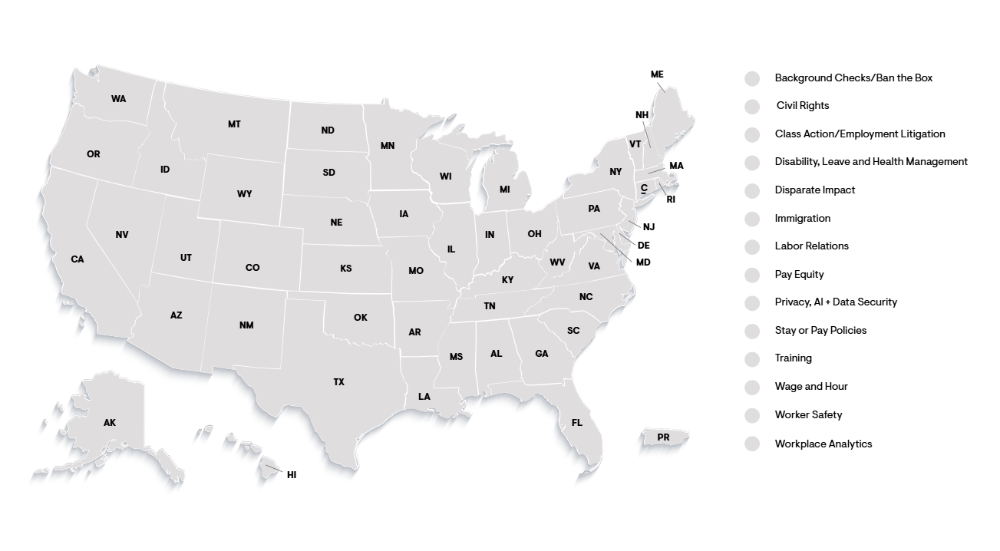
The patchwork of state and local laws addressing a range of employment practices across the employee life cycle is becoming even more intricate and will continue to create compliance challenges for multijurisdictional employers. The interactive map below provides a selection of these workplace rules, responsibilities and requirements from a long list of enacted legislation with effective dates ranging from late 2025 into 2026.
Workplace Safety, Environmental + Industry-Specific Risks
Increased OSHA and State Mandates + the Impact of Other Business Challenges
From workplace violence and evolving heat illness concerns to the impact of transformational technologies and tariffs, employers in 2026 will be confronted with a range of regulatory concerns and compliance challenges.
Workplace Violence
States are increasingly mandating industry-specific workplace violence prevention requirements.
Retail
- New York's Retail Worker Safety Act requires retail employers with 10 or more employees to adopt a written workplace violence prevention policy and provide interactive training.
- Larger employers must provide silent response-button access beginning in 2027.
Healthcare
- New York, Oregon, and Virginia recently joined a growing list of states to address workplace violence prevention in the healthcare industry.
- Common requirements include written prevention plans or policies, risk assessments, training, reporting mechanisms, and anti-retaliation provisions.
Heat Injury and Illness Prevention
This area continues to develop, with new regulations continuing to take shape.
- OSHA's proposed federal heat standard is pending, following rulemaking and comment.
- OSHA's National Emphasis Program on outdoor and indoor workplace heat-related hazards was extended into April 2026.
- Employers should be aware of state requirements and continue to monitor developments.
- Common obligations include both indoor and outdoor protections, monitoring environmental conditions, risk assessments, rest breaks, shade and cool drinking water, training, and acclimatization plans.
Tariffs + AI: Industry Affects
Employers in many industries are seeing substantial shifts to their operations from outside and within their organizations. Tariff-driven cost volatility and supply chain disruption are leading employers to reevaluate staffing, scheduling and operational models — adjustments that carry significant labor and employment implications, including WARN Act exposure, wage and hour risks, scheduling compliance challenges and heightened union activity. At the same time, AI implementation is reshaping job duties; altering hiring, scheduling and performance management practices; and introducing significant compliance risks related to discrimination, privacy, surveillance, and job restructuring.
Significant Tariff Impacts: Industries
Construction + Real Estate
- Rising raw materials costs may have direct and indirect effects on budgets and therefore on construction employment.
- Potential reduction in commercial and residential new construction would likely have downstream impacts on real estate industry.
Healthcare
- Hospital budgets may have reduced margins due to equipment and supply costs, increasing the need to assess staffing levels and manage overtime. Such assessments can exacerbate bargaining pressures in a unionized environment.
Manufacturing
- Increased cost of raw materials may lead to shifts in production and potential workforce reductions, triggering RIF and WARN Act concerns.
- Supply chain disruptions could cause scheduling changes that require wage and hour compliance attention.
Retail
- Volatile cost of goods could create need to adjust staffing budgets, contributing to scheduling instability and triggering predictive scheduling compliance concerns in some states.
Transportation + Logistics
- Supply chain disruptions may require rapid schedule and route adjustments, thereby increasing overtime risks and forcing employers to navigate rest, meal break and hours-of-service requirements.
Significant AI Impacts: Industries
Education + Collegiate Athletics
- AI use in monitoring, grading and record-keeping must consider FERPA compliance for student data.
- Rapid changes to education environment due to AI integration in student and faculty work may raise privacy, discrimination, and academic freedom concerns.
Healthcare
- AI in diagnostics raises questions about scope-of-practice, credentialing, and job displacement for technicians and support staff.
- AI-based monitoring tools (patient flow, employee productivity) may raise privacy and NLRA surveillance risks.
Manufacturing
- Robotics and increased automation may reshape job duties or reduce workforce needs, issues that are particularly impactful in unionized environments.
- AI-driven scheduling and monitoring can trigger conflict around surveillance concerns.
Retail + Restaurants
- Smart customer service tools can displace cashiers and servers or lead to schedule changes, causing predictive scheduling compliance concerns in some states.
- Efficiency gains may lead to possible reductions in force, highlighting WARN Act analysis.
Technology
- Heavy AI adoption places this sector under heightened scrutiny for bias, discrimination, privacy, and algorithmic transparency.
- Employers face expanding obligations as jurisdictions regulate AI in hiring, performance management, and workplace monitoring.
- Rapid deployment also increases the likelihood of classification disputes and employee upskilling needs.
The content of this article is intended to provide a general guide to the subject matter. Specialist advice should be sought about your specific circumstances.
