
- within Intellectual Property topic(s)
- in United Kingdom
- with readers working within the Healthcare industries
- within Technology topic(s)
The application underlying the present decision relates to developing rod patterns in nuclear reactors based on a simulation. However, the European Patent Office refused to grant a patent since the relevant features of claim 1 would not produce a technical effect. Here are the practical takeaways of the decision T 2660/18 (Developing rod patterns in nuclear reactors/GLOBAL NUCLEAR FUEL-AMERICAS) of December 7, 2021 of Technical Board of Appeal 3.5.07:
Key takeaways
A technical effect must be achieved over substantially the whole scope of the claimed invention.
The invention
The application underlying the present decision relates to determining rod pattern (or blade pattern) designs for a nuclear reactor core.
The description outlines the underlying problem as follows:
[0002] A core of a nuclear reactor such as boiling water reactor (BWR) or pressurized water reactor (PWR) has several hundred individual fuel bundles of fuel rods (BWR) or groups of fuel rods (PWR) that have different characteristics. These bundles (fuel rod groups) are preferably arranged so that interaction between rods within a fuel bundle (rod group), and between fuel bundles (fuel rod groups) satisfies all regulatory and reactor design constraints, including governmental and customer-specified constraints. Additional, the rod pattern design, e.g., the arrangement of control mechanisms such as control blades (BWR) or control rods (PWR) within the core must be determined so as to optimize core cycle energy. Core cycle energy is the amount of energy that a reactor core generates before the core needs to be refreshed with new fuel elements, such as is done at an outage.
[0006] A Nuclear Regulatory Commission (NRC) licensed core simulation program reads the resulting input file and outputs the results of the simulation to a text or binary file. A designer then evaluates the simulation output to determine if the design criteria has been met, and also to verify that no violations of margins to thermal limits have occurred. Failure to meet design criteria (i.e., violations of one or more limits) require a manual designer modification to the input file. Specifically, the designer would manually change one or more operation parameter and rerun the core simulation program. This process was repeated until a satisfactory rod pattern design was achieved.
[0007] This process is extremely time consuming. …
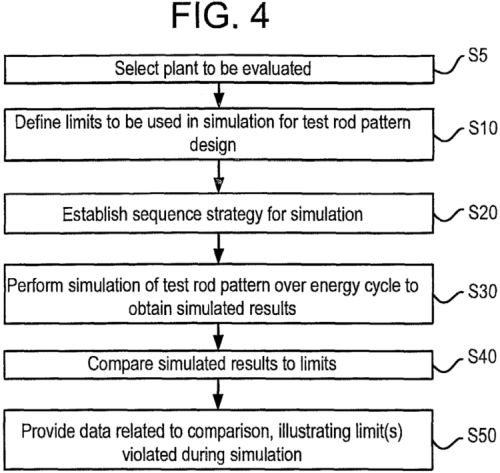
Fig. 4 of EP 1 435 626 A2
Here is how the invention is defined in claim 1 of the main request:
|
Claim 1 (main request) A computer-implemented method of developing a rod pattern design for a nuclear reactor, the rod pattern design representing a control mechanism for operating the reactor, comprising the steps of: defining via a database server (250) a set of limits that is a set of limiting or target operating and core performance values for a specific reactor plant or core energy cycle, wherein the set of limits is applicable to a proposed test rod pattern design to be tested, the proposed test rod pattern design comprising one of a design of notch positions and sequences of control blade patterns in a boiling water reactor core and a design of group sequences for control rods in a pressurized water reactor core; establishing via a user and an interface (300), based on the limits, a sequence strategy for positioning one or more subsets of the proposed test rod pattern design; simulating via a calculation server (400) reactor operation on at least a subset of the proposed test rod pattern design to produce a plurality of simulated results; comparing the simulated results against the limits by using a total objective function to compare how closely a simulated proposed test rod pattern design meets the defined set of limits, wherein the total objective function is a summation of all individual constraint components defined by OBJpar = MULTpar * (RESULTpar – CONSpar), wherein CONS is a limit of the defined set of limits for a particular constraint parameter (par); RESULT is one of the simulation results for that particular constraint parameter, and MULT is a multiplier for the constraint parameter; and providing via the calculation server data indicative of limits that were violated by the proposed test rod pattern design during the simulation. |
Is it technical?
First of all, the Board stated that the closest prior art document D1 fails to teach the following two features of claim 1:
7. The distinguishing features of claim 1 having regard to the disclosure of document D1 are thus:
(DF1) defining the sets of limits using a database server
(DF2) comparing the simulated results against the limits using a total objective function which is the sum of all individual constraint components defined by
OBJpar = MULTpar * (RESULTpar- CONSpar),
where CONS is a limit of the defined set of limits for a particular constraint parameter (par); RESULT is one of the simulation results for that particular constraint parameter and MULT is a multiplier for the constraint parameter.
However, both features would only refer to obvious measures.
In addition, more interestingly, the Board ruled that claim 1 also lacks an inventive step in view of a general-purpose computer. Against this assessment, the Appellant argued as follows:
15. The appellant argued that the technical effect was “reducing the time to design rods and doing so in a safe manner” and the “implicit use of the modified rods in the reactor that was simulated for operating the reactor safely within target operating and core performance value limits”. The technical effect resulted from a computer-based arrangement that provided “a way to efficiently develop a rod pattern design for a nuclear reactor, where the rod pattern design represented a control mechanism for operating the reactor”, as well as a “computer-based method for providing internal and external users the ability to quickly develop, simulate, modify and perfect a rod pattern design for (implicit) use in their reactor” (letter of 19 November 2021, pages 8 and 9).
However, the Board in charge explained that such an effect would not be produced by the distinguishing features:
15.1 The board does not see such an effect coming from the distinguishing features. Moreover, the same effects are achieved by the method disclosed in document D1 (see abstract: “The system is successfully demonstrated by generating control rod programming for the 2894-MW (thermal) Kuosheng nuclear power plant in Taiwan. The computing time is tremendously reduced compared to programs using mathematical methods.”).
Furthermore, to convince the Board, the Appellant referred to T 0625/11, cited in the G1/19 decision:
16. During the oral proceedings, the appellant also cited decision T 625/11. In case T 625/11, the board concluded that the determination, as a limit value, of the value of a first operating parameter conferred a technical character to the claim which went beyond the mere interaction between the numerical simulation algorithm and the computer system. The nature of the parameter thus identified was, in fact, “intimately linked to” the operation of a nuclear reactor, independently of whether the parameter was actually used in a nuclear reactor (T 625/11, Reasons 8.4).
However, contrary to the parameters used in T0625/11, in the Board’s view, the claimed limits might correspond to limits set by a human person or by an organization:
17.1 The limits are “limiting or target operating and core performance values for a specific reactor plant or core energy cycle”. They might correspond to limits set by an administrative authority such as the NRC mentioned in the application (page 2, second full paragraph).
Hence, the Board maintained its position that no technical effect is produced by the distinguishing features as no parameter is identified by the claimed method that is intimately linked to the operation of a nuclear reactor, as it is the case in the method according to T 0625/11:
18. The board is of the opinion that no technical effect is achieved by the method’s functionality as the method merely produces a test rod pattern (i.e. a fuel bundle configuration) design and data “indicative of limits that were violated by the proposed test rod pattern design during the simulation”.
19. Thus, contrary to case T 625/11, no parameter is identified that is “intimately linked to” the operation of a nuclear reactor.
Moreover, the rod pattern design and the limits cold both not be directly used in a reactor:
Although the method yields a rod pattern design and provides limits of core performance values for a reactor plant having this design, this rod pattern design and the limits cannot be used directly in a nuclear reactor system. The rod pattern would first need to be manufactured.
In addition, a rod pattern could also be used for study purposes and thus may be utilized in non-technical applications, and therefore, a technical effect would not be achieved over substantially the whole scope of the claimed invention (G 1/19, points 94 and 95):
Moreover, a rod pattern design appears to have non-technical uses such as for study purposes. These are “relevant uses other than the use with a technical device”, and therefore a technical effect is not achieved over substantially the whole scope of the claimed invention (G 1/19, points 94 and 95). In fact, the reactor for which the rod pattern was designed may not yet have been built and may never be built.
Hence, the present case would not be an exceptional case in which calculated effects achieved by a simulation could be considered as implied technical effects:
Hence, this is not an “exceptional case” in which calculated effects can be considered implied technical effects (see decision G 1/19, points 94, 95 and 128).
Since also the auxiliary requests were considered obvious, as a result, the appeal was dismissed due to lack of inventive step.
More information
You can read the whole decision here: T 2660/18 (Developing rod patterns in nuclear reactors/GLOBAL NUCLEAR FUEL-AMERICAS) of December 7, 2021
The content of this article is intended to provide a general guide to the subject matter. Specialist advice should be sought about your specific circumstances.
[View Source]