

Key takeaways
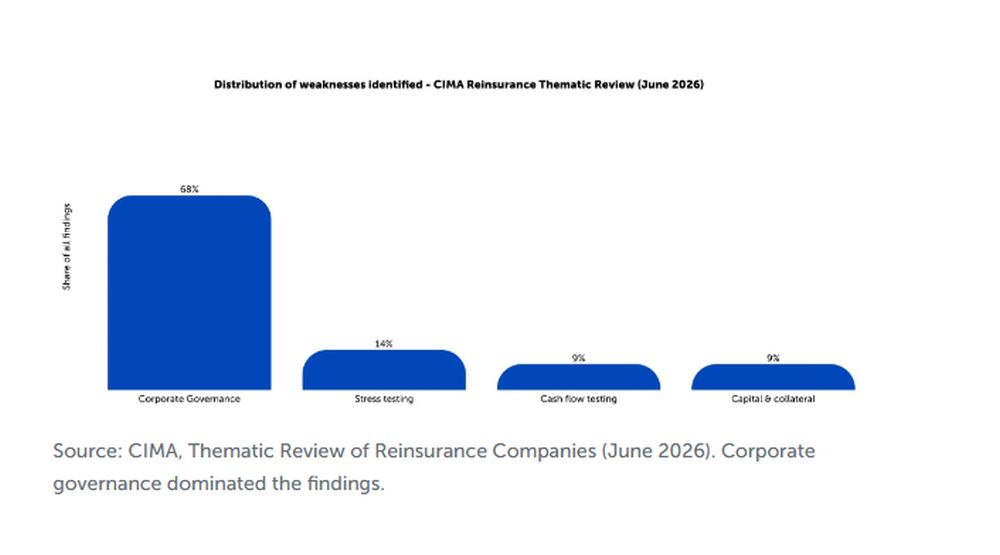
- Governance is under the microscope. 68% of CIMA-identified weaknesses were governance-related.
- Stress testing in the spotlight. A comprehensive stress testing framework, with independent review and validation of assumptions and results, is critical. These frameworks require appropriate Board oversight and formalised, periodic testing of stress scenarios.
- The governance framework should tell a consistent story. Policies, business plans, committee charters, delegated authorities, outsourcing agreements, investment guidelines, stress testing, cash flow testing, board packs, and minutes must all be consistent. Achieving this relies on solid legal, regulatory, and actuarial expertise or advice.
The Thematic Review of Reinsurance Companies issued by the Cayman Islands Monetary Authority ('CIMA') in June 2026 (the 'Review') finds that corporate governance accounts for sixty-eight percent of all weaknesses identified across the Class B(iii) and Class D entities examined. The review covered both life/annuity and P&C reinsurers holding these licence classes, but the governance findings are particularly material for commercial platforms with billion-dollar balance sheets. For those entities, the message to boards is clear: Cayman is aligning its governance expectations with the institutional standards that cedants, their US state regulators, rating agencies, and other key stakeholders already expect from major reinsurers. This is a sign of jurisdictional maturation and a call to action to strengthen documentation, processes, and service-delivery frameworks across the industry.
What the review found
CIMA examined Class B(iii) and Class D reinsurers (including both life/annuity and P&C business) with fieldwork between mid-2025 and Q1 2026. The findings clustered around governance architecture rather than capital or liquidity concerns. Within the 68% percent governance share, sub-committee governance and board oversight each accounted for 20%; missing service-provider contracts, segregation of duties, and internal audit gaps each accounted for 13%; outdated business plans, meeting discipline, and board self-assessment each accounted for 7%. These patterns align with the governance fundamentals emphasised by the IAIS Insurance Core Principles and the NAIC’s guidance on affiliated investment management agreements.
Market maturity changes the governance standard
Cayman’s reinsurance industry has expanded to an institutional level, with 114 reinsurers, around US$30 billion in premiums, and US$102 billion in assets. As the industry grows, supervisory standards are evolving accordingly. Jurisdictions with significant reinsurance markets that are reviewed by the IAIS already adhere to these governance standards; similarly, all Cayman platforms serving the same cedants must meet these expectations.
Defining the board and its committees
Effective governance begins with clear definitions at the board level. Every key role (eg CEO, and committee chairs) must have a written, board-approved outline of responsibilities. Committees should function in accordance with their current terms of reference and regularly report to the board. A delegation-of-authority matrix is essential to distinguish between reserved matters and delegated functions. The composition of the Board and committees needs to be sufficiently independent and any conflicts of interests appropriately managed. This is particularly pertinent for platforms writing affiliated reinsurance and/or which have investments managed by affiliates. Additionally, Board members are required to conduct periodic self-assessments to ensure accountability. These practices align with the three-lines-of-defence framework outlined in CIMA’s Internal Controls rule and statement of guidance and reflect the IAIS Insurance Core Principles on corporate governance. Much of this documentation, such as charters, terms of reference, board minutes and resolutions, board self-assessments and reserved-matter schedules, is inherently legal in nature, and Walkers can assist.
Governance is now a commercial advantage
For chief executives, good governance offers a competitive edge. Providing detailed business plans and governance documents on processes, protections, and escalation enhances credibility with CIMA, cedants, investors, and rating agencies. Regulators in the US and elsewhere increasingly require governance files to show compliance with IAIS and NAIC standards. Well-constructed governance is an asset, not an expense.
The business plan is a credibility document
The Review flagged outdated business plans as an area for improvement amongst reinsurance companies examined. However, beyond compliance with the regulatory requirement for updating and obtaining CIMA approval for material business plan changes, there is room for further improvement when it comes to the business plans of commercial reinsurance companies, which are more complex vehicles than traditional captives, in order to align with international market standards. It is critical for business plans to detail how the platform prices treaties, monitors ALM, manages liquidity, tests cash flows, maintains collateral, oversees related asset managers, and escalates breaches, so that CIMA and the cedant's regulator can be fully informed of, and can properly scrutinise, the reinsurer's operations. More robust business plans from licensing covering these matters in detail, consistent with the company's suite of policies and procedures, will position reinsurance companies well to effectively manage their risks, operate efficiently and improve regulatory compliance. CIMA’s current rules, statements of guidance and other regulatory measures ('RSOGs') already establish these expectations. The Review serves as a reminder to ensure business plans and policies covering these matters remain up to date, interconnected and that they are implemented effectively.
What should boards and managers do now?
We recommend that boards and managers use the Thematic Review as an opportunity to assess their reinsurance company's governance and other frameworks against (i) the findings in the review, (ii) CIMA’s RSOGs, and (iii) best practices in the jurisdictions the Cayman reinsurer aims to/does write business:
- Assess whether the business plan reflects current operations with enough detail for CIMA, cedants and cedant regulators to understand the operating model.
- Assess whether policies (including in relation to risk appetite, capital, ALM, liquidity, crisis management, hedging, dividend use, outsourcing, conflicts, investment guidelines, internal audit) contain bespoke content and are consistent with CIMA’s RSOGs.
- Assess whether committee charters, delegated authorities, director responsibilities, and reserved matters are documented and current.
- Assess whether written agreements are in place for material outsourced functions (e.g., insurance management, investment management, actuarial services, and IT) with clear pricing, oversight, reporting, termination provisions, and other provisions expressly required in CIMA's RSOGs.
- Assess whether internal audit or independent assurance (where applicable) covers stress testing, cash flow testing, ALM, capital/collateral, non-guaranteed elements, and recapture mechanics.
- Assess whether board packs and minutes evidence challenge and whether collateral terms (including substitution, top-up, cure, termination, recapture, etc.) work under stress and satisfy cedant regulator expectations.
Thematic reviews conducted by CIMA provide important insights into areas of particular focus for CIMA, which should be part of inspection-readiness. CIMA has previously published thematic reviews on key topics such as corporate governance and outsourcing which help licensees understand CIMA's expectations.
Walkers works closely with clients to help them achieve and sustain institutional grade governance and robust compliance. For boards, managers, and GC functions, the thematic review offers an ideal opportunity to assess whether external legal expertise could enhance your governance structure, internal controls, and other requirements. To explore how the review impacts an existing or planned platform or how you can prepare for upcoming on-site inspections or other thematic reviews, please contact your usual Walkers relationship partner or members of our Insurance & Reinsurance team and Regulatory & Risk Advisory team.
The content of this article is intended to provide a general guide to the subject matter. Specialist advice should be sought about your specific circumstances.
[View Source]


