- within Government and Public Sector topic(s)
- with readers working within the Banking & Credit industries
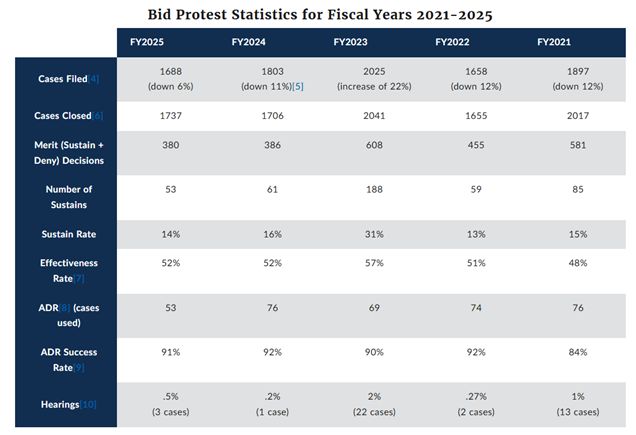
On December 12, 2025, the Government Accountability Office (GAO) released its Bid Protest Annual Report to Congress for Fiscal Year 2025. This report, required by the Competition in Contracting Act of 1984, provides Congress GAO's bid protest statistics covering fiscal year 2025, including the most prevalent reasons GAO sustained protests. The 2025 GAO report reveals that bid protest filings were down 6% as compared to last year (1,688 in FY 2025 as opposed to 1,803 in FY 2024). Aside from an increase in FY 2023—attributed to a large procurement resulting in numerous protests—bid protest activity at GAO has been steadily decreasing for several years as shown in the top row of the below table:
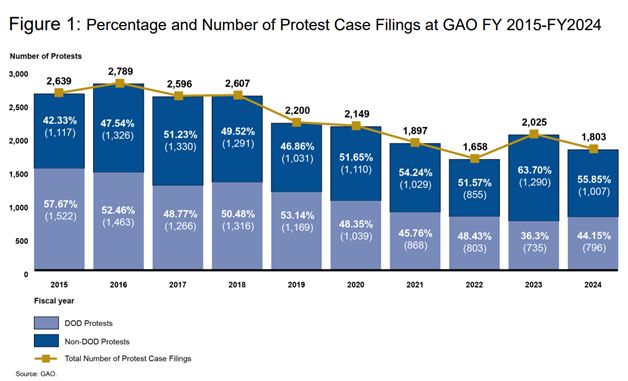
In fact, in a separateGAO report from this summer, GAO highlighted the downward trend in filings over the past decade. Since the recent highwater mark in 2016, filings have decreased 39% overall:
This past fiscal year, GAO resolved the merits of 380 of the 1,688 cases filed, reflecting the lowest number of cases in recent history. The remaining cases were dismissed or the protestor withdrew the protest. In sum, GAO sustained 53 protests, reflecting an approximate 14% sustain rate. The "Effectiveness Rate"—the percentage of cases where the protestor obtained some form of relief either through the procuring agency taking voluntary corrective action or the GAO sustaining the protest—remained the same as FY 2024, at 52%. Thus, last year, protesters obtained some relief in more than half of the cases filed. Indeed, GAO's Effectiveness Rate has remained relatively steady even as the number of protest filings continues to drop. GAO further reported that it conducted a hearing in three cases (continuing the relatively rare usage of this procedure), and notably, alternative dispute resolution (ADR) was markedly down 31% last year (53 ADR cases in 2025 versus 76 ADR cases in 2024). However, when GAO undertook ADR, that process proved successful in 91% of the cases, which remains consistent with the last four fiscal years.
Finally, GAO reported that the three most prevalent grounds resulting in GAO sustaining a bid protest were: (1) unreasonable technical evaluation; (2) unreasonable cost or price evaluation; and (3) unreasonable rejection of an offeror's proposal. This year, unreasonable rejection of a proposal supplanted "flawed selection decision," but the other two grounds remained in the top three reasons supporting GAO's sustain decisions.
Jenner & Block's Government Contracts lawyers have extensive bid protest experience, including prior service as a supervising bid protest hearing officer at GAO, and stand ready to support any challenges to the award of a government contract or the terms of a solicitation.
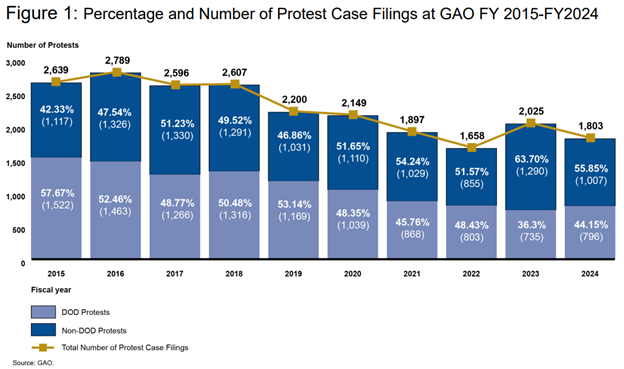
In fact, in a separateGAO report from this summer, GAO highlighted the downward trend in filings over the past decade. Since the recent highwater mark in 2016, filings have decreased 39% overall:
This past fiscal year, GAO resolved the merits of 380 of the 1,688 cases filed, reflecting the lowest number of cases in recent history. The remaining cases were dismissed or the protestor withdrew the protest. In sum, GAO sustained 53 protests, reflecting an approximate 14% sustain rate. The "Effectiveness Rate"—the percentage of cases where the protestor obtained some form of relief either through the procuring agency taking voluntary corrective action or the GAO sustaining the protest—remained the same as FY 2024, at 52%. Thus, last year, protesters obtained some relief in more than half of the cases filed. Indeed, GAO's Effectiveness Rate has remained relatively steady even as the number of protest filings continues to drop. GAO further reported that it conducted a hearing in three cases (continuing the relatively rare usage of this procedure), and notably, alternative dispute resolution (ADR) was markedly down 31% last year (53 ADR cases in 2025 versus 76 ADR cases in 2024). However, when GAO undertook ADR, that process proved successful in 91% of the cases, which remains consistent with the last four fiscal years.
Finally, GAO reported that the three most prevalent grounds resulting in GAO sustaining a bid protest were: (1) unreasonable technical evaluation; (2) unreasonable cost or price evaluation; and (3) unreasonable rejection of an offeror's proposal. This year, unreasonable rejection of a proposal supplanted "flawed selection decision," but the other two grounds remained in the top three reasons supporting GAO's sustain decisions.
Jenner & Block's Government Contracts lawyers have extensive bid protest experience, including prior service as a supervising bid protest hearing officer at GAO, and stand ready to support any challenges to the award of a government contract or the terms of a solicitation.
The content of this article is intended to provide a general guide to the subject matter. Specialist advice should be sought about your specific circumstances.