
AI solutions for patent search and analysis are redefining how teams approach innovation workflows, mitigating the risks of “innovating blind” while improving their IP knowledge. Discover how artificial intelligence tools support workflows for patents and R&D, and how to transform data into innovation strategy using generative AI.
Imagine a research and development (R&D) team that has dedicated 18 months to a promising technology concept. The prototypes are functional, and internal reviews are positive, yet a formal patent check performed late in the process reveals a catastrophic stop: a competitor filed a patent on a nearly identical approach three years ago.
This scenario, known as "innovating blind," is a common oversight in R&D processes. It occurs because critical strategic decisions are made using only a fraction of the available evidence. While market reports and scientific journals offer value, they are incomplete without patent data, which contains critical technical information often exclusively disclosed in these documents.
When Artificial Intelligence Solutions for Patents Can Assist
As Questel Subject Matter Expert Jens Schlehahn discusses in our on-demand webinar "Are You Innovating Blind? What Patent Data Reveals That You’re Missing," access to accurate and comprehensive patent data is vital to informing innovation decisions, since it provides visibility into existing technical solutions and helps organizations avoid unknowingly reinventing the wheel or investing heavily in already crowded technological landscapes.
Historically, this data has been gatekept by complexity, requiring specialists with knowledge of intricate Boolean query building and legal terminology. Fortunately, dedicated artificial intelligence (AI) solutions for patent search and analysis are now removing these barriers, making technical foresight accessible at the earliest stages of innovation. By dismantling traditional barriers to complex patent information, dedicated AI solutions for patent research, such as our AI Agent Sophia, are already transforming what was once the exclusive domain of specialists into a source of intelligence exploitable by everyone from engineers to R&D directors.
How Questel Harnesses AI for Patent Research and Analysis
For patent professionals, AI provides a powerful "engine" that can deliver real value by mastering data complexity. However, AI is just the engine; it's how we implement it that makes the difference. That's why all our AI solutions for IP and innovation professionals are anchored by six strategic objectives:
- Innovation: Our AI solutions assist users in exploring technical concepts and ideas that were previously beyond their analytical reach.
- Lowering Entry Barriers: It democratizes access, making AI patent research possible for stakeholders across organizations by enabling searches in natural language rather than specialized logic.
- Expertise: The goal is to augment the expert, providing tools that increase efficiency and empower professionals to deliver higher-level insights.
- Meaning: By utilizing neural embeddings, the system moves beyond literal keyword matching to understand the actual context and conceptual "DNA" of an invention.
- Workflow: Questel focuses on seamless connectivity within Orbit Intelligence, ensuring users can focus on evaluating and analyzing data without being slowed down by administrative friction between tools.
- Ergonomics: Technology must feel natural and intuitive, allowing the user to focus on strategic decision-making rather than navigating the tool itself.
This human-centric philosophy ensures that as organizations adopt our AI solutions for patent search and analysis, they maintain a balance of efficiency, responsibility, and trust.
Find out more about Questel's roadmap for AI and IP.
Achieving Precision with Dedicated Artificial Intelligence for Patents
Questel's AI Agent Sophia was developed specifically to help IP and R&D teams facilitate rapid, accurate, and comprehensive patent research. To see its features in action, let's take an example of an invention for a heated shoe:
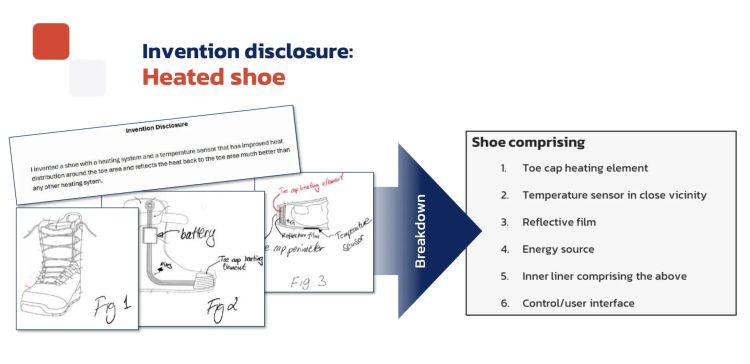
The traditional route when searching for prior art related to inventions, such as this heated shoe, requires users to gather all relevant facts, build complex search queries, review findings for relevancy, and analyze references before compiling a final search report. Our AI Agent substantially speeds up that process through two purpose-built features: Sophia Search for semantic search and Sophia Query for natural language search query building.
—Focus on the Meaning with Sophia Search
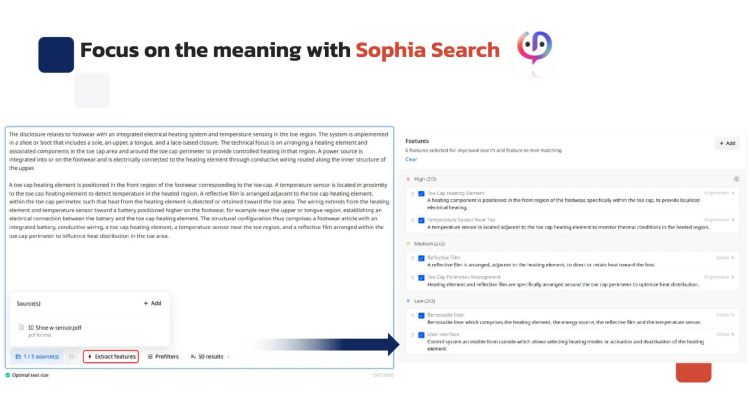
Sophia Search is an AI-powered patent semantic search tool that uses natural language and advanced neural embeddings to extract features disclosed in a user's input and patent full text based on conceptual similarity as well as exact terminology. By capturing intent and meaning, it delivers higher recall with significantly less trial and error.
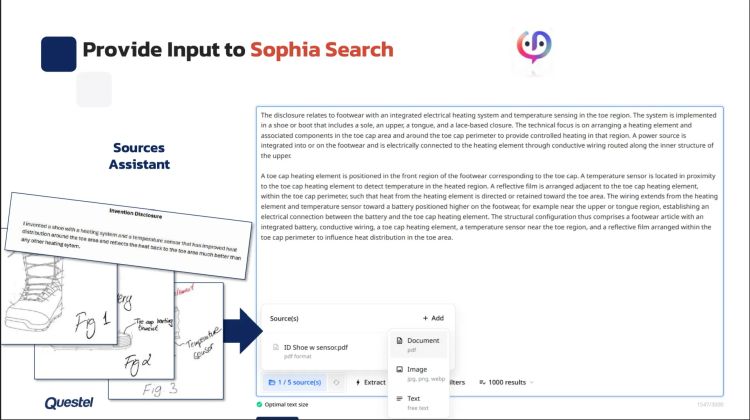
In our scenario, the user provides input to Sophia Search, using our Sources Assistant, which enables the upload of multiple documents, such as invention disclosures or even prototype images. The AI performs an image-to-text analysis, distilling visual data into an exhaustive technical description optimized for searching. This capability ensures that R&D teams can validate a visual concept before a single line of a formal disclosure is even written.
Provide Input to Sophia Search
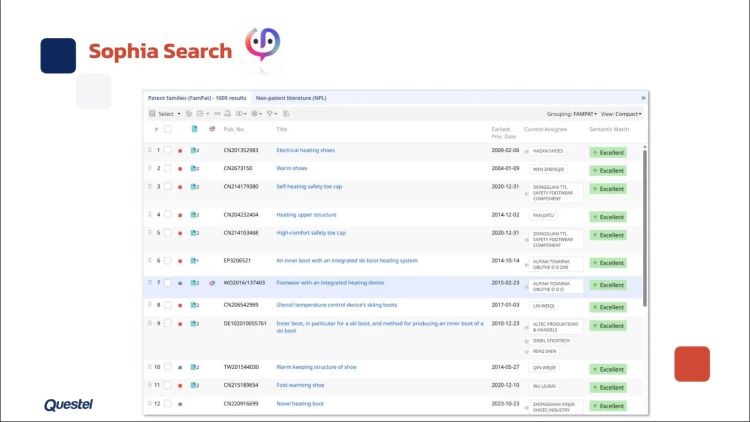
Sophia Search Results
Focus on the Meaning with Sophia Search
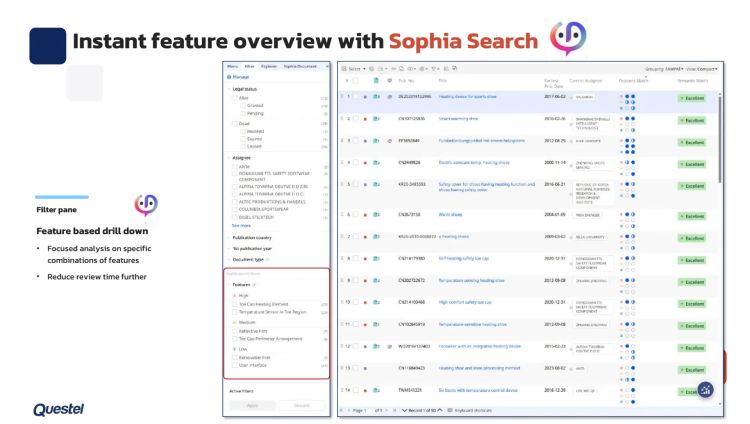
Instant Feature Overview with Sophia Search
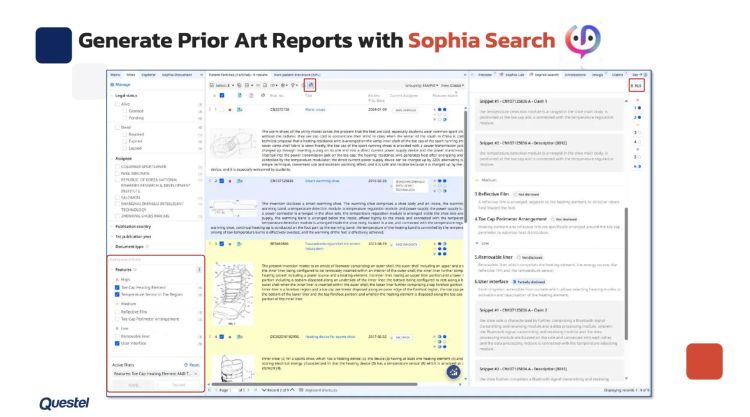
Generate Prior Art Reports with Sophia Search
Transparency and Explainability: Redefining AI for Patents
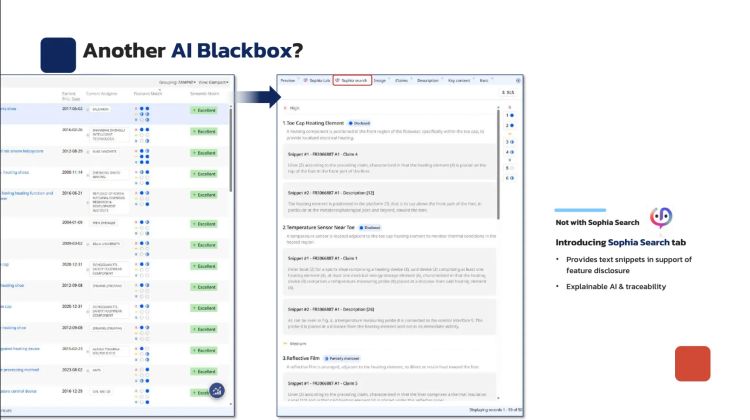
A potential risk of adopting AI solutions for patent workflows is the inability to justify or trace how an AI arrived at a specific conclusion. If the internal working and decision-making process of an AI tool is opaque (known as "black box AI"), then how can users be confident in the quality and accuracy of the results?
Sophia Search was developed under the principles of "explainable AI" to avoid hallucinations and ensure full traceability. It automatically extracts specific technical features from a user’s input — such as a "toe cap heating element" or a "reflective film" — and maps them directly against the full text of retrieved patents, so users can quickly access and validate text in patent claims or descriptions to understand why a feature is marked as fully, partially, or not disclosed.
The tool is also designed to save vital time. The feature-based filter allows users to focus their analysis on specific combinations of features. For freedom-to-operate (FTO) or invalidity searches, this capability reduces manual screening time, allowing experts to focus quickly on relevant technical information. Meanwhile, the reporting capabilities enable users to generate prior art search reports with ease. Combined, this delivers a secure end-to-end search, review, and reporting process.
—Assess the Competitive Landscape with Sophia Query
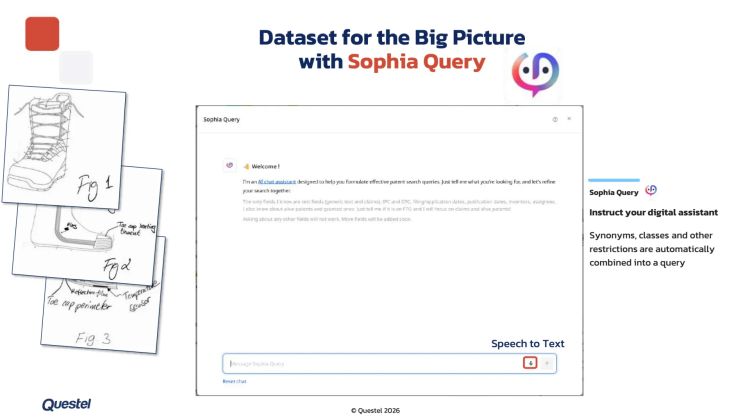
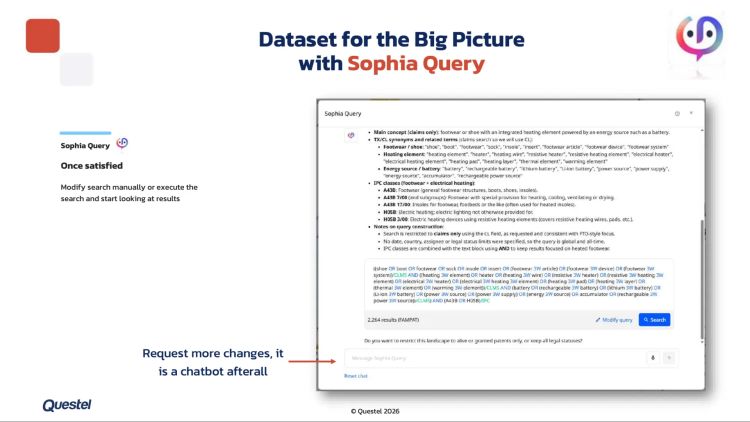
Sophia Query is an AI chatbot assistant, trained to take natural language instructions and turn them into a Boolean patent search query. Simply describe a concept using text or voice-to-text commands, and the assistant automatically expands the request with technical synonyms and IPC/CPC classes to jumpstart the search query creation phase.
Returning to our scenario of the heated shoe, let's see how Sophia Query supports users to understand the competitive landscape around their inventions.
Again, the traditional process here would be to gather all relevant facts, build complex search queries, review findings for relevancy, and analyze references before compiling a final search report. With Sophia Query and Orbit Intelligence, users can dramatically expedite the search query building, review, and analysis process.
- Simply instruct your digital assistant to get started
- Synonyms, classes and other restrictions will be automatically combined into the query
- Modify your search manually or request modifications via the chat box
- Once satisfied, execute the search and start reviewing the results
- Transfer the results using the built-in analytics module to make the results explorable in Orbit Intelligence
Instruct Your Digital Assistant
Chat with Sophia Query to Modify
Questel’s AI Strategy: Trust, Security, and Human Control
We have defined a policy outlining our ethical, legal, and operational commitments to ensure the responsible use of AI in our IP services. These include:
- Compliance & Transparency
We commit to adhering to the EU AI Act, ensuring clear communication on AI capabilities, limitations, and data handling through robust contractual frameworks. - Data Security & Privacy
As an ISO 27001-certified company, Questel enforces strict data protection measures and ensures client data is not used by third-party AI models. - Accountability & Governance
Clients are responsible for verifying AI outputs, while Questel maintains an internal AI committee and ongoing staff training to support ethical AI development.
Find out more about our holistic and responsible approach to AI and IP.
Transforming Data into Strategy: Insights from Orbit Intelligence
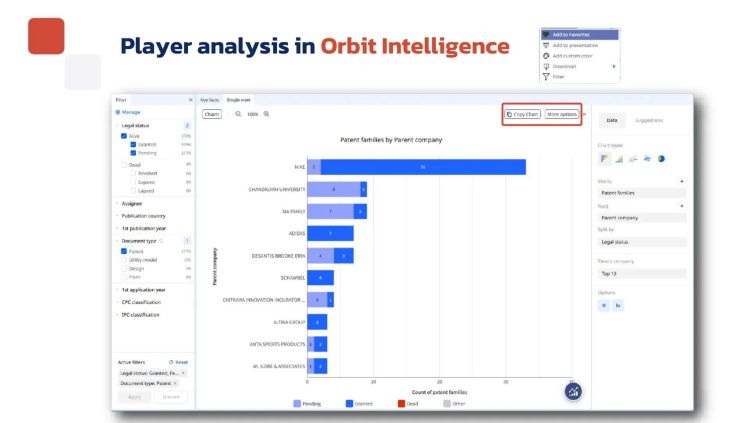
Orbit Intelligence provides the perfect platform to take patent landscape analysis one step further. The IP business intelligence tool delivers both "big picture" insights (legal status, investment trends, top players, player comparisons, and market coverage) and detailed patent search analytics.
Returning to our scenario of the heated shoe, we can see the platform offers some critical and strategic knowledge:
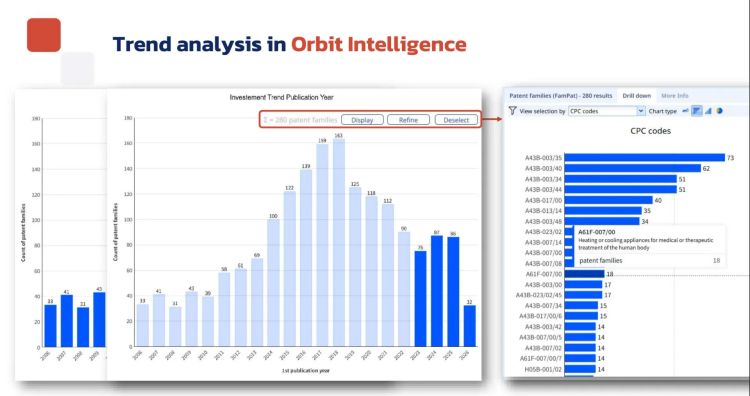
Investment Trends & Risk Landscape
The analytics reveal that the field has been worked in since around 2004, with the first publications happening in 2026. It’s a field that features many utility models (around 60% of the dataset), but which shows slowing activity after peaking in 2017-18.
Competitive Landscape
Strategic Pivots
Three Key Benefits of Orbit Intelligence for Patent Intelligence
1. Unmatched AI & Data-Powered Patent Search
100,000 users have trusted us daily for the past 25 years to carry out their FTO and prior art searches. We capture more relevant results thanks to our unique combination of:
- Enriched global patent data: 80+ searchable fields, single-invention grouping, data cleansed, corrected and normalized from 107+ patent authorities.
- AI and Boolean search engines: Unmatched combination of proximity operators and truncations, plus top-notch patent embeddings.
2. Customizable Patent Analytics
We provide an unrivalled range of data fields in our charts, allowing data cross-referencing which transforms raw data into insights:
- 80+ available expert fields on matrix, heat map or diagram,
- 40+ Unique value metrics, especially patent value/market strategy/impact,
- Filter by litigation, licensing, oppositions, or standard essential patents (SEPs) for a focused analysis.
3. All-in-One Platform
Work faster and together, with everything in one place: no switching tools, no risk of losing data between systems:
- All add-on modules (bio sequences, chemistry, designs, SEPs) are fully integrated,
- Save, annotate, share results,
- AI-generated summaries,
- Patent comparison,
- Keywords in context (KWIC), and
- Image-to-text linking.
Find out more by contacting our subject matter experts for a demo today.
Avoid Innovating Blindly with Orbit Intelligence and Sophia
Innovation decisions are stronger when patent data is part of the picture, but until recently many R&D and IP teams did not have access to vital patent datasets, or the knowledge to search and analyze them effectively.
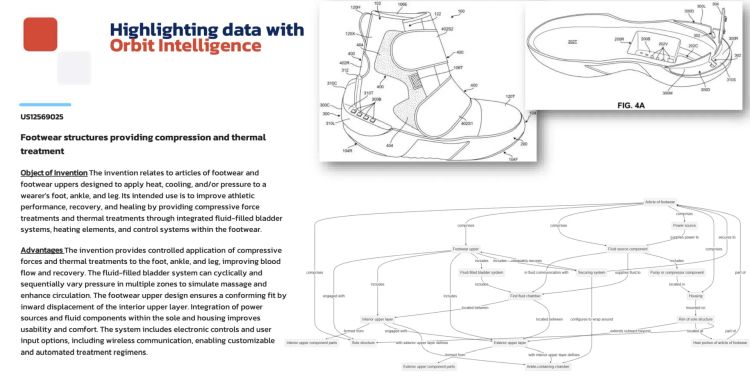
From insights into early technical solutions to competitor activity, technology maturity, and risk, our Orbit Intelligence search and analytics platform and dedicated AI Agent Sophia make it possible for all stakeholders to access valuable information that appears in patents first.
By removing the need for Boolean logic, AI has removed the traditional barriers to patent search, with semantic search, natural language query building, and automation making patent insights more accessible than ever before.
To find out how to use patent data in your innovation strategy, watch our webinar "Are You Innovating Blind? What Patent Data Reveals That You’re Missing," or contact our subject matter experts for a demo of Orbit Intelligence and our AI Agent Sophia.
The content of this article is intended to provide a general guide to the subject matter. Specialist advice should be sought about your specific circumstances.
[View Source]