
The application at issue claimed a medical intervention control system. The system stores patient data, analyses it to estimate the likelihood of different outcomes, and directs whether to proceed with or hold back medical intervention. The applicant argued that adding these specific blood-flow measurements to the system’s data set produced a technical effect. However, the Board found that data analysis in order to output instructions to “perform or to desist from a medical intervention” is to assist a physician in performing a method of therapy, which is an intellectual activity and non-technical. Arguing that a larger training dataset improves an AI system’s performance is mere speculation unless the claim specifies what analysis or training the system actually performs on that data.
Key takeaways
Merely generating instructions to assist a physician in performing a method of therapy, which typically relies on an intellectual activity, constitutes a non-technical task
Arguing that a bigger training data set improves an AI system’s performance is mere speculation unless the claim specifies what analysis or training the system actually performs on that data.
The invention
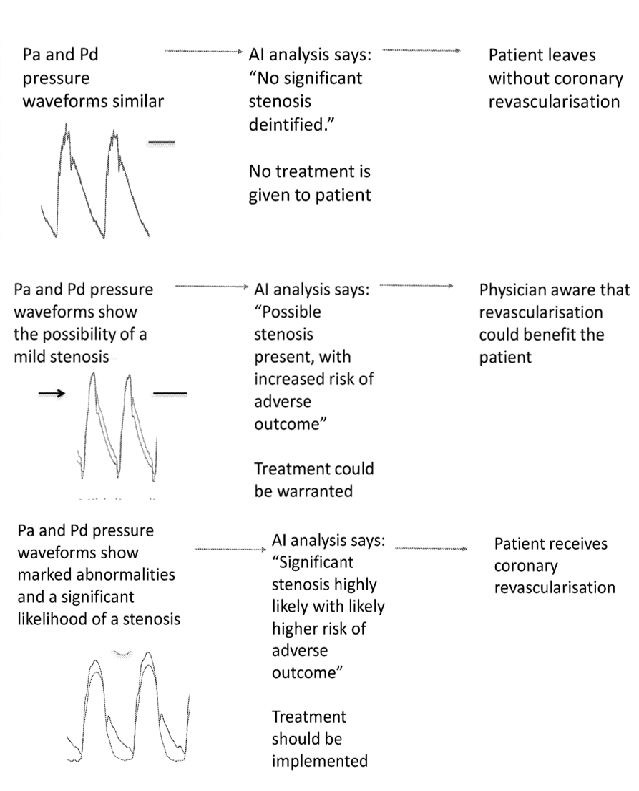
The claimed system holds a database with a data set containing data from at least one data source, comprising study data and sensed data including waveforms or images obtained from sensing equipment. A waveform detector identifies a waveform, categorises it and adds this waveform data to the sensed data. An analyser analyses the subject data with respect to the data set and outputs an associated probability for each of one or more outcomes, where the associated probability is affected by an intervention, taking the subject data derived from the patient and testing for outcomes and potential interventions which influence the outcomes. An action and alert management module receives the output from the analyser and, for respective interventions, outputs a direct instruction to an intervention allocation module, either to perform an intervention or to desist from performing it.
-
Claim 1 of Main Request (feature number included by the Board)
F1 A medical intervention control system for providing a risk analysis and influencing intervention action on a patient, the system comprising:
F2 a database with a data set containing data from at least one data source comprising study data and sensed data,
F2a wherein the sensed data comprises: captured or sensed data points, waveforms or images obtained from sensing equipment to provide data on: fractional flow reserve (FFR), instant wave-free ratio version of FFR (iFR), coronary flow reserve (CFR), and/or the relationship between resting distal coronary pressure to aortic pressure ratio (Pd/Pa);
F3 a waveform detector operable to identify a waveform from the at least one data source, extract the waveform, categorise the waveform, normalise the waveform to a predetermined format, determine waveform characteristics and parameters of the waveform and add this waveform data to the sensed data;
F4 a measurement module to derive subject data from the patient;
F5 an analyser operable to analyse the subject data with respect to the data set, and output an associated probability for each of one or more outcomes, wherein the associated probability is affected by an intervention, wherein the analyser takes the subject data derived from the patient and tests for outcomes and potential interventions which influence the outcomes;
F6 an action and alert management module configured to receive the output from the analyser, and to provide feedback to an intervention allocation module and, for respective interventions, being operable to output a direct instruction to the intervention allocation module to perform an intervention or a direct instruction to the intervention allocation module to desist from performing the intervention; and
F7 the intervention allocation module to perform the intervention or desist from the intervention depending on the direct instruction from the action and alert management module on the current patient.
Is it patentable?
The Examining Division’s position
The examining division refused the application and observed that no technical effect could be derived since the analyser or other modules do not use the data listed and the waveform data generated by the waveform detector.
The Applicant’s arguments
The appellant argued that the data set used by the analyzer included the sensed data, and that this sensed data was explicitly augmented by the waveform detector. Thus, the invention expanded the range and type of information on which the analyser was trained, using data that was otherwise unusable by the system.
Therefore, the technical effect was that the system may draw information from and make use of a wide range of stored data that may be relevant to informing about medical interventions, and improved the performance of a system for informing medical interventions.
The Board’s analysis
The Board agreed with the examining division that apart from the actual step of performing the intervention none of the feature contributed to the technical character of the claimed invention. Merely generating instructions to assist a physician in performing a method of therapy, which typically relies on an intellectual activity, constitutes a non-technical task (T 1910/20, Reasons 1, last paragraph).
On the appellant’s performance argument, the Board found that the claim does not actually specify what kind of analysis the analyser performs on the subject data with respect to the data set, let alone any training of the analyser. It was therefore mere speculation to argue that the system exhibits improved performance by having an expanded data set. To the contrary, the Board considered it algorithmically more likely that an expanded data set puts additional burden on computational resources and even deteriorates the performance of the underlying system. Therefore,the Board found that the subject-matter of claim 1 of the main request does not involve an inventive step.
The content of this article is intended to provide a general guide to the subject matter. Specialist advice should be sought about your specific circumstances.
[View Source]