
AI and emerging technologies are reshaping IP departments, service models, and operational strategies, influencing everything from IP task management to long-term talent retention and client expectations. How can IP leaders manage the operational challenges and opportunities introduced by new technologies, and what do they mean for the future of the IP profession?
Are we headed towards the future of intellectual property (IP) being managed by chatbots and artificial intelligence (AI)? That was the question at the heart of our recent webinar onAI and the future of IP departments. For the session, Marco Imperiale, Founder & Managing Director of legal consulting company Better Ipsum, joined Questel's Marie Farges and Elena Galletti to discuss real-world use cases for AI in the IP and legal sphere. Here we summarize the key points from their discussion on the implications of AI for IP.
What Does AI Mean for the Future of the IP Profession?
Share your views and benchmark your approach by participating in our 2026 Industry Outlook research.
From Human Industry to AI Technocracy?
Just as machines replaced human industry during the Industrial Revolution, the AI revolution of our era is consigning to history the need for humans to process many routine and administrative tasks.
Outside the workplace, AI has well and truly entered our daily routines, helping us to find information online, monitor health markers, create itineraries and budgets, and even weigh up pivotal life choices.
In the workplace, this technology is proving equally pivotal, not least by increasing the quantity of work we can deliver on a day-to-day basis. In the IP sector, for example, technology is reducing the time to draft, summarize, and research specific data points, and improving accuracy, speed, and oversight in record-keeping.
AI for IP Real-World Use Cases
If you have attended any IP conference in the past 12+ months, you will have seen lots of booths and workshops dedicated to AI solutions that promise to simplify the workload of IP practitioners by quickly performing routine IP tasks on their behalf. But, with technology in the sector evolving rapidly, what are the most compelling real-world use cases?
Our2025 industry outlook researchidentified the top 6 features valued by IP professionals as:
- Summarization (65%)
- Search assistants in natural language (59%)
- Translation (55%)
- Chatbots/Q&A (42%)
- Image search (40%)
- Task automation (34%)
Looking in more detail at trademark use cases, AI tools forsearch (91%) and watch (53%),office action response management(51%),goods & services description drafting(43%), andonline brand protection(43%) emerged as the most widely adopted solutions to date.
At the top of the list for patent practitioners weresearch(92%),summarization(81%),translation(64%),competitor analysis/landscapes(47%), andpatent classification(34%).
Rewiring the Sector with AI for IP
Our2025e researchrevealed 77% of organizations to be quite or very enthusiastic about the adoption of AI, with 58% of IP professionals actively using AI solutions for IP, citing a positive impact on their work.
This trend can be seen across the legal and business sectors, with a2025 McKinsey Global Surveyfinding that more than three-quarters of organizations now use AI in at least one business function.
Critically, as the use of generative AI increases, organizations are beginning to take steps to drive bottom-line impact—for example, by redesigning workflows to harness generative AI tools and putting senior leaders in critical roles, such as overseeing AI governance.
"The redesign of workflows has had the biggest effect on an organization's ability to generate value from its use of generative AI."
The findings also show that organizations are working to mitigate a growing set of gen-AI-related risks and hiring for new AI-related roles while they retrain employees to participate in AI deployment.
The same is true for the IP profession at large. Instead of generating their own outputs, many IP practitioners are now charged with overseeing the quality of generative AI outputs or are responsible for training those tools, fundamentally changing their role and responsibilities—with more to come.
Deep Learning and the Patent Landscape
Questel's 2025 analysis of patent filings in the AI sector, 'The Rise of Multimodal AI, Intelligent Agents, and Digital Humans,' identified some critical trends for future AI adoption.
Our report reveals that AI is currently entering a new phase driven by three closely related innovation areas: multimodal AI, digital humans, and intelligent agents. These technologies are clearly emerging together and reinforcing each other, creating a new generation of AI systems that can perceive, communicate, and act in ways that were not possible a few years ago.
- Multimodal AI (approx. 15,000 patent families):AI systems that can understand and generate more than one type of data at the same time, such as text, images, audio, and video.
- Digital Humans (approx. 8,000):AI-powered virtual characters that can speak, show facial expressions, and interact with users in a human-like way.
- Intelligent Agents (around 6,000):AI systems designed to pursue goals autonomously by reasoning, planning, using tools, and taking actions over time.
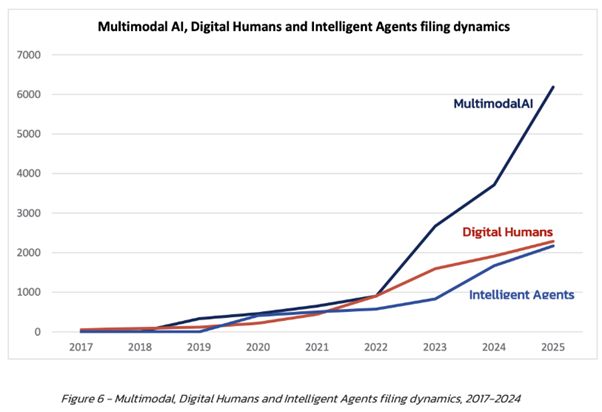
The patent landscape reveals that a small number of global technology leaders are shaping this transition by combining foundation models, agentic capabilities, and human-like interfaces into coherent innovation strategies. Download the report to read the full analysis.Find out more
What are the Implications of the AI Evolution for IP Professionals?
The fast-growing market of AI technologies has varying implications and potential consequences for IP professionals.
Firstly, it's important to understand the capacities and limits of current tools if you are to select the right solutions and use them optimally.
—Key considerations:
- Cost and ROI: Do you have the budget to invest in your chosen tools, and what will be the return on that investment?
- Need analysis: Will the solutions resolve a specific issue? Which specific capacities do you need?
- Time and governance:Who will manage the solution day-to-day (including updating workflows, internal training) and oversee its output?
- Accuracy and security:How will you (or the provider) mitigate the risks of hallucinations, bias, copyright infringement (...), and uphold privacy, quality, and completeness?
- Ethics and confidentiality:How will you
maximize the benefits of AI while simultaneously upholding your
professional accountability, includingethical responsibilities?
Understanding the limits of machine solutions is key to ensuring human responsibility. While AI will undeniably replace humans in some roles, keeping humans in the loop will remain critical in high-risk sectors, such as legal and IP, where oversight is necessary to uphold professional and ethical standards (at least for now).
10 Potential Pitfalls to Avoid for Intellectual Property Teams
Better Ipsum's Marco Imperiale shared 10 potential traps for AI in the IP sector:
- Infobesity
- Fear of missing out (FOMO)
- Lack of time (too many other urgencies)
- Lack of technical training
- Lack of process management training
- Decisions driven by ego
- Risk of using clients as guinea pigs
- Lack of prototyping
- Missing R&D mindset
- Lack of collaboration with different players
Choosing the right tool can be hard; implementing that tool effectively can be even harder. As one contributor to our2025 researchput it:"It helps to work with an AI specialist who knows the IP field."
How to Establish a Culture of AI with Humans in the Loop
—Key questions to consider:
- Is your team trained in the use of AI?
- For which tasks do you trust AI—would you allow the right tool to draft decisions?
- Areallyour practices/teams/resources using AI tools, or only some?
- How much are you spending on tech? Is it part of the IT budget, or does it come from headcount?
- Do you have dedicated committees and internal champions/evangelists, and how are you rewarding partners/attorneys/associates (etc.) taking care of the implementation?
- How has it impacted your business model; for example, are you thinking about different pricing strategies (without tech, with tech, with human approval, etc.)?
- How is the use of AI adding value internally or to clients?
- What is your data culture?
- How are you upholding privacy and quality? Do you have anAI policycontrolling which tools you
use?
By removing the time demands of routine or administrative matters, AI promises to enable IP professionals to free up more time to concentrate on (human) added-value tasks, such as ideas and opinions.
However, the reality is that humans and AI are already dependent on each other. Humans rely on technology to resolve their growing workloads; the technology requires human input to deliver high-quality solutions for increasingly complex functions, from searching and monitoring to drafting and analyzing.
To find out more about AI for IP, watch our webinar onAI and the future of IP departments,explore ourAI assistants for patentandtrademark productivity, or contact our subject matter experts for tailored support.
The content of this article is intended to provide a general guide to the subject matter. Specialist advice should be sought about your specific circumstances.