

The recent developments in the field of AI technology have opened new opportunities for the quick drafting of legal documents. Indeed, given the right prompts, AI technology can be a useful tool. However, we have also noted a number of issues that have arisen out of this practice. At Olliers, we have seen an increase in the number of present and potential clients who are using AI technology instead of consulting lawyers and legal professionals on their DBS cases and applications from record deletion.
Olliers’ Specialist DBS Lawyers
Here at Olliers we have vast experience in responding to DBS Minded to Bar letters, disputing information included on enhanced certificates and applying for police records to be deleted. We also routinely assist with individuals already on the DBS barred list.
We tailor representations specifically to each client to ensure the strongest case is put forward to the relevant body/organisation and factor in all appropriate grounds such as record deletion guidance, public intertest, human rights etc.
It is important to consider that AI technology works by drawing on information across the internet. Therefore, AI does not ‘think’ in the same way a human being does. This is important because AI is very good at giving a list of ‘considerations’ and ‘things to bear in mind’ when writing a legal document for your case. However, it cannot reason what are the best considerations suited to the particular circumstances of your case. Indeed, as an example, we have seen AI make recommendations for contradictory claims. Specifically, AI recommended stating that a client had worked in regulated activity for x amount of years with no issues arising, while also recommending that we include a statement saying that the client does not work in regulated activity and so should not be placed on the barred list. AI technology has no capacity for rationalising or appreciating the nuance and implications of details.
It is crucial to bear in mind that AI technology relies on the prompts it is given. Better prompts will lead to better results. But in order to ask the right questions for your case, often a legal professional is needed. This is particularly important when we consider AI’s tendency to simply agree with the prompter, which introduces the danger of creating an echo chamber. As well as their legal expertise, lawyers and legal professionals have the benefit of distance from your case and can therefore offer a new perspective and fresh set of eyes on the account being put forward. By discussing your case, lawyers are able to weigh up the balance of available evidence and help you draft a persuasive and specifically tailored argument for why you should be kept off the DBS barred lists, or why your arrest record should be deleted from the PNC. Having an experienced case worker reacting in real time to your account and the details of your case is better placed to offer advice as when to challenge and when to accept findings.
What the regulator says about AI
Your privacy is at stake too
As a further indication of the pitfalls of using AI, we have had clients who have been given:
False information – one client was told by AI that convictions can be deleted from the PNC, when there is no provision in legislation that allows for this
Incomplete information – another client was informed that receiving a NFA decision from the police was enough to justify the deletion of an arrest record when, in reality, this would form part of a larger argument
Misleading information – a third client was given a list of grounds for deletion that did not follow the wording of the NPCC guidance, which should be cited, but was based on more general grounds. Specifically, AI stated that ‘evidential difficulties’ was a ground for deletion, when this is absolutely not the case
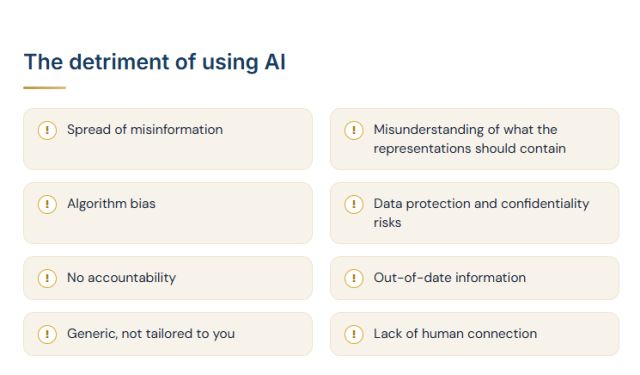
Finally, lawyers and legal professionals are able to provide a human touch and empathy through what can be an extremely stressful process. We understand what is at stake at a human level. That is why we are committed to dealing with you with empathy and understanding. It is also why we see part of our job as ‘demystifying’ the process and procedures of the DBS and the police.

Successful DBS Case studies
Client W believed that they would have to present their DBS case before a panel due to AI – we were able to correct this impression, clearly explain how the DBS process actually works, and answered their questions in a clear and concise manner before they instructed.
Client X ran our representations through AI and was given ‘advice’ to remove crucial financial information which provided important context to the allegation.
Client Y sent us a screenshot of their AI generated response which suggested the specific description of the allegation of assault read as entitled and should be rephrased. AI failed to understand the nuance of the evidential context.
Client Z used AI to write their own representations prior to instructing us. Their AI generated argument failed to include any persuasive emotional weight to the application for record deletion and misquoted police processes.
In conclusion
AI can be a useful tool, but we would caution against relying on it at the expense of legal professionals who can guide you through the process, tailor their arguments to the specifics of your case, and present your account in a clear, evidence-based way.
The content of this article is intended to provide a general guide to the subject matter. Specialist advice should be sought about your specific circumstances.
[View Source]