

- within Immigration topic(s)
- with Finance and Tax Executives and Inhouse Counsel
- in United States
- with readers working within the Law Firm industries
Introduction
Welcome to the May 2026 edition of the Luther Malaysia Bulletin.
As readers of our regular Newsflashes are aware, we publish standalone newsletters whenever there is a significant legal, tax, regulatory or immigration development we wish to bring to your attention quickly. In contrast, the Bulletin serves as a digest of the developments over a certain period—things-to-note, upcoming changes, ongoing developments, and so on. This issue is for developments up to April 2026.
If you are interested in following us, please subscribe to our Newsflashes and Bulletins: HERE, or connect with us on LinkedIn HERE. If you would like to discuss any of the topics in this Bulletin, our contact details can be found on page 17 below.
Immigration: Revision of Employment Pass Policy Effective 1 June 2026
On 14 January 2026, the Ministry of Home Affairs (“MOHA”) announced changes to the policy for the Employment Pass (”EP”) applications. These changes will take effect from 1 June 2026 and apply to all new EP applications and renewals.
In summary, the main changes are as follows:
- The minimum salary for each category of EP will change;
- The requirement for a cooling-off period for a Category III EP will be abolished;
- Employers must have a succession plan for Categories II and III, i.e., a plan for an expatriate to be replaced by Malaysian nationals;
- EP Category III holders will be able to apply for Dependant Passes (“DPs”);
- An application for renewal involving a category change (e.g. a person is switching from EP Category II to Category I) will be treated as a new application; and
- The introduction of duration “reset” rules for applications after 1 June 2026.
Overall, the changes are being implemented to align with the political objectives of reducing reliance on foreign labour and prioritising the employment of qualified Malaysian talent, as well as promoting knowledge transfer, skills, and expertise development. They are not intended to restrict the entry of expatriates, but to ensure that their employment genuinely complements the development of local capabilities.
At the moment, these changes have only been outlined in broad strokes, and there is little detailed guidance. Guidelines may be published closer to the implementation date.
I. Salary thresholds
There are three categories of EP, each with their own minimum salary thresholds. The comparison table below shows the current monthly salary range for each category and the new range that will apply from 1 June 2026:
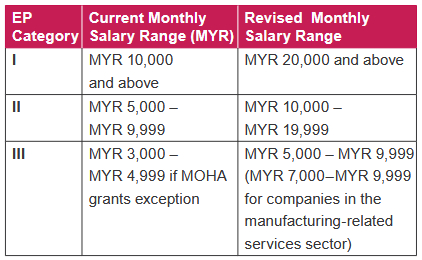
There are two key points: The first is that currently, companies are able to apply for a Category III EP for expatriates with a monthly salary between MYR 3,000 and MYR 4,999, provided that they obtain MOHA’s approval to be exempted from the requirement for the salary to be at least MYR 5,000. After the new rules take effect, a salary below MYR 5,000 will no longer be possible – the minimum for a Category III EP is MYR 5,000 with no possibility of an exception. It should also be noted that those in the manufacturing-related services sector are subject to a higher range of MYR 7,000 to MYR 9,999.
Secondly, the minimum salary thresholds for Categories I and II have been increased, to MYR 20,000 and MYR 10,000, respectively.
II. Removal of cooling-off periods
Under the current rules, Employment Pass Category III holders who had renewed their pass twice or for three years in a row had to leave the country and serve a three-month cooling-off period before they could apply for an Employment Pass Category III again, with limited exceptions.
Under the new EP policy, this cooling-off period requirement will be removed. EP Category III holders can apply again under the same category without having to wait, provided that they meet all the other requirements.
III. Succession plan
A “succession plan” will become relevant for EP Categories II and III. Also known as a replacement plan, it is essentially a structured and clearly defined plan to prepare local employees to replace expatriates within a specified employment period.
At the moment, there is no official guidance on the content and format of the plan, though further details may be published closer to the implementation date.
In general, companies should identify roles that can be transferred to local employees and set out this process in the replacement plan. This should include an explanation of how the expatriate’s role will be transferred to a local employee, for example through training, mentoring and knowledge transfer activities, alongside an indicative timeline for the handover. The succession plan may need to be presented to the Immigration Department during the EP application process or during the company interview session with immigration officers. Failure to implement these succession plans may affect future applications.
Should the company wish to extend an expatriate’s employment beyond the period specified in the plan, the Immigration Department will review the request on a case-by- case basis.
IV. Dependants
EP Category III holders are presently unable to bring in their dependants under a DP. Moving forward, this will change, and DPs will be available for all three categories of EPs.
V. Change of EP category becomes new application
If an expatriate changes EP category (for example, from Category II to Category I), it will be treated as a new application, as opposed to a renewal. This will necessitate a new letter of approval from the Department of Labour (if it has expired), a MYFutureJobs advertisement (if the position is not exempt) and the shortening or cancellation of the existing EP before the new EP can be approved.
If the EP is renewed within the same category (for example, Category II to Category II), it will be treated as a renewal.
VI. EP duration and “reset” after 1 June 2026
Although the new policy provides for EP durations of up to 10 years (for Categories I and II) and up to 5 years (for Category III), in practice, approvals are highly unlikely to be granted for the full 10 or 5 years in a single approval. As is currently the case, EP approvals are typically issued for 12, 24, 36, 48 or 60 months, depending on the decision of the immigration officers.
For EPs that are renewed or applied for on or after 1 June 2026, the EP duration will “reset” upon approval. In other words, any previous years under an EP will not be taken into account when determining the EP duration for the first EP or renewal granted on or after 1 June 2026.
For subsequent applications after that first EP/renewal on or after 1 June 2026, the EP duration will then be calculated on an accumulative basis. For example:
- An expatriate applies for an EP under Category II on 2 June 2026. They renew again under Category II in June 2027 – at that point, they will have accumulated 1 year.
- If, at the June 2027 renewal, they change to Category I, this will be treated as a new EP application and the EP duration will reset to 0.
VII. What should employers do?
We recommend taking the following steps:
- Companies should consider whether a succession plan is required, and if so, either prepare one or at least lay the groundwork by planning out their workforce over the next few years, and collecting documentation such as reports and assessments on the training, knowledge transfer and skills development of local employees.
- Review all existing and proposed EP roles to ensure that the basic salary meets the minimum MYR 5,000 requirement (or MYR 7,000 for those in the Manufacturing Related Services sector);
- Plan ahead for the “reset” of EP duration for EPs renewed or applied for after 1 June 2026, and understand how subsequent EPs will be counted on an accumulative basis;
- Consider carefully whether a change of EP category (which will be treated as a new application) or a renewal within the same category is more appropriate for each expatriate, taking into the account the different requirements for a new application and a renewal;
- Factor in the removal of the Category III cooling-off period, which may provide greater flexibility for workforce planning involving Category III expatriates, subject to compliance with the new salary and succession plan requirements.
If you have any questions or need clarification on any immigration matters, please feel free to contact us.
To view the full article click here
The content of this article is intended to provide a general guide to the subject matter. Specialist advice should be sought about your specific circumstances.


