

Experts believe Australia is currently missing out on the full economic value of its skilled migrant workforce.
Recent analysis shows that more than 600,000 permanent migrants are working below their qualification level, despite widespread shortages in critical sectors such as engineering, teaching, health, and trades.
This mismatch isn’t due to a lack of talent—it’s the result of slow, inconsistent, and often duplicative skills recognition and licensing processes across states and professions.
Migrants who have already undergone rigorous skills assessments for some skilled visas are frequently required to repeat similar assessments once onshore, delaying their ability to work in their trained occupations.
Skills recognition processes for migrants
Overseas qualifications and work experience aren’t always recognised in Australia because they may not align with local industry, licensing, or training standards.
Many migrants need to complete two separate processes before they can work in their nominated occupation: a Skills Assessment for their visa and Occupational Licensing to meet state or national standards.
Requiring two similar processes to verify skills is unnecessarily repetitive, costly, and time-consuming—especially during a period of skills shortages.

Business impact
For employers, delays in skills recognition processes represent a significant untapped opportunity. Many highly qualified professionals already living in Australia are ready to fill shortages, but fragmented skills recognition systems hold them back.
Dr Martin Parkinson, a former Treasury secretary and contributor to the ‘Review of the Migration System‘ report, addressed these issues alongside Violet Roumeliotis, Chief Executive Officer of Settlement Services International, at a National Press Club this month.
A nurse qualified in Queensland should not face a different licensing process in Western Australia. An electrician licensed in Victoria should not have to start again in New South Wales.
– said Dr Parkinson.
Right now, 44 per cent of qualified permanent migrants are working below their skill level.
That is about 620,000 people not working in their trained professions, while we have critical shortages in those same fields.
– said Ms Roumeliotis.
According to Ms Roumeliotis:
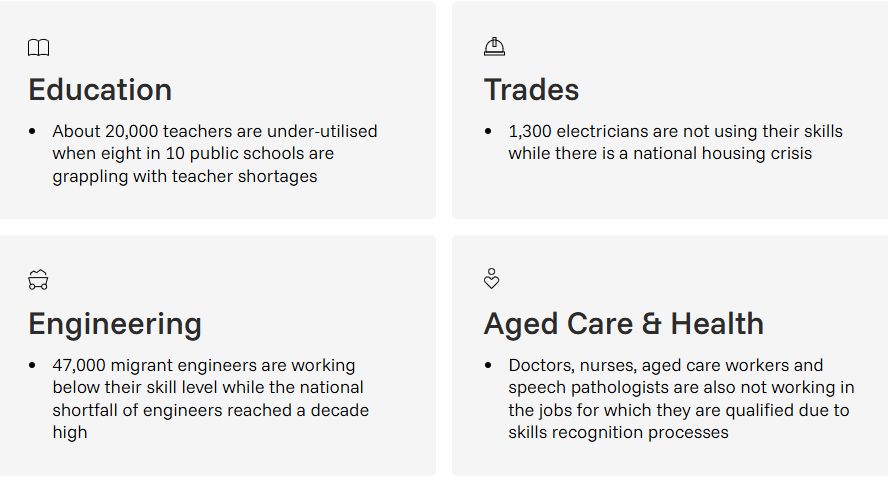
What’s next: Possible reforms
A national campaign, ‘Activate Australia’s Skills,’ is pushing for reforms that would streamline skills recognition, improve licensing portability across states, and provide clearer pathways for migrants to enter their professions sooner.
The campaign is supported by an alliance of more than 100 businesses, unions, and employer groups.
Proposed measures include:
- An independent and centralised national commissioner for skills recognition, providing oversight of the process from ‘visa’ to ‘occupational license’ to ’employment’
- A single navigation service for migrants throughout the skills recognition process
- Targeted financial support where needed
- Better alignment between visa requirements and occupational licensing
For employers, these reforms could mean faster access to qualified workers, reduced recruitment delays, and a more efficient migration system that better matches skills to workforce needs.
Sustainable people strategy: Global talent
Ideally, a worker’s qualifications should be mutually recognised in each state and territory in Australia without the need for retraining.
Delays and limitations can also arise where a migrant meets national or state standards to work in their occupation but does not meet skills assessment requirements for certain skilled visas.
Interstaff supports employers requiring sustainable global talent strategy to strengthen workforce capabilities.
Access our immigration insights to explore:
- Work rights and visa conditions
- Skilled visa changes
- Temporary and permanent visa pathways
Sources:
Interstaff’s Registered Migration Agents, MARN: 0533879
The content of this article is intended to provide a general guide to the subject matter. Specialist advice should be sought about your specific circumstances.
[View Source]