
- within Intellectual Property topic(s)
To drive real efficiency across their IP management practices, portfolio owners must address the complex landscape of decentralized record management, admin-heavy processes, and disconnected tools. Fortunately, the technology now exists to enable corporations to simplify and centralize their IP operations.
How do you transition IP from a legal back-office function to a strategic business partner for your organization? This was the question at the heart of our recent webinar. 'Equinox Corporate+—Leveraging Salesforce for Large IP Portfolio Owners.' As Questel's Global SME SaaS Director, Eric Moran, explained during the session, addressing the three pillars of 'people, processes, and technology' will not only help organizations to overcome IP complexity but also deliver a solid foundation for future growth. Here we summarize the key points from his presentation.
—The Evolution of IP Management
Not that long ago, the IP department was viewed primarily as a back-office legal function—focused on meeting deadlines and ensuring compliance. IP management systems (IPMS) were originally developed with these narrow objectives in mind.
As IP assets have become a core driver of innovation and competitive advantage, the role of the IP department has evolved. It is now more critical than ever that IP operations integrate seamlessly with broader business systems and functions, encompassing research and development (R&D), sales & marketing, executive leadership, and finance.
Whether they use project management systems, such as Asana or Jira, or reporting platforms, like Power BI and Perdoo (as shown below), each department within an organization has its own initiatives and systems that allow it to run effectively—and these preferred systems and processes are continuously evolving. Aligning IP with these changing technologies and processes is vital for the success of any IP department. However, IP cannot be a passenger; instead, it must be the driving force—or at least fully integrated with—the initiatives of these different departments.
|
The Challenge to Connect and Integrate IP systems must align with the technologies used by other departments. |
R&D/Innovation Invention Harvesting, Freedom to Operate, Project Alignment—Systems: JIRA, Asana, Trello |
Product & Marketing Brand Protection, Market Readiness, Competitive Intelligence—Systems: Marketo, Aha!, Productboard |
Sales Infringement Monitoring, Territorial Coverage, Deal Enablement—Systems: DealHub, Conga, Salesforce |
|
Legal Licensing & Contracts. Litigation Support, Trade Secrets—Systems: Onit, Legal Tracker, DocuSign |
Finance Budgeting & Forecasting, Valuation, Cost Recovery—Systems: SAP, Oracle, Ariba |
Executive Leadership Business Strategy, KPIs & Reporting, M&A/Due Diligence—Systems: Power BI, Tableau, Perdoo |
—Four Modern Pressures and Complexities for IP Leaders to Navigate
Challenge #1: The Data Explosion
IP filings have grown exponentially since the first ever filing, with over 3.5 million patents now filed each year. To manage this data explosion, companies and firms need to adopt more sophisticated IP management solutions that can handle the increase in IP filings, docket workloads, and legal complexity.

To support them, modern IP management technology must:
- Automate docketing workflows: Eliminate manual data entry as global filings increase.
- Enable customizable rulesets: Apply the right timelines, fees, and actions based on IP type and jurisdiction.
- Track and order services in-platform: Initiate and monitor filings, translations, and renewals directly from your IPMS.
- Use dashboards for visibility: Monitor filing trends, workload, and jurisdictional bottlenecks in real-time.
Challenge #2: Increasing Global Complexity
IP is no longer confined by borders. As globalization accelerates, it's increasingly vital for companies to adopt solutions that ensure compliance with international regulations and standards.
To support IP owners, modern IP management systems must:
- Continuously monitor global requirements: Auto-update laws, deadlines, and rules across jurisdictions (e.g., US, EP, CN, IN, etc.)
- Enable centralized, real-time access: Teams and partners must securely access accurate IP data—no matter their location or role.
- Simplify updates and compliance handling: Regulatory changes should be applied without disruption or reliance on manual input.
- Support integrated external collaboration: Connect directly with foreign agents, annuity providers, and translation services from within the IPMS.

Example of a modern, connected IP management system (the Equinox IP Portal).
Did You Know?
- The Venetian Patent Statute (1474) is considered the world's first codified patent system. It granted inventors exclusive rights to their creations for 10 years.
- The first patent was granted by the Republic of Florence, Italy, in 1421 to the architect Filippo Brunelleschi for 'Il Badalone,' a boat he designed specially to transport marble for the construction of Florence Cathedral.
- The modern-day patent office was first established in the UK in October 1852 by the Patent Law Amendment Act of 1852.
Challenge #3. The Rise of 'New' IP
From Non-Fungible Tokens (NFTs) to AI-generated inventions, 'new' forms of IP are challenging traditional national legal systems and practices. For example, inventors of AI innovations (including AI models and algorithms) are currently faced with the dilemma of trying (and potentially failing) to patent their inventions or turning to trade secrets.
To support them, modern IP management systems must:
- Support hybrid protection strategies: Track both patent and trade secret assets in one place.
- Enforce access controls: Ensure only authorized users can view trade-secret-classified data.
- Enable lifecycle tracking: Monitor transitions between trade secret and patent status.
- Document decision rationale: Maintain internal audit trails for why a route was chosen.
- Customize IP case types and rulesets: Tailor workflows, deadlines, and compliance logic for different protection paths, like AI-generated content, algorithms, or confidential models.
Challenge #4: Collaborative R&D
In recent decades, we have seen a shift from traditional 'defensive' forms of IP protection towards shared IP models, open innovation, and cross-border R&D.
These more 'collaborative' forms of R&D are helping organizations to accelerate industry growth, build brand leadership, attract talent, and expand market positioning. However, the resultant IP can be challenging for IP professionals to manage.
To support them, modern IP management systems must enable:
- Flexible categorization and tagging: Your IPMS should support tagging assets as "open," "strategic," "licensable," etc., enabling segmented oversight.
- Collaboration tracking: Systems must track which assets are shared with whom, under what terms, and integrate with NDAs, licenses, and partner agreements.
- Audit & policy compliance: Modern IPMS platforms should log user access, changes, and disclosures—enabling compliance with internal sharing policies.
- Integration with innovation tools: Open innovation often comes with shared R&D. Your system should interface with tools like tech scouting platforms, invention disclosure portals, and joint project trackers.
- Reporting for strategic decision-making: The ability to report on asset classes, usage, or external interest helps IP managers make data-driven decisions about what to protect, license, or share.
—Where Does Traditional IP Management Technology Fall Short?
From manual workflows and missed deadlines to data silos and outdated tools, IP owners face the same familiar set of challenges in traditional IP management systems:
- Manual Workflows & Missed Deadlines
Many teams still rely on manual processes and legacy software, making it difficult to handle today's volume and complexity of IP filings. This creates inefficiencies, increases human error, and slows decision-making.
With IP strategies spanning multiple jurisdictions, staying on top of varying deadlines, renewals, and local requirements is a growing challenge. By harnessing automation, modern IP management systems help IP owners keep pace with global demands.
Before automation:

After automation:

- Data Silos Across Teams
As innovation becomes more open and collaborative, disconnected systems between legal, R&D, and external partners hinder visibility and introduce risk. Breaking down silos through technology integration is essential for secure and streamlined collaboration.
Before integration:

After integration:

- Legal Systems that Don't Scale
Older IP tools often lack the flexibility to grow with changing business needs. As IP becomes more strategic, companies require scalable systems that can evolve with new workflows, data demands, and integrations.
- Monolithic Architecture: Changes to one part require redeploying the entire system. Difficult to isolate issues or scale individual components.
- Hardcoded Rules and Rigid Workflows: Business logic is baked into code, making changes time-consuming. Lacks flexibility to adapt to new use cases or jurisdictions.
- Performance Bottlenecks: Slow processing times as data or user volume increases. Legacy databases or inefficient queries become choke points.
- Limited Integration Capabilities: Poor support for APIs or modern integration methods. Hard to connect with newer platforms (AI, analytics, third-party services).
- Manual Workarounds and Processes: Heavy reliance on spreadsheets, email, or manual data entry. Increased risk of human error and duplication.
- High Cost of Customization: Custom changes are expensive and time-intensive. Often requires specialized legacy developers (who may be retiring).
Time for a Solution: The Salesforce & Equinox Love Story
Why is Equinox Corporate+ on Salesforce? What does the Salesforce infrastructure allow us to do?
Benefit #1: Easy to Set Up and Install
Depending on the integration, setting up Equinox Corporate+ is typically straightforward. Most apps are available via a direct download from the Salesforce AppExchange, and a guided installation process is usually provided. In many cases, it's as simple as dragging a component onto the desired page layout.
Once configured, users can immediately begin leveraging the integration—for example, enabling real-time team chats directly within a case or accessing linked documents from platforms like SharePoint without leaving the Equinox Corporate+ environment.
While some integrations may require involvement from IT—for example, to retrieve API credentials or configure access permissions—these steps are generally lightweight. Because Equinox Corporate+ is built on Salesforce, it benefits from a plug-and-play architecture that keeps the process simple for administrators and quick to deploy across departments.
Benefit #2: Legal & Security Compliance
Salesforce is the world's leading customer relationship management technology, trusted by 150,000+ customers worldwide. By leveraging the Salesforce technology, Equinox Corporate+ maintains a comprehensive set of compliance certifications and attestations, including:
- Data encryption at rest and in transit
- Granular access controls, including role-based permissions and field-level security
- Audit logging and monitoring
- Multi-factor authentication (MFA) and SSO integrations
- Certifications: ISO 27001, SOC 1/2/3, FedRAMP, HIPAA, GDPR, CCPA, etc
- Event monitoring and Shield Platform Encryption for
extra-sensitive data
Users can also tailor the sophisticated permission controls to protect access rights and uphold maximum data security.
| ISO 27001 Compliance with specific information security and risk management requirements | ISO 27017 Adherence with ISO/IEC 27002 Code of Practice controls for cloud services |
|
ISO 27018 Adherence with Code of Practice controls for protection of personal information |
NEN 7510 Protecting health information for organizations in the Netherlands |
|
NIST SP 800-171 U.S. security requirements for protecting Controlled Unclassified Information in Nonfederal Systems and Organizations |
PCI DSS Validation of controls around cardholder data to reduce credit card fraud |
|
PrivacyMark PrivacyMark is a Japanese privacy-centric program certifying legal entities, which applies to Salesforce Japan Co., Ltd. |
Resilience, BCP & DR Business Continuity and Disaster Recovery |
|
Salesforce BCRs Binding Corporate Rules for the Processing of European Personal Data |
SOC 1 Type II report covering internal controls over financial reporting systems |
|
SOC 2 Type II report covering Security, Availability, Integrity, Confidentiality, and Privacy |
SOC 3 Public report of Security, Availability, Integrity, Confidentiality, and Privacy controls |
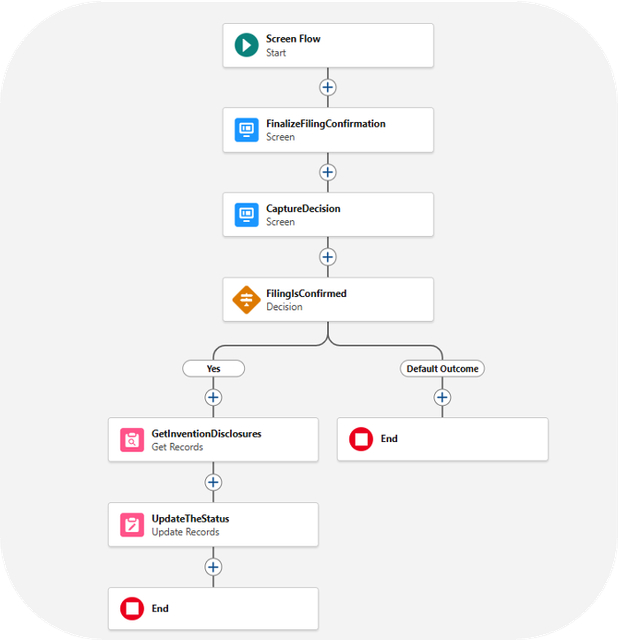
Ease of Customization
The no-code workflows enable users to build rapid automation for approval processes, custom business processes, enforcement tracking, decision trees, automated case updates, surveys, and feedback, as well as integration with external systems:
Benefit #3: Unify IP Management
With your people, assets, and processes on one platform, you can unlock smarter decisions, automation, and insightful reporting.
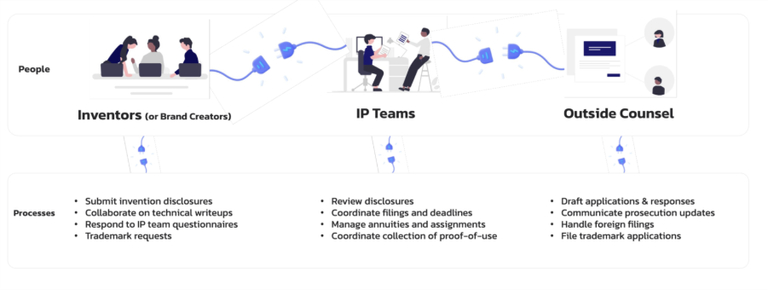
From disclosures to office actions, data flows in—and Equinox Corporate+ handles the rest. Automated triggers create records, assign tasks, and move work forward, reducing manual effort and keeping your team focused on strategy. Real-time dashboards turn activity into insight—giving teams instant visibility into filings, deadlines, spending, and portfolio health, so they can spot issues and make informed decisions faster.
More than Technology: Success Depends on People, Process & Change Management
Success isn't just about having the right tools; it's about how those tools are used. It's the combination of people, processes, and technology—not just the platform—that drives real transformation.
- People: Engaged teams turn technology into real impact.
- Processes: Process turns tools into outcomes.
- Technology: The enabler that connects people and processes.
1 People are the Key to Success
People don't just adopt systems; they shape them. Your internal teams contribute deep institutional knowledge, business context, and the practical needs that shape how the system must work. Our team brings implementation expertise, industry best practices, and guidance at every step. Real success happens when we listen, collaborate, and co-create a solution tailored to your organization.
From planning to launch, our cross-functional team of solution engineers, implementation developers, data migration specialists, and designers delivers a solution that fits your business.

2 Clear Processes Turn Ideas into Solutions
During implementation, a structured, phased approach ensures alignment, momentum, and minimal disruption. We work with you to define key workflows, map out timelines, and engage the right stakeholders—laying the foundation for long-term success inside the system.

3 Technology Simplifies IP Management
The right IP management technology should enable collaboration and strategy for your portfolio long-term. Equinox Corporate+ is built on Salesforce to remain at the forefront of the latest technologies, including artificial intelligence (AI), while Questel's focus on integration ensures we simplify IP management for our clients at every step.
The Future of IP Management is Clear
To meet the challenges of today and tomorrow, IP owners need systems that are intuitive, adaptable, and remove unnecessary manual work. They need their suppliers to embrace innovations like AI and automated workflows, not just to keep up, but to help them lead. And they need true integration across service providers, connecting IP data points and breaking down those long-standing silos.
That's exactly what we're working towards here at Questel: a smarter, more connected, and future-proof approach to IP management designed not just for today's challenges, but for tomorrow's possibilities. And we hope you'll be part of that journey with us.
The content of this article is intended to provide a general guide to the subject matter. Specialist advice should be sought about your specific circumstances.