
For the German version, please read here >>
Legal basis
The calculation is based on:
- The official manual of the Schengen short stay calculator of the European Commission
- Article 6 of the Schengen Borders Code
Basic rule: 90 days within 180 days
A non-EU citizen with a Schengen Type C visa (business visa) may stay in the Schengen area for a maximum of 90 days within a rolling period of 180 days.
Important aspects:
- This is a rolling period, not a fixed calendar period.
- Every day of stay counts, including the day of entry and departure.
- The check is carried out for each individual day that the person stays in the Schengen area.
The validity of the visa (e.g. 1 year, multiple entries) determines when you are allowed to travel – the 90 / 180 rule determines how long you are allowed to stay.
Specific example: Burcu Gökhan travels to Switzerland for project implementation and strategic planning.
Person
Burcu Gökhan is a third-country national from Istanbul who works in marketing. She is not a citizen of the European Union and is therefore subject to the residence regulations for short stays in the Schengen area. In November 2025, she received a 120-day permit from the canton of Zurich, valid until 31 December 2026. She was then able to obtain a Schengen Type C visa with the same validity and multiple entries and exits.
Residence status
The person has a Schengen Type C visa (120-day permit) with multiple entries until 31 December 2026. The visa entitles the holder to short-term business stays in the Schengen area and is subject to the legal limit of a maximum of 90 days within a period of 180 days, even if the holder has a valid 120-day permit. Before entering the country, Burcu must check that the Schengen regulations are being complied with.
Travel dates (business trips)
Burcu made or plans to make the following business trips Zurich:
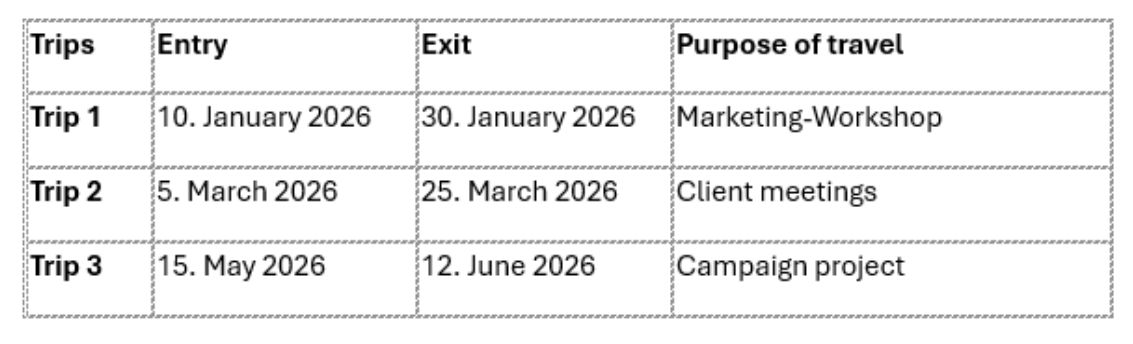
Both the date of entry and the date of departure are counted as full days of stay.
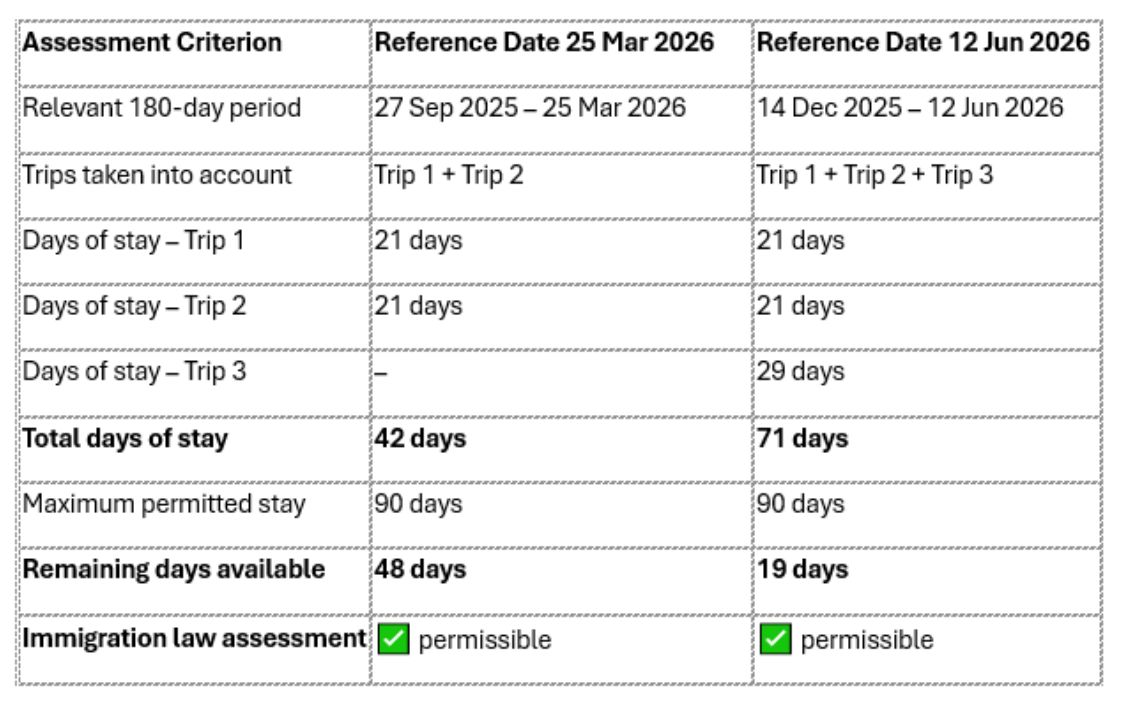
Consolidated Overview – Assessment of the 90 / 180-Day Rule
Third-country national | Marketing | Business visa (type C) - Comparative keydate audit
Detailed examination of the 90 / 180 rule (on 12 June)
Step 1: 180-day review
From 12 June backwards 180 days → Period: 14 December 2025 – 12 June 2026
Step 2: Count days of stay in the period
- Trip 1 (10–30 January): 21 days
- Trip 2 (5–25 March): 21 days
- Trip 3 (15 May–12 June): 29 days
Total:
21 + 21 + 29 = 71 days
Result: Burcu remains within the permitted 90 days.
Remaining days for further Schengen trips:
90 − 71 = 19 days
For each individual day of stay (e.g. 10 June), the following is checked:
1) How many days has the person been in the Schengen area in the previous 180 days?
This number must not exceed 90.
2) When is re-entry with full availability possible?
The oldest days of stay are from trip 1 (from 10 January 2026).
- 180 days after 10 January 2026 = 9 July 2026
From 9 July, these days fall outside the calculation window.
Burch can then gradually use more days again until 90 days are available again.
Important practical information for business travellers:
✔ Document all entry and exit dates accurately
✔ Use the official EU Schengen calculator before each trip:https://ec.europa.eu/assets/home/visa-calculator/calculator.htm?lang=en
✔ Multiple-entry or long-term visas and the 120-day authorisation do not override the 90 / 180 rule
✔ Overstaying can lead to:
- Fines
- Entry bans
- Rejection of future visas
Important Insights
- The 90 / 180-day rule is the central regulation for short stays
- It applies to business, tourist and visitor visas, as well as to third-country nationals requiring a visa with a 120-day authorisation valid for 12 months.
- The period is flexible, not fixed
- The responsibility for correct calculation always lies with the traveller
The content of this article is intended to provide a general guide to the subject matter. Specialist advice should be sought about your specific circumstances.