
- with Senior Company Executives, HR and Finance and Tax Executives
- with readers working within the Accounting & Consultancy and Business & Consumer Services industries
A Canadian tax lawyer explains when a voluntary disclosure still qualifies for relief under the CRA’s updated Voluntary Disclosures Program, and when a CRA tax audit has already closed that door.
Overview: Voluntary Disclosure vs. CRA Tax Audit in Canada
A taxpayer who discovers an error in a past tax filing faces a narrow and closing window. If the error is corrected before the Canada Revenue Agency becomes aware of it, the Voluntary Disclosures Program (VDP) can eliminate most penalties, reduce interest, and take criminal prosecution off the table. If the same error surfaces after a CRA tax audit has already started, most of that relief disappears. For Canadian taxpayers weighing a voluntary disclosure against the risk of a CRA tax audit, understanding exactly where that line falls, and how the CRA’s newly updated VDP rules define it, is the difference between a manageable correction and a costly tax audit carrying penalties, interest, and potential prosecution.
Background: How the CRA’s Voluntary Disclosures Program and Tax Audit Powers Differ
The VDP is not a matter of CRA generosity. It is a discretionary relief mechanism created under subsection 220(3.1) of the Income Tax Act, which gives the Minister of National Revenue the authority to waive penalties and interest that would otherwise apply. Equivalent discretionary authority for GST/HST and other consumption taxes is set out in GST/HST Memorandum 16-5-1.
Effective October 1, 2025, the CRA replaced its previous VDP framework, Information Circular IC00-1R6, with Information Circular IC00-1R7. The update was significant. The old General and Limited program categories are gone. In their place, the CRA now sorts every VDP application into one of two streams, unprompted or prompted, depending on how much contact the CRA already had with the taxpayer before the application was filed. Any tax amnesty guidance still describing a General Program or a Limited Program is describing rules that no longer apply to applications received on or after October 1, 2025.
A CRA tax audit operates under different legal authority entirely. It is a verification exercise carried out under the CRA’s broad information-gathering powers, intended to confirm that a taxpayer’s filings match their actual financial affairs. Where a CRA tax audit crosses into a criminal tax investigation, an entirely different set of constitutional protections applies.
The Supreme Court of Canada addressed that line directly in R. v. Jarvis, 2002 SCC 73, holding that once the predominant purpose of a CRA inquiry shifts from verifying compliance to establishing penal liability, the taxpayer’s rights against self-incrimination under the Canadian Charter of Rights and Freedoms are engaged. Our firm’s analysis of the audit-versus-investigation line sets out how that distinction plays out in practice. It matters for VDP timing because a taxpayer under an active CRA tax audit, even one that has not yet become a criminal investigation, is generally past the point where a disclosure can still be considered voluntary.
The stakes behind that timing are not abstract. Under section 239 of the Income Tax Act, a taxpayer convicted of tax evasion can face a fine of up to 200 percent of the tax evaded and up to two years of imprisonment on summary conviction, rising to up to five years on indictment. Failure to file a return under section 238 carries a fine of up to $25,000 and up to one year of imprisonment.
In the most serious cases involving deliberate deception, the CRA can refer a matter for prosecution as fraud under section 380 of the Criminal Code, which carries a maximum penalty of up to 14 years. A successful VDP application takes criminal prosecution off the table entirely for the disclosed matter. A CRA tax audit that turns up the same non-compliance does not.
At a Glance: Voluntary Disclosure vs. CRA Tax Audit
The two processes are often confused because they can involve the same underlying non-compliance. The table below sets out how they differ once either one is underway.
| Voluntary Disclosure (VDP) | CRA Tax Audit | |
|---|---|---|
| Who initiates it | The taxpayer, before the CRA has identified the issue | The CRA, or another regulator, verifying compliance |
| Interest relief available | 75% (unprompted) or 25% (prompted) | None |
| Penalty relief available | Up to 100%, including gross negligence penalties | None; penalties assessed in full where applicable |
| Criminal prosecution risk | Eliminated on the disclosed matter | Can lead to referral for criminal investigation |
| Governing authority | Income Tax Act s. 220(3.1); IC00-1R7 | Income Tax Act ss. 231.1, 231.2 (audit and information-gathering powers); s. 152(4) (reassessment) |
Key Issues: The IC00-1R7 Voluntariness Test and What the Case Law Says
Paragraph 16 of IC00-1R7 states plainly that a VDP application must be voluntary to be granted relief. Paragraph 17 defines when it is not: an application is not voluntary if a tax audit or investigation has already been initiated against the taxpayer, or a related taxpayer, regarding the information being disclosed. Critically, that tax audit or investigation does not have to come from the CRA itself. A tax audit or investigation opened by a law enforcement agency, a securities commission, or another federally or provincially regulated authority can also disqualify a disclosure.
Within that voluntariness requirement, IC00-1R7 draws a further distinction that determines how much relief is available.
Unprompted application: made before any verbal or written communication about the specific compliance issue, or where the only prior contact was an education letter offering general filing guidance rather than identifying a problem.
Prompted application: made after communication that identifies a specific error or omission, sets a deadline to correct it, or follows the CRA’s receipt of third-party information naming the taxpayer or a related taxpayer.
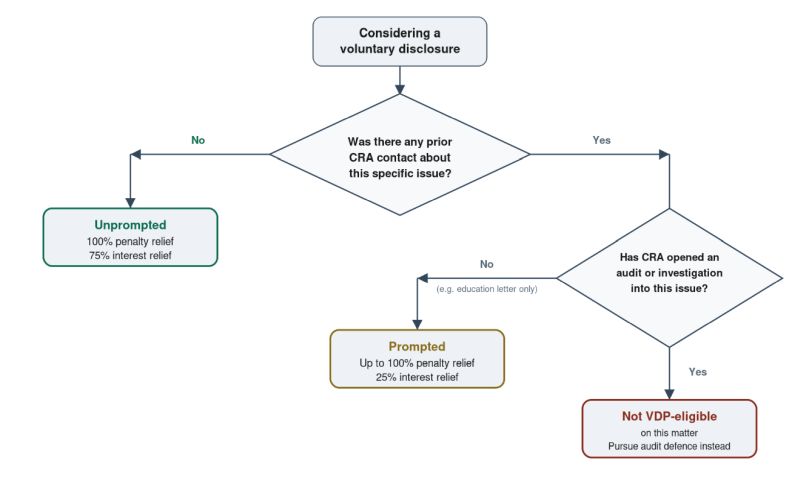
Figure: How the CRA’s voluntariness test determines VDP relief under IC00-1R7.
The financial difference between the two is substantial. Under the current relief schedule, an unprompted application is normally eligible for 100 percent relief of applicable penalties and 75 percent relief of applicable interest. A prompted application is normally eligible for up to 100 percent penalty relief but only 25 percent interest relief. Both streams, where accepted, protect the taxpayer from criminal prosecution on the disclosed matter and waive gross negligence penalties.
Prince v. Canada (National Revenue), 2020 FCA 32, illustrates what happens when a disclosure is filed too late and used as a shield against an ongoing tax audit. The CRA had already audited the taxpayer for the 2005 through 2014 taxation years and advised him of its intention to reassess. Only then did the taxpayer submit a VDP application, which the CRA dismissed as not voluntary. While the taxpayer’s request for a second-level VDP review was still pending, the CRA issued a proposal letter setting out the reassessments. The taxpayer sought an injunction and applied for judicial review, arguing the reassessments should wait for the VDP review to conclude.
The Federal Court of Appeal disagreed. It held that a proposal letter is not a final reviewable decision, and more importantly, that the CRA’s reassessment powers under the Income Tax Act operate independently of a pending VDP application. A CRA tax audit that is already underway does not pause because a taxpayer has asked the CRA to reconsider its voluntariness determination.
David J. Rotfleisch, the firm’s founding tax lawyer and one of Ontario’s Certified Specialists in Taxation, describes the lesson from Prince directly: “A voluntary disclosure application is not a stay of proceedings. The CRA’s tax audit and reassessment powers keep moving on their own timeline, whether or not a disclosure review is still pending.”
Where a taxpayer believes the CRA refused VDP relief unfairly, the recourse is a second administrative review, followed if necessary by an application for judicial review to the Federal Court under section 18.1 of the Federal Courts Act, filed within 30 days of the CRA’s decision.
On judicial review, the CRA’s exercise of discretion is assessed on the reasonableness standard set out in Canada (Minister of Citizenship and Immigration) v. Vavilov, 2019 SCC 65, meaning the Federal Court will generally defer to the CRA’s decision unless it falls outside a range of defensible outcomes given the facts and the governing legislation.
How to Apply for the Voluntary Disclosures Program
A VDP application is made using Form RC199, Voluntary Disclosures Program (VDP) Application. A taxpayer may complete and submit it personally, or authorize a representative, such as an experienced Canadian tax lawyer, to submit it on their behalf. The CRA will only discuss the file, or release information about it, to the taxpayer or their authorized representative.
The application must disclose all known errors and omissions, including related arm’s length and non-arm’s length transactions, and must be accompanied by supporting documentation, returns, forms, statements, and schedules, for the six most recent years. Where the disclosure involves income or assets located outside Canada, that documentation requirement extends to ten years. A tax year within that period that contains no errors or omissions does not need to be included, though the CRA may request additional years at its discretion.
Payment of the estimated tax owing, or a request for a payment arrangement, must accompany the application before relief can be granted, and approval of a payment arrangement is not guaranteed. Taxpayers who are unsure whether to proceed can request a pre-disclosure discussion with the CRA on an anonymous basis first.
An application can also be denied for reasons that have nothing to do with the merits of the underlying disclosure, including incomplete information, failure to respond to CRA requests within the given timeframe, or the CRA’s discovery of additional non-compliance that was not originally included.
Implications for Canadian Taxpayers Facing a CRA Tax Audit or VDP Decision
Not every letter from the CRA closes the door on a voluntary disclosure. An education letter, a general filing reminder, or correspondence about an unrelated matter will not, on its own, make a later disclosure involuntary. Once a letter identifies a specific error, sets a deadline to respond, or follows from third-party information naming the taxpayer, the analysis changes, and the application will likely be treated as prompted at best, or refused outright if a tax audit has already opened.
The scale of CRA enforcement activity makes this a live risk for far more taxpayers than headlines about criminal prosecutions might suggest. The CRA conducts over 350,000 audit and review actions annually, including an estimated 15,000 audits of cash-based businesses and 35,000 tax shelter audits. Most of these begin as routine verification, not criminal investigation, but each one can independently close off VDP eligibility for the taxpayer, and any related taxpayer, on the matters under review.
The exposure also extends beyond the taxpayer who receives the letter. Under paragraph 17 of IC00-1R7, a tax audit opened against a corporation can cut off VDP eligibility for a related taxpayer, such as a shareholder or director, on connected issues, even if that individual has not personally been contacted.
This is a common trap in owner-managed businesses, where a corporate tax audit and a shareholder’s personal unreported income are treated by the CRA as related matters. An experienced Canadian tax lawyer can assess whether a specific corporate tax audit has already closed the door on a related shareholder’s own disclosure.
The same principle applies to unreported cryptocurrency transactions, an area where the CRA has significantly expanded its use of blockchain analytics and exchange reporting to identify non-compliant taxpayers before those taxpayers come forward on their own, as discussed in our guide to using the VDP for unreported crypto profits. Taxpayers who assume a small or old cryptocurrency gain will go unnoticed are increasingly filing disclosures after the CRA has already identified the transactions through an exchange.
Regardless of whether VDP relief is ultimately granted, a taxpayer who receives a Notice of Reassessment increasing tax payable should file a fresh Notice of Objection within the statutory deadline, without exception. As Prince demonstrates, the objection deadline runs independently of any pending VDP review, and waiting for a VDP decision before objecting can cost a taxpayer their appeal rights entirely.
Why Acting Before CRA Contact Preserves Your Tax Amnesty Options
The rules under IC00-1R7 reward taxpayers who act first. An unprompted application filed before any CRA contact keeps 75 percent interest relief on the table, along with full penalty relief and protection from prosecution. The same error, disclosed after a compliance letter or a CRA tax audit has started, drops to partial interest relief at best, and often no relief at all. Because the voluntariness determination turns on facts the CRA has already gathered, not on the taxpayer’s own sense of urgency, the only way to know where a specific situation falls is to have it assessed before anything is submitted.
Top Tax Tips: Protecting Your Voluntary Disclosure Eligibility
Taxpayers who suspect they have an unreported tax issue should resist the instinct to wait and see whether the CRA notices. As David J. Rotfleisch, the firm’s founding tax lawyer and a Certified Specialist in Taxation, puts it, “the gap between an unprompted and a prompted application can decide whether a client keeps 75 percent of their interest charges or only 25 percent, and that gap often comes down to a single letter sitting unopened in a mailbox.”
Before submitting anything to the CRA, taxpayers can request a pre-disclosure discussion on an anonymous basis, which allows a preliminary conversation about eligibility and expected relief without identifying the taxpayer. This step is informal, non-binding, and does not start the clock on a formal application.
Taxpayers should also gather complete supporting documentation before applying. IC00-1R7 requires six years of supporting records for domestic issues and ten years where the disclosure involves offshore income or assets, and an incomplete application can be denied even where the underlying disclosure would otherwise qualify. Where a corporation is under a CRA tax audit, related shareholders and directors should assume their own VDP eligibility is affected and seek advice immediately rather than waiting for direct CRA contact.
On the litigation side, Rotfleisch also notes that a VDP application is not a stay of proceedings. A pending voluntary disclosure will not stop the CRA’s tax audit or reassessment powers from moving forward on their own timeline, so a Notice of Objection still has to be filed on time regardless of how the disclosure review is going. Taxpayers who are also considering our firm’s guidance on surviving a CRA tax audit more generally can review it alongside this analysis before deciding how to respond to any CRA correspondence.
FAQs
Can I still file a voluntary disclosure after the CRA has contacted me?
Sometimes. Routine correspondence, education letters, and communication about unrelated matters generally do not disqualify a later disclosure. Once the CRA has identified a specific error, set a compliance deadline, or received third-party information naming the taxpayer, the application will usually be treated as prompted, with reduced interest relief, or refused entirely if a tax audit or investigation has already begun.
What is the difference between an unprompted and a prompted VDP application?
An unprompted application is filed before any CRA communication about the specific issue, or after only an education letter. A prompted application follows communication that identifies a specific compliance problem or a deadline to correct it. Unprompted applications receive higher interest relief.
How much penalty and interest relief does the Voluntary Disclosures Program provide?
Under Information Circular IC00-1R7, effective for applications received on or after October 1, 2025, unprompted applications normally receive 100 percent penalty relief and 75 percent interest relief. Prompted applications normally receive up to 100 percent penalty relief and 25 percent interest relief. Both streams protect against criminal prosecution and waive gross negligence penalties on the disclosed matter.
Does a CRA tax audit of my corporation put my personal VDP eligibility at risk?
Yes, potentially. Under IC00-1R7, a tax audit or investigation opened against a related taxpayer, including a corporation in which someone is a shareholder or director, can affect that individual’s own eligibility for related issues, even without direct personal contact from the CRA.
Will filing a voluntary disclosure stop a CRA tax audit or reassessment already underway?
No. As the Federal Court of Appeal confirmed in Prince v. Canada (National Revenue), 2020 FCA 32, the CRA’s reassessment powers operate independently of a pending VDP application or review. A CRA tax audit that has already started will generally continue while the disclosure is being evaluated.
What happens if the CRA denies my voluntary disclosure application?
A taxpayer can request a second administrative review, and if that is unsuccessful, apply to the Federal Court for judicial review of the CRA’s decision within 30 days. The Federal Court will assess whether the CRA’s exercise of discretion was reasonable, not whether the court would have reached the same decision.
Does an education letter from the CRA disqualify me from the Voluntary Disclosures Program?
Not on its own. IC00-1R7 treats an application made after only an education letter, one offering general filing guidance without identifying a specific compliance issue, as unprompted, provided no other communication about the issue has occurred.
How far back does a voluntary disclosure need to go?
IC00-1R7 requires supporting documentation for the six most recent years for domestic non-compliance, extending to ten years where the disclosure involves offshore income or assets. A tax year within that window with no errors or omissions does not need to be included.
What is the penalty for tax evasion in Canada if I do not use the Voluntary Disclosures Program?
Under section 239 of the Income Tax Act, a conviction for tax evasion can carry a fine of up to 200 percent of the tax evaded and up to two years of imprisonment on summary conviction, rising to up to five years on indictment. Failure to file a return under section 238 carries a fine of up to $25,000 and up to one year of imprisonment. More serious cases of deliberate deception can be prosecuted as fraud under section 380 of the Criminal Code, carrying up to 14 years.
Can my accountant or bookkeeper submit a voluntary disclosure on my behalf?
Yes. A taxpayer may authorize a representative, including a tax lawyer or accountant, to submit a VDP application using Form RC199. The CRA will only discuss the application or release information about it to the taxpayer or their authorized representative.
The content of this article is intended to provide a general guide to the subject matter. Specialist advice should be sought about your specific circumstances.
[View Source]