

The conversation has been about the tech. It should be about how you really move the needle.
In the early 1920s, Henry Ford called in Charles Steinmetz to diagnose a fault in a large electrical generator that his own engineers had failed to fix. Steinmetz asked for a notebook, a pencil, and a cot. For two days and nights, he listened to the generator and filled pages with calculations. On the second night, he climbed up, made a chalk mark on the casing, and told Ford's engineers to remove the plate at that location and replace sixteen windings from the field coil. They did. The generator ran perfectly.
Ford queried the $10,000 invoice. Steinmetz sent an itemised version: "Making chalk mark on generator, $1. Knowing where to make mark, $9,999."
Whether the tool is a piece of chalk, a replacement part, or (in 2026) an AI agent, the cost of the tool itself has rarely been the constraint. What remains scarce, and where value is actually created, is the knowledge of where to apply it, and why. In the current wave of enterprise AI adoption, that distinction is being largely ignored. Organisations are accumulating tools and proofs of concept, and vendors are pushing AI with an almost religious fervour. The question of deployment is being treated as an afterthought, almost as if the AI will magically deliver on its promised business outcomes.
The value is in the algorithms
In a grocery retail trading and supply operation, the substantive commercial value (the kind that appears in margin, availability, and working capital) has always been accessible through traditional machine learning (ML): price optimisation, promotional uplift modelling, and inventory target-setting that trades off availability and waste across volatile fresh categories. These algorithms exist and, in many retailers, have existed for years.
The gap is between what the models recommend and what the organisation decides.
In most retailers today, that gap is filled by people: buyers, supply chain managers, and planners who spend the majority of their time reviewing outputs, applying personal judgment, escalating exceptions, and making incremental calls. A promotional volume decision that an algorithm optimised overnight passes through several people with different risk tolerances before it becomes locked in the system. This is a rational, human response to “black box” tools that produce outputs without context. But it is expensive, slow, and inconsistent; an enormous volume of ML-derived value sits uncaptured because of how businesses have set themselves up around these tools and systems.
What generative AI contributes
GenAI's role is not to replace machine learning. However, it has several powerful capabilities that unlock greater value from legacy or new optimisation models.
- Decision logic made intelligible
When an inventory algorithm recommends increasing stock cover on a volatile fresh line ahead of a bank holiday, it does not explain itself in language a category buyer understands. A GenAI layer can “talk” to the buyer, or supply chain analyst, in their language, stating the recommendation in terms of the business rules it was optimising against (availability targets, waste tolerances, supplier lead times, or historical demand volatility). The buyer does not need to understand the mathematics, but they do need to understand why a recommendation is reasonable and believe in it enough not to block or modify it. That is the gap GenAI closes.
- Execution at scale and with consistency
Agentic AI can take a set of decisions and execute them across hundreds of lines without the variance that comes from executing across multiple teams with variable capabilities, time available for the task, and individual motivation. The floor of decision quality rises once execution stops being variable.
- Senior commercial talent operating across a wider span
A trading director who previously managed a team of buying managers (reviewing, coaching, coordinating, and escalating) no longer needs to work at that level of granularity when the work beneath them is being handled consistently and intelligibly by AI agents. The experienced commercial leader who managed Meat, Fish & Poultry can hold accountability for other Fresh departments. Supplier relationships and board-level conversations, previously crowded out by day-to-day management, can absorb more of their time.
- A different shape for the commercial organisation
The structural consequence is a leaner operating model, but the mechanism for achieving it matters, because the familiar “AI will flatten organisations” narrative points to the outcome without explaining the cause.
The disruption operates differently at each level. At the operator level (buying administrators, supply planners, and junior buyers) AI agents replace the bulk of execution work: data monitoring, exception identification, and instruction generation. At the manager level, the orchestration layer reduces the burden of coordination and oversight, but experienced commercial judgment remains essential for setting the rules, handling genuine exceptions, and managing AI systems whose recommendations must be challenged. At the director level and above, the primary change is leverage: the same capability deployed across a wider remit, with more time for the relationships and decisions that drive disproportionate value.
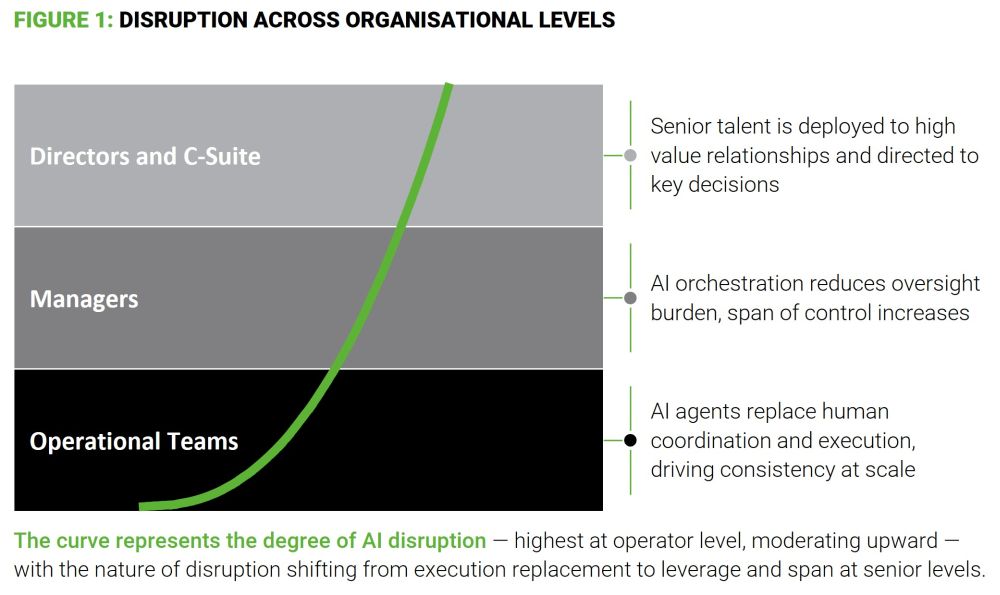
The result is an organisation where more of its total cost is concentrated in people capable of generating disproportionate returns, and less in the coordination and execution work that AI can now handle reliably.
Three components, designed together
If you deploy ML optimisation without the GenAI orchestration layer, you get the status quo: models whose outputs are diluted and inconsistently executed by a layer of people who do not trust them. Deploy GenAI agents without the underlying optimisation models, and you get fast, consistent execution of mediocre decisions. Redesign the operating model without either, and you have a leaner organisation that is simply less capable.
The combination – ML and optimisation tools, GenAI orchestration and agentic execution, and deliberate process and operating model redesign – is what moves the needle. Getting there requires holding the commercial problem, the technical architecture, and the organisational design in the same frame simultaneously. That is precisely where most pure-play AI vendors and many digitally native consultancies fall short. They can build the technology, but designing the operating model around a trading or supply function they have never run is a different matter.
The same logic applies across retail and consumer sectors
The argument in this piece is illustrated through grocery retail, where the commercial stakes are high, the ML opportunity is well understood, and the gap between algorithmic recommendation and organisational decision is visible and costly. The underlying logic applies wherever a similar pattern holds:
Luxury Retail: Pricing and markdown optimisation: algorithms that can determine optimal entry and exit prices across a fragmented estate, undermined by buying teams that override recommendations without a consistent rationale.
Food Manufacturing: Demand planning and S&OP, where ML-generated forecasts are routinely adjusted by commercial teams before they reach the shop floor.
Clothing Retail: Depth-of-buy and size ratio optimisation: decisions where the data advantage is significant but the organisational trust in algorithmic output remains low.
In every case: The commercial opportunity is large, traditional ML holds most of the value, and GenAI's contribution is to make that value accessible rather than to generate it from scratch.
Rather than an AI strategy, the starting point should be an honest assessment of where the real commercial gap is, and whether the organisation is currently set up to close it. The operating model, the technology, and the required process and people changes will flow from that.
The content of this article is intended to provide a general guide to the subject matter. Specialist advice should be sought about your specific circumstances.
[View Source]