Software development is on the cusp of a true paradigm shift. The rise of agentic tools that handle significant portions of coding and delivery work is driving a fundamental change in how software is built, governed, and scaled. Development teams will require fewer people, and the work of those people is all the more critical as the shift to an AI-native model enables organizations to automate key steps in the software development lifecycle (SDLC). People provide oversight and quality assurance; human judgment ensures that what’s produced is trustworthy and delivers real customer value.
For decades, people have defined and developed software. Agile built a human-centric model around the 8 to 12-person squad. In a typical team, most effort went into Build (approximately 32% percent, per AlixPartners’ Activity Reference Model) and Test (approximately 18%), with only about 7% devoted to Guide — the work of identifying problems worth solving. Automation helped through build pipelines, test automation, and AI-assisted development, but these advances largely maximized human throughput within the existing model.
The latest agentic tools are different. As agents write code, generate tests, orchestrate deployments, and coordinate their own work, the fundamental principles of good software development — quality, security by design, privacy by design — remain true, but the how changes.
Early adopters report 26–56% productivity gains, but most of these come from boosting the existing model rather than from the deeper impact expected from agents. For example, a study of GitHub Copilot users found that coding tasks were completed 56% faster, while researchers following nearly 5,000 developers found a 26% increase in weekly task completion, with disproportionately larger gains among junior staff. Although results in mature codebases vary, agentic tools can, at a minimum, ease demand and prioritization pressures. Still, they will only create real value by redesigning how the work around them is done, requiring tightly defined agent and human roles.
These productivity increases raise a sharper and more important question: Does the new model create genuine end-customer value, or does it simply produce more software?
The central question for CTOs and CPOs, therefore, shifts from “how do we maximize the productivity of our workforce?” to “how do we ensure we continue to deliver value for our users?” Without a strong Product function, adding resources to build software is likely to result in a proliferation of low-value or superfluous functionality. The overall goal is not just efficiency. It requires a thoughtful approach to creating different roles, controls, economics, and a different path to simplification at scale.
Five principles for an agentic software development life cycle (SDLC)
We propose five human-centric principles to guide organizations adopting this fundamentally different operating model.
- Humans set direction and remain accountable for outcomes. Product and Engineering leaders define the problems and architecture, while ensuring accountability. They ensure that benefits are realized while agents take on execution.
- Investment in specification and test quality pays dividends. Humans should focus on creating structured requirements and test-driven development to provide deterministic constraints for non-deterministic models.
- Architecture becomes the core control mechanismfor agents by providing clear patterns, interfaces, and security frameworks to ensure the production of consistent, stable code.
- Supervisory engineering becomes a distinct disciplinethat shifts the focus from writing code to building and orchestrating agents, directing workflows, and validating outputs. Most importantly, they decide when human engineers need to intervene.
- Organizational knowledge becomes an executable control layer. Standards, architecture decisions, and policies must be available in forms that both humans and agents can use. Agents must be able to trace organizational knowledge to a named owner, thereby preventing cognitive debt and code drift as systems change.
What this means in practice
Today’s squad will transform as traditional product managers, architects, and supervisory engineering roles shift to high-leverage positions, and people spend less time coding. Time spent finding problems, creating specifications, and gathering feedback may increase, while Build and Test human effort correspondingly decrease.
Agent success will depend upon well-developed specs and test architecture. Trust in the process and outcomes will come from clear decision rights and explainability.
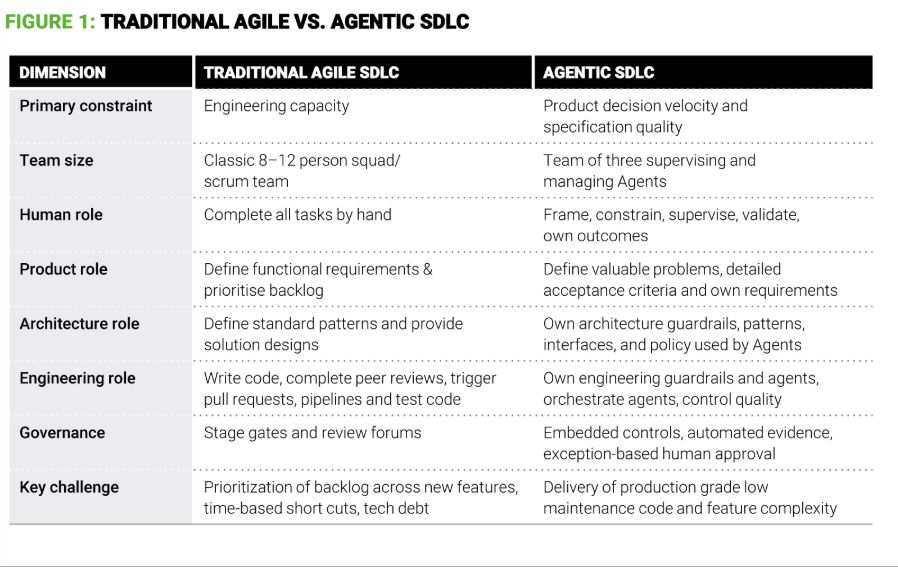
As agents begin to handle most Build and Test functions, the limiting production factor shifts from engineering capacity to organizational attributes, with decision velocity becoming a delivery advantage. Teams that can make high-quality decisions on product, architecture, security, and release quickly will convert agentic capacity into value, in contrast to those with slow-moving forums, unclear ownership, and fragmented governance.
Where CTOs and CPOs should start
Five simple questions can help launch and focus the journey to Agentic SDLC:
- Where is software delivery constrained today: coding, decisions, architecture, testing, security, release, or adoption?
- Which parts of our backlog are agent-ready because they have clear context, acceptance criteria, tests, and ownership?
- Which architecture and security standards are currently documented but not enforceable by agents or pipelines?
- Who is accountable for supervising agent output, and what authority do they have to stop or approve a change?
- How will we know whether agentic delivery is creating customer value rather than just increasing software volume?
The tools needed for the shift to an agentic SDLC are being developed in real time. Organizations must prepare now to realize the full potential of this transformative model. Those who get ahead will focus on roles and processes while ensuring that clear governance is at the core of redesigned teams of highly leveraged humans, safely directing a large fabric of agents that create products that deliver true customer value.
The content of this article is intended to provide a general guide to the subject matter. Specialist advice should be sought about your specific circumstances.
[View Source]