AI capabilities, particularly the expansion of agents handling enterprise workflows, are accelerating faster than companies anticipated. These capabilities will soon create category winners, shrink other markets, and shock legacy businesses that were underwritten for growth or margin that may no longer be feasible. Recently, our team rapidly coded a tool for a client that generated better data insights than the leading SaaS product in the space. The client canceled its SaaS subscription budget for that tool the next day. Companies can also now quickly close financial books with several agents and one human in the loop, dramatically reducing the number of licenses needed.
At AlixPartners, we have been analyzing enterprise software industry disruption patterns for several years. We recently evaluated more than 500 privately-owned companies across software segments to develop a framework for grouping companies by risk level and protective moat buffer.
Our analysis indicates that out of eight different moats a company can use to protect its competitive advantage, two are proving most critical, with 24% of the companies analyzed facing significant disruption risk given weak protection on those dimensions.
The leading buffers against AI disruption
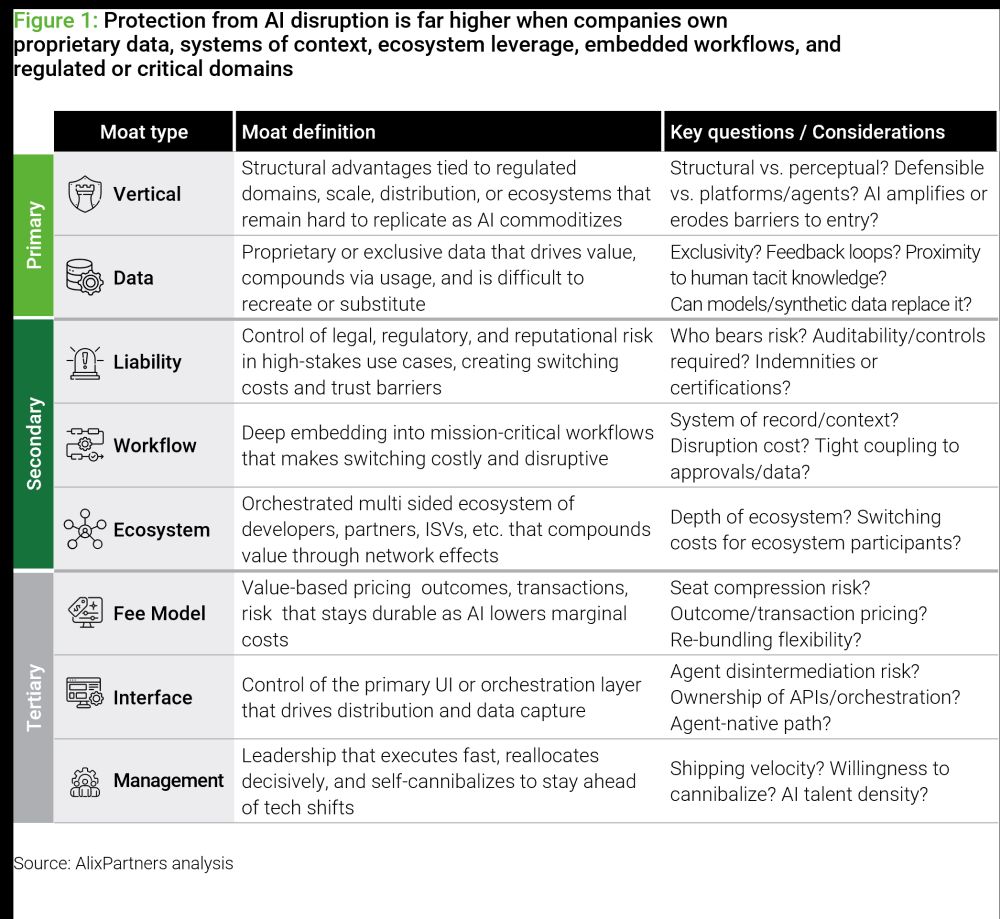
We established that the two primary moats of vertical and data specialization separate the safest companies from those facing the greatest AI disruption.
Vertical moats
Companies with vertical specialization maintain proprietary industry assets and specialized workflows that competitors lacking deep expertise cannot easily match. They deliver solutions to industries with high regulation and limited tolerance for error; downtime or mistakes carry serious financial, legal, or human consequences. Potential AI substitutes face a high evaluation bar before deployment.
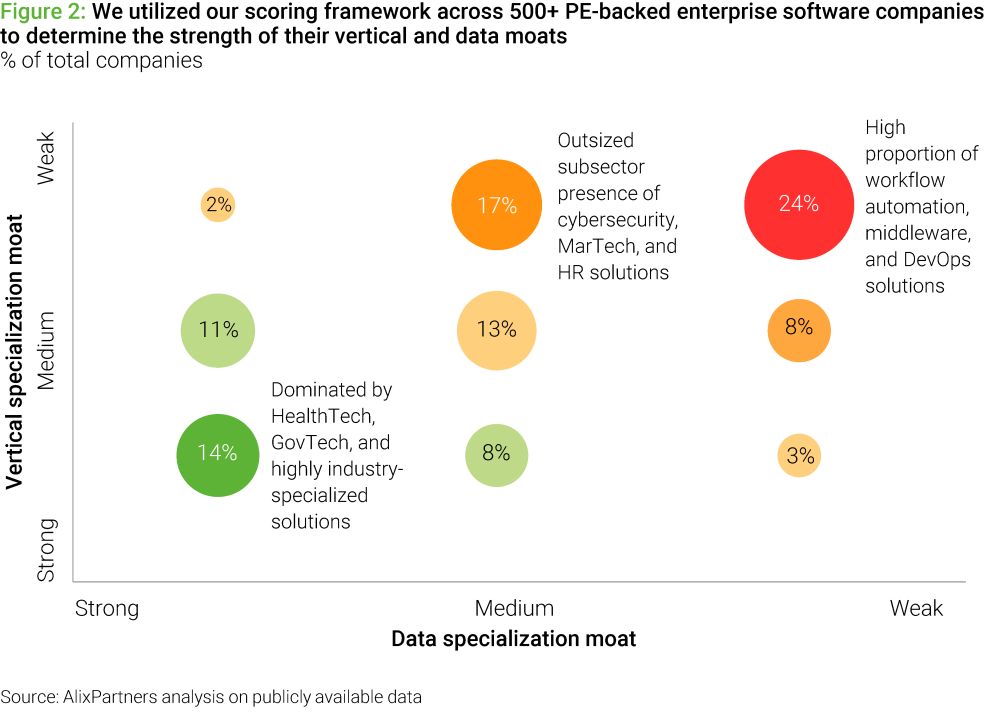
Our analysis of 500+ enterprise software companies shows the gap clearly: More than 80% of firms in industry-agnostic segments (DevOps, middleware, workflow automation) screen as having a weak vertical moat. In segments targeting higher complexity like financial services and healthcare, that number drops below 10%.
Data moats
Companies with data specialization hold proprietary or exclusive data that accumulates with every deployment. It could take years for a competitor to recreate or replicate such a data set at any cost; as such, AI proliferation only strengthens the position of data specialists, as the data they’ve collected is exactly what AI needs to deliver outcomes.
For example, a leading provider of IT infrastructure modernization tools (e.g., mainframe modernization, app migrations) offers a counterintuitive data moat. Although AI could replicate the company’s functionality, this platform controls critical data layers underlying client operations, making it a de facto system of record. This data custodianship, not the tooling itself, is defensible against AI disruption.
Which segments are at risk?
The data paints a foreboding picture for many enterprise software / SaaS companies.
According to our analysis, 24% of the 500+ companies have weak data and vertical moats, the cohort most highly exposed to AI disruption. By contrast, only 14% have strong data and vertical moats that mark them as highly protected.
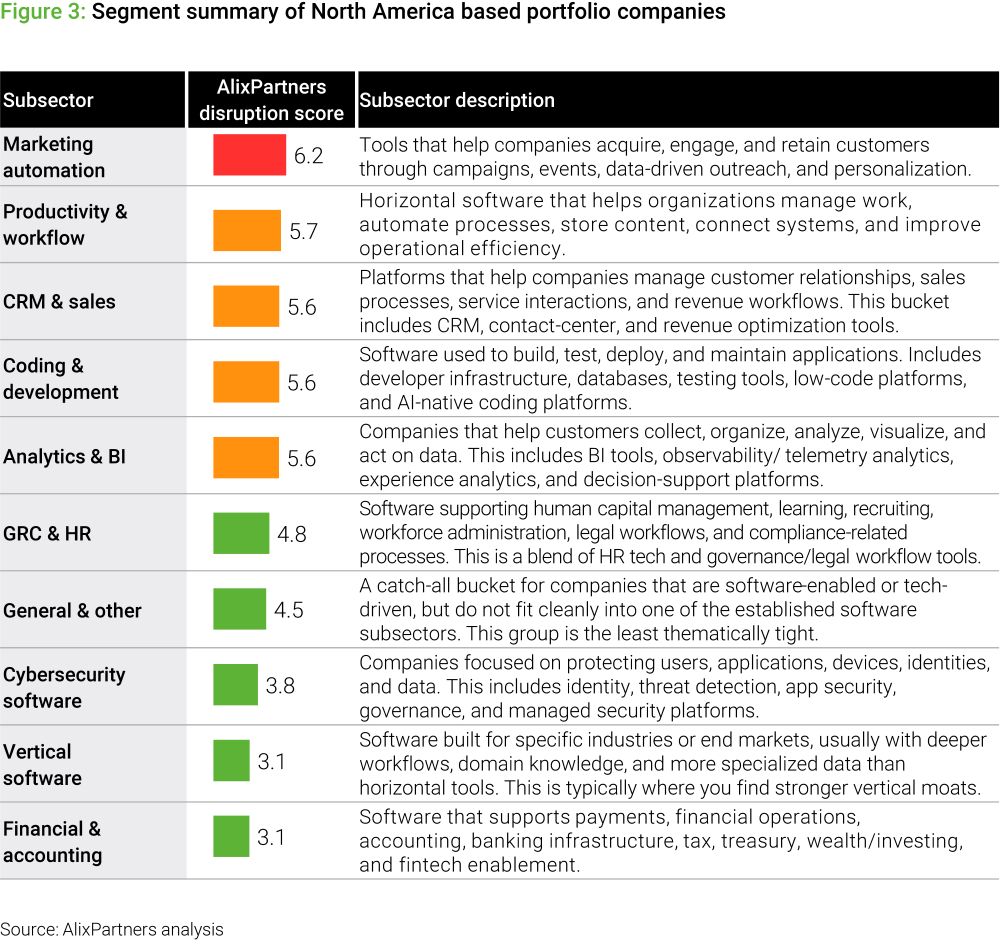
Analyzing the 500+ companies identifies five segments facing the highest degree of disruption: marketing automation, productivity & workflow, CRM & sales, coding & development, and analytics & BI.
Looking ahead
As AI narrows the gap, operators and investors must act decisively. Most enterprise software and SaaS companies must pursue one of four strategies:
- Ignite growth: Leverage the fortress position with robust moats and use AI investments to unlock net new growth.
- Invest & fix: Identify areas with disruption risk and actively invest to defend and generate opportunities for growth, either through internal build-outs or acquisitions.
- Sell: Identify potential acquirers seeking your customers, markets, or capabilities. AI natives are particularly attractive buyers as they often prefer acquiring customer bases over organic growth.
- Exit: When core moats are indefensible, plan an orderly wind-down to maximize value recovery.
In subsequent articles in this series, we will dive deeper into the key issues facing investors and SaaS company leaders as they consider how to combat AI disruption. We’ll also break down how AlixPartners’ proprietary agentic repositioning framework helps companies identify archetypes and actionable initiatives across product, pricing, operating model, and more to drive additional value in an agentic AI future.
The content of this article is intended to provide a general guide to the subject matter. Specialist advice should be sought about your specific circumstances.
[View Source]