The future of industrial automation is taking shape: autonomous factories, self-optimising production lines, and AI making operational decisions across assets, processes and sites.
While the technology exists to support much of this, many manufacturers lack the ability to operationalise it at scale, and that gap has a primary root cause: fragmented data.
Most manufacturing organisations have more data than they can act on. The problem is where it sits, scattered across systems that do not communicate, inconsistently labelled, and locked in legacy infrastructure that was never designed to share. The result is a fragmented operational picture that AI can use to answer questions within that narrow view, but it cannot extend to the operation as a whole.
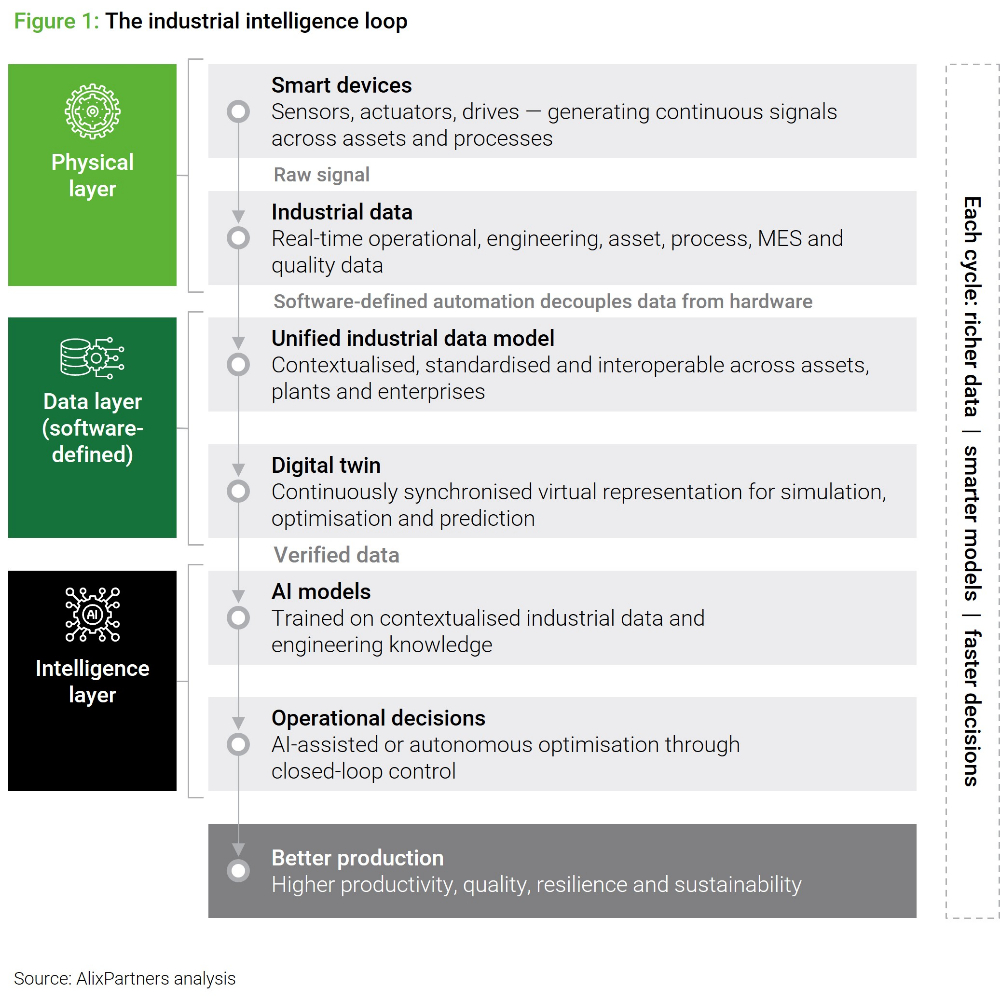
Pilots have proved that the model works, but they are unable to address the issues of standardisation and integration that scaling requires. As shown in figure 1, a coherent data foundation will close that gap, and building one requires transformation capability, not just technology investment. The manufacturers getting this right are funding both.
Value is moving up the stack
The traditional control layer – programmable logic controllers (PLCs), input/output systems, supervisory control and data acquisition (SCADA) – is being commoditised. New entrants are pricing it down, margins are compressing, and value is pooling at both ends of the stack, where software and data are at the top, and smart field devices are at the bottom.
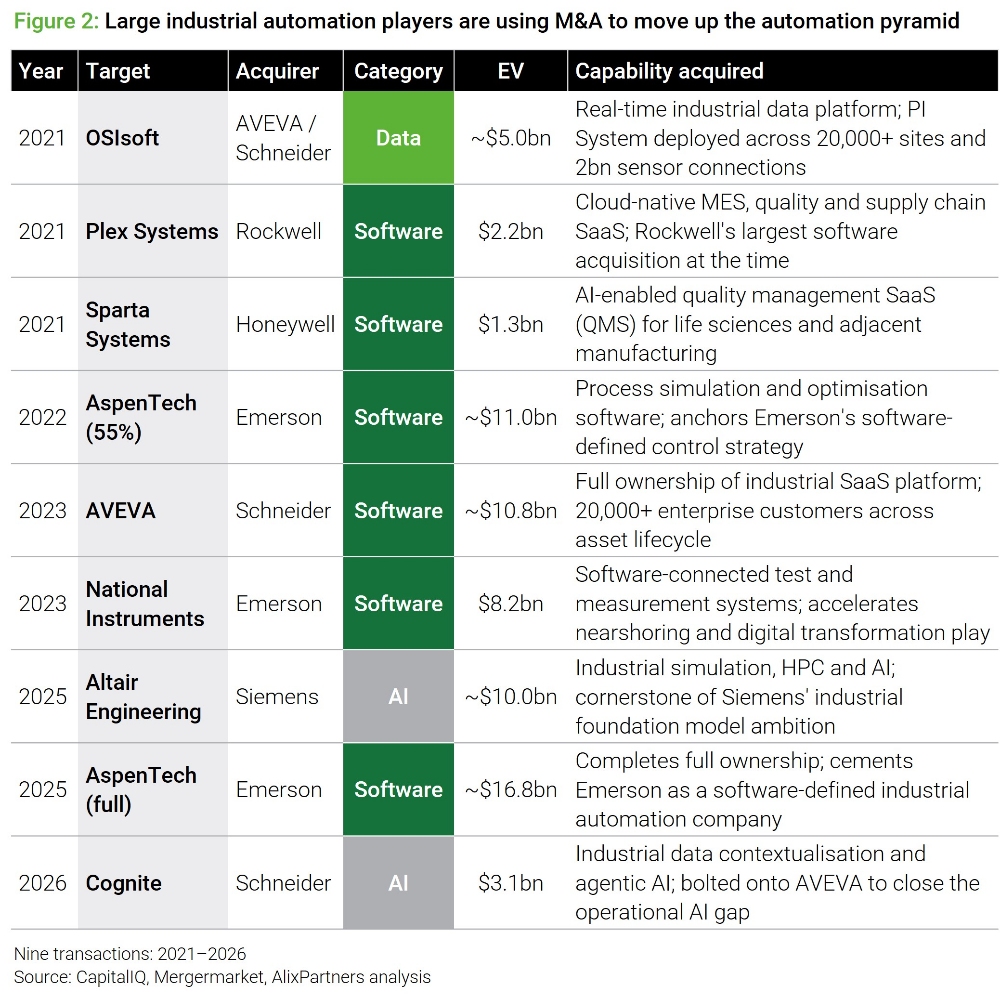
Some organisations are acting on this deliberately. Schneider Electric took full control of AVEVA in 2023, a UK-listed industrial-software leader valued at more than £10 billion with more than 20,000 enterprise customers, and repositioned it toward a subscription, cloud-and-data model spanning the full asset lifecycle. The strategy commoditises the control layer on open standards, then captures the value migrating upward. Schneider frames software-defined automation as the foundation for AI, on the logic that running AI at scale requires standardised, portable data, which is precisely what decoupling control from hardware delivers.
Siemens pursued the same thesis with its approximately $10 billion acquisition of Altair in 2025, folding simulation, high-performance computing, and data science into its digital twin and industrial AI portfolio. The stated objective is an 'Industrial Foundation Model' trained on verified engineering data. Meanwhile, Emerson, completing its buy-out of the AspenTech minority stake it did not already own, described the move as the final phase of its transition toward software-defined control. This transaction valued AspenTech at close to $17 billion in enterprise value.
The pattern is consistent, where incumbents use M&A to move up the stack and quietly carve out or wind down non-core hardware in the process.
And, as figure 2 below shows, around $70 billion in cumulative capital has been deployed in these efforts, based on these select deals alone from the past five years.
Ownership only takes you so far
However, acquisitions cannot close every gap, and partnerships and joint ventures are filling the rest.
Foxconn and Intrinsic, an Alphabet company, formed a joint venture in 2025 to deploy adaptive automation across electronics assembly, pairing Foxconn's manufacturing scale with Intrinsic's AI-robotics software. Neither could build what the other brings.
At the standards level, Schneider Electric, AVEVA, ETAP, NVIDIA, Autodesk and others joined the Alliance for OpenUSD, making digital twins and simulation assets interoperable. The logic is straightforward, whereby the contextual data layer only delivers value if it is not locked inside a single vendor's ecosystem.
The strategic question, then, is not whether to acquire or partner. It is knowing precisely what to buy, what to partner for, and what to walk away from. Three implications follow.
The most valuable acquisition targets are those that provide the missing contextual layer – the data assets, domain knowledge, and integration capability that make the rest of the stack useful. Alliances are a genuine alternative to ownership for capabilities that are infrastructural rather than differentiating. Forcing full ownership of every layer is expensive, slow, and often counterproductive. Plus, founder-owned integrators and niche specialists with real data or domain depth are more strategically valuable than they were five years ago. Carve-outs from larger manufacturers and industrial conglomerates are adding to deal flow on both sides.
Where transformations stall
Four factors separate the manufacturers that scale from those that stall:
- A working data foundation
- End-to-end connected workflows
- The ability to replicate across multiple plants
- A closed loop between digital and physical operations
In most organisations, design, production, and operations still run in parallel. When those connections are made, the results are tangible. Design decisions reflect what is actually happening on the production line, operations move beyond fixed recipes, and testing shifts from the shop floor to simulation. The digital twin stops being a visualisation and starts doing real work – learning from operations and feeding that intelligence back into decisions.
The barriers include inconsistent data definitions across sites, differing ways of working, legacy systems, plants with varying equipment, and diverse cultures. Individual pilots may succeed, but full-scale transformations stall because proving the model works is relatively straightforward compared to rebuilding everything around it.
Most organisations are not ready for the full-scale transformation; the underlying data and the operating systems that support it remain a binding constraint. Closing that gap requires a different kind of investment than deploying better technology.
Execution is the differentiator
Most leadership teams know what needs to happen. The gap is execution – sequencing M&A, operational change, digital capability, and organisational redesign in the right order, at a pace that compounds rather than stalls.
The manufacturers that get this right will set the competitive baseline for the next decade. Those that treat data integration as a second-order problem – something to address after the technology is deployed – will find themselves simply one vendor among many.
The content of this article is intended to provide a general guide to the subject matter. Specialist advice should be sought about your specific circumstances.
[View Source]