The EU 'Platform Work' Directive aims to improve the working conditions of platform workers and to protect the personal data of persons performing platform work. Below, we examine the Directive in more detail, together with the progress made by EU Member States in transposing its provisions into national law.
Directive (EU) 2024/2831 on improving working conditions in platform work (known as the ‘Platform work directive’) was adopted on 14 October 2024. Member States have until 2 December 2026 to transpose it into national law.
What is in the Directive?
The purpose of the Directive is to improve working conditions and the protection of personal data in platform work by:
- introducing measures to facilitate the determination of the correct employment status of persons performing platform work;
- promoting transparency, fairness, human oversight, safety and accountability in algorithmic management in platform work; and
- improving transparency with regard to platform work, including in cross-border situations.
As part of this, the Directive introduces a rebuttable legal presumption of employment status for platform workers. Accordingly, the relationship between a digital labour platform and a person performing platform work will be legally presumed to be an employment relationship when facts indicating control and direction, according to national law, collective agreements or practice in force in the Member States are found. If the digital platform wants to rebut this presumption, it must prove that the contractual relationship in question is not an employment relationship.
The Directive also introduces new protections relating to algorithmic management, together with additional safeguards around the use of worker data (including restrictions on the processing of certain categories of personal data). In particular, workers must be informed about the use of automated monitoring and decision-making systems.
The Directive applies to persons performing platform work in the EU, regardless of where the platform is established.
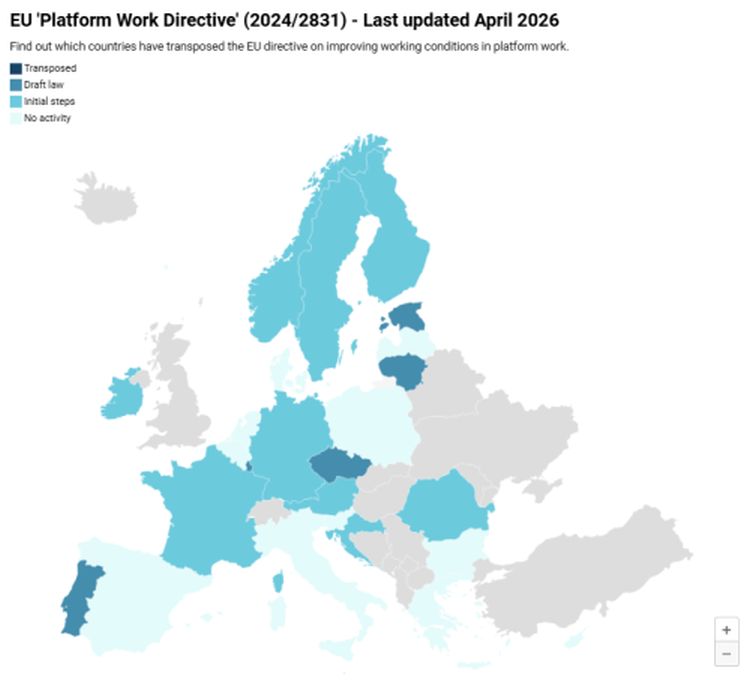
How are countries progressing with transposition?
The content of this article is intended to provide a general guide to the subject matter. Specialist advice should be sought about your specific circumstances.
[View Source]