
- with Senior Company Executives, HR and Finance and Tax Executives
- in Canada
- with readers working within the Accounting & Consultancy and Business & Consumer Services industries
Introduction
Sex workers provide services ranging from phone-sex operators, erotic dancers, sex-toy makers, and strip-club managers to pornographic actors, webcam models, and escorts. All self-employed Canadian sex workers have one thing in common, however: tax. In particular, a self-employed Canadian sex worker who earns enough revenue must register for a GST/HST number and start charging GST/HST (or the applicable provincial equivalent, like HST) on services provided or goods sold to clients, exactly as any other self-employed business owner must.
This article discusses the GST/HST obligations of self-employed Canadian sex workers carrying on business through a sole proprietorship, partnership, or private corporation, and closes with tax tips on claiming input tax credits, avoiding director’s liability, and correcting past non-compliance through the Voluntary Disclosures Program. This piece focuses specifically on GST/HST; for the income tax side, including personal filing obligations and deductible business expenses, see our companion article on income tax and GST obligations of Canadian sex workers on TaxPage.com.
Sex Work as a Taxable Supply and the Requirement to Register for GST/HST
Section 165 of the Excise Tax Act imposes GST/HST on “every recipient of a taxable supply made in Canada.” A “taxable supply” is the provision of property or a service in the course of a commercial activity, or in plain English, the sale of goods or services. This captures most business transactions, including the exchange of sexual services for financial gain.
The obligation to pay GST/HST falls on the person who receives the good or service; the obligation to collect the tax falls on the supplier. A supplier need not collect GST/HST if earning less than $30,000 in gross revenue over the previous four consecutive calendar quarters. But a self-employed sex worker earning $30,000 or more in worldwide gross revenue must register for a GST/HST number, charge GST/HST on goods and services provided, collect that tax, and remit it to the CRA. Registration is generally required within 29 days of crossing the threshold. Our guide to GST/HST registration requirements covers the registration process and the narrow exceptions to it in more depth. Failure to register and collect GST/HST when required does not eliminate the liability; it simply means the sex worker may owe the uncollected tax out of pocket, on top of penalties, interest, and, in serious cases, prosecution for tax evasion.
Registering also means a bookkeeping system has to be put in place, and the business becomes subject to a GST/HST audit by the CRA like any other registrant. If the sex worker paid GST/HST to business vendors, those amounts can be claimed as an input tax credit (ITC), reducing the net GST/HST payable to the CRA.
GST/HST Filing Requirements for Self-Employed Sex Workers
If obligated to register, a sex worker must file GST/HST returns for each reporting period, even if the worker earned no revenue during that period or had no net GST/HST payable. The length of a reporting period depends on annual revenue during the last fiscal year: a business earning $1.5 million or less may choose an annual, quarterly, or monthly reporting period; a business earning over $1.5 million but not more than $6 million may choose quarterly or monthly; and a business earning over $6 million must file monthly.
- If the reporting period is monthly, the return and net GST/HST payable are both due by the end of the following month.
- If the reporting period is quarterly, the return and net GST/HST payable are both due within one month of the end of the quarter.
- If the reporting period is annual and the business is incorporated, the return and net GST/HST payable are both due within three months of the fiscal year-end.
- If the reporting period is annual and the business operates as a sole proprietorship, the return itself is due by June 15 of the following year, but the net GST/HST payable is due earlier, by April 30, matching the personal income tax payment deadline. Assuming both dates line up is a common and avoidable source of interest charges.
A sex worker with relatively few GST/HST-bearing business expenses may also want to consider the Quick Method of accounting, an optional simplified method that allows a registrant to remit a fixed percentage of GST/HST-included revenue rather than tracking and claiming ITCs on individual purchases. It is not the right choice for everyone, since a registrant with substantial GST/HST-bearing expenses, commercial rent or equipment purchases, for example, may recover more through the regular ITC method.
Filing late where an amount is owing triggers a civil failure-to-file penalty under section 280.1 of the Excise Tax Act, generally 1% of the amount owing plus an additional 0.25% for each complete month the return remains outstanding, up to a maximum of about 4%, on top of daily compounded interest at the prescribed rate. This applies regardless of intent, and it is the penalty regime most registrants who fall behind actually encounter, as distinct from the more serious criminal failure-to-file offence under subsection 326(1), which can result in a fine of up to $25,000 or up to 12 months’ imprisonment where a return is not filed at all despite being required. Our article on penalties under the Excise Tax Act for GST tax fraud covers both the civil and criminal consequences of falling behind on GST/HST filings in more depth.
Director’s Liability for the Unremitted GST/HST of an Incorporated Sex Work Business
A corporation is a separate legal entity: its obligations, rights, and liabilities generally do not extend to its shareholders, directors, or employees. But a sex worker who owns and operates an incorporated business should know that the CRA can pursue the corporation’s director personally for the corporation’s unremitted GST/HST. Subsection 323(1) of the Excise Tax Act confers vicarious liability on “the directors of the corporation at the time the corporation was required to remit,” and each director becomes jointly and severally liable for the corporation’s unremitted GST/HST once the CRA has attempted, without success, to collect from the corporation itself.
Two protections limit this exposure. First, under subsection 323(3), a director is not liable if the director exercised the degree of care, diligence, and skill to prevent the failure that a reasonably prudent person would have exercised in comparable circumstances, a due diligence defence that is harder to make out than it sounds. Our case commentary on Hall v The King, 2023 TCC 158 covers a recent example where the Tax Court found a director personally liable because the due diligence defence was judged insufficient on the facts. Second, under subsection 323(5), the CRA cannot assess a director for a corporation’s GST/HST arrears more than two years after the person last ceased to be a director. A sex worker may limit exposure by resigning as director, starting that two-year clock, but the resignation must meet the requirements of the governing corporate statute and actually be communicated to the corporation. Our case commentary on Cliff v The Queen, 2022 FCA 16 covers a director who was held liable specifically because she could not prove that a signed, written resignation had been sent to the corporation. A more recent decision, Stevens v The King, shows both defences failing in the same case: a director assessed for over $700,000 in unremitted GST/HST claimed he had resigned years earlier and, alternatively, that he had exercised due diligence by delegating the corporation’s finances to someone else. The Tax Court rejected both arguments, finding his resignation could not be objectively verified, since there was no acknowledgement of receipt, no corporate record of it, and no explanation for why he never mentioned it to the CRA until years later, and finding that passively delegating tax compliance to someone else without any oversight or follow-up did not amount to due diligence. Our more detailed guide to GST/HST director’s liability covers both defences in greater depth.
“Incorporating without understanding director’s liability is one of the more common mistakes we see across every industry, not just this one,”
says David J. Rotfleisch, founding tax lawyer and CPA at Rotfleisch & Samulovitch, and a Law Society of Ontario Certified Specialist in Taxation. “But the stakes are the same either way: if you’re the sole director of a corporation that falls behind on GST/HST, resigning on paper after the fact rarely helps, and neither does assuming your bookkeeper or accountant has it covered. The courts have been very clear about that.”
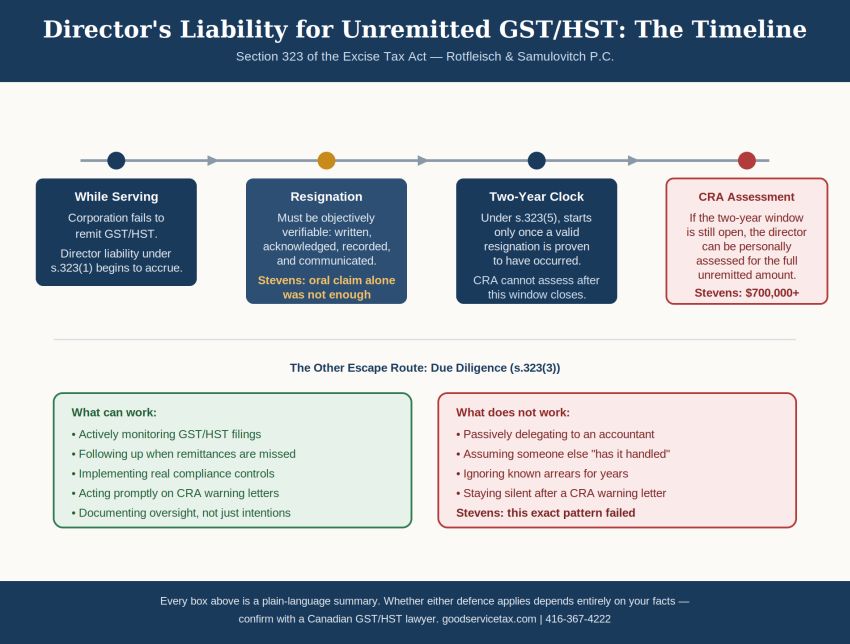
Figure: The director’s liability timeline under section 323 of the Excise Tax Act.
Pro Tax Tips – Claiming Input Tax Credits, Avoiding Director’s Liability, and Correcting Non-Compliance
A sex worker may reduce net GST/HST payable to the CRA by claiming ITCs equal to the GST/HST paid to commercial suppliers. Depending on the nature of the business, this can include the GST/HST paid on commercial rent, internet service, business-related cell phone use, costume and wardrobe purchases, production or camera equipment for content creation, advertising, or renovations to a dedicated business space. To qualify, the sex worker must have been a GST/HST registrant during the period the tax was paid or became payable, and must retain documentary evidence substantiating the claim, the same requirements that apply to any other registrant claiming an ITC.
If serving as a director of a corporation with GST/HST debts, review the due diligence and two-year limitation protections above with a tax lawyer before assuming either one automatically applies; both turn heavily on the specific facts, as Hall, Cliff, and Stevens illustrate, and delegating tax responsibility to someone else is not, on its own, a defence. And where past non-compliance, whether unregistered periods, uncollected tax, or unremitted amounts, has already occurred, the CRA’s Voluntary Disclosures Program can provide relief from penalties and, in appropriate cases, protection from criminal prosecution, provided the disclosure is made before the CRA contacts the taxpayer about the same non-compliance. Our updated guide to the Voluntary Disclosures Program covers the rules that took effect October 1, 2025.
“The tax obligations here are no different from any other self-employed business, but the stigma around the industry means a lot of sex workers either don’t realize GST/HST applies to them at all, or assume the CRA won’t come looking,”
says David J. Rotfleisch, founding tax lawyer and CPA at Rotfleisch & Samulovitch, and a Law Society of Ontario Certified Specialist in Taxation. “Neither assumption holds up. The CRA doesn’t distinguish based on the nature of the business when it comes to enforcing registration and remittance obligations, and getting ahead of a compliance gap voluntarily is always a better position than waiting to be caught.”
Takeaway
A self-employed sex worker’s GST/HST obligations track those of any other self-employed business owner: register once gross revenue reaches $30,000, charge and collect GST/HST, file returns on the assigned schedule, and claim ITCs on legitimate business expenses with proper documentation. The added risk for those operating through a corporation is director’s liability for unremitted amounts, a risk that a valid resignation and genuine due diligence can limit but not always eliminate. Where past compliance has already fallen short, the Voluntary Disclosures Program is generally the safer path forward, provided it is used before the CRA identifies the shortfall independently.
Originally published July 8th, 2020
Last Updated: August 17, 2026