

AI is everywhere. It’s being tested, approved, and rolled out across organizations.
Inaccurate and hallucinated outputs continue to surface, and legal and professional consequences make headlines. Earlier this year, the Georgia Supreme Court suspended a prosecutor after AI-generated fake citations appeared in a court filing, leading the court to vacate the ruling entirely.1
It’s becoming widely understood that generic AI isn’t built for high-stakes environments. The conversation has shifted to secure, approved systems as the path forward.
According to Grant Thornton’s 2026 AI Impact Survey, 78% of executives lack confidence they could pass an independent AI governance audit within 90 days.² Organizations are responding accordingly.
Security teams are involved.
Policies are in place.
Vendors are being vetted.
And still, something is missing.
The Assumption
There’s growing confidence in how AI is being deployed. The risks feel understood and, more importantly, managed.
Once the right checks are in place, the conversation moves on.
If it’s secure, it’s safe.
If it’s approved, it’s reliable.
That’s the assumption.
It just isn’t where reliability is established.
Where It Breaks
The issue shows up after the output is generated.
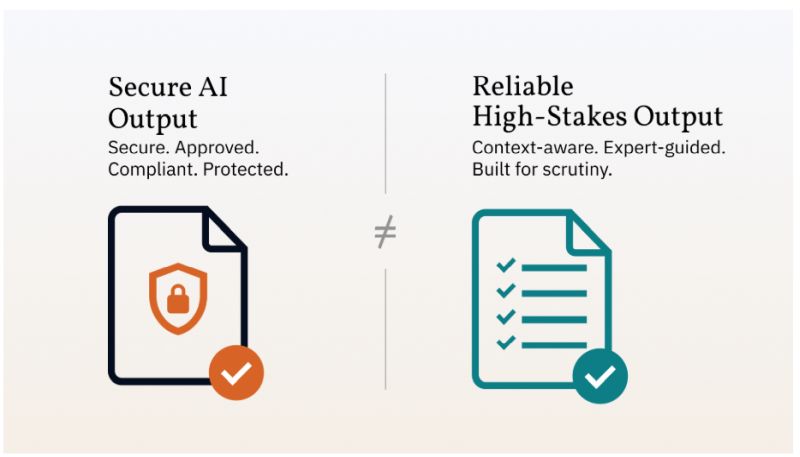
A system can meet every security requirement, with data protected and processes controlled, and still fall short of what’s needed to stand up under scrutiny.
In high-stakes environments, that’s the risk that matters. Not just access or exposure, but whether the output reflects the right context, standards, and intent.
Because without context, outputs can look correct, read clearly, and still miss what actually matters.
A regulatory filing can use technically correct language and still fail to align with jurisdiction-specific requirements, internal standards, or the intent behind the disclosure.
The system lacks the understanding required to get the work right at this level.
The Shift
Security has always been part of the equation. It protects the process.
But it doesn’t determine whether the output can be relied on.
In high-stakes environments, that comes down to something else entirely.
Context and domain understanding.
Systems need to reflect how your organization operates, including your terminology and expectations.
That’s the shift.
From tools that generate outputs to systems that understand the work.
Systems that reflect your context and standards, and are guided by professionals who understand the domain, the nuance, and what’s at stake.
Generic AI can generate outputs. It does not produce outputs that can be relied on in high-stakes work.
That’s the limitation. Because the work demands more than a surface-level answer. It requires systems built on domain expertise.
Expertise that takes years to build.
And in high-stakes environments, there’s no shortcut to it.
That’s what Apertera is built on.
More than two decades of expertise in high-stakes work.
So you produce what stands up under scrutiny.
Frequently Asked Questions
Security protects data and processes, but it doesn’t ensure the output reflects the right context, standards, or intent. In high-stakes environments, reliability depends on more than security.
Reliable outputs require systems that reflect your organization’s context, terminology, and expectations, guided by domain expertise and professional oversight.
By using systems designed to learn and adapt to their workflows, with domain expertise built in and processes that ensure outputs align with internal standards.
Sources
1 – Atlanta News First
2 – Grant Thornton’s 2026 AI Impact Survey
The content of this article is intended to provide a general guide to the subject matter. Specialist advice should be sought about your specific circumstances.
[View Source]