
- with Senior Company Executives, HR and Finance and Tax Executives
- in Canada
- with readers working within the Accounting & Consultancy and Business & Consumer Services industries
Download a PDF copy of this Blog here.
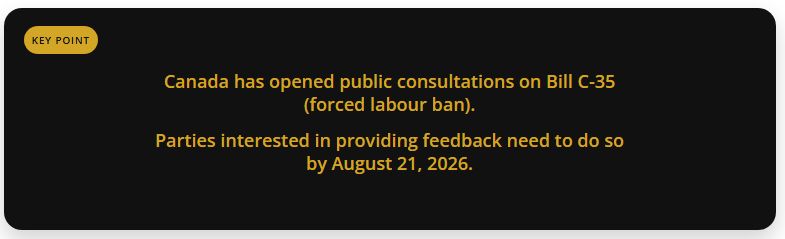
We have previously written about Canada's draft forced labour laws in Bill C-35 here . Canada has now launched public consultations with respect to Bill C-35, with the consultation period remaining open from July 27 to August 21, 2026.
In this Customs & Trade Report, we review the key details importers need to know regarding the public consultations on Bill C-35.
Background on Bill C-35
Canada already has certain forced labour legislation in the Fighting Against Forced Labour and Child Labour in Supply Chains Act, which requires certain entities to file annual reports detailing steps taken to prevent/reduce the risk of forced labour being used in their supply chains. The importation of goods produced wholly or in part from forced labour is also prohibited under tariff item no. 9897.00.00 and s. 136 of the Customs Tariff.
The United States Government, in a United States Trade Representative report in June of 2026, criticized Canada's forced labour regime and threatened tariff action, prompting the Canadian government to table Bill C-35 in Parliament. The aim of Bill C-35 is to implement a stronger forced labour ban at the border.
It is likely the Government of Canada will prioritize moving Bill C-35 in Parliament in light of US concerns about the inadequacy of Canada's current forced labour regime, and also to help ease tensions in the broader Canada-US trade dispute.
Public Consultations on Bill C-35
The public consultation period on Bill C-35 will take place from July 27 to August 21, 2026, and will proceed in two parallel tracks.
The first track will involve Global Affairs Canada ("GAC") seeking stakeholder feedback on the "approach, evidence, criteria, and methods for identifying goods suspected of being produced with forced labour". Those goods will ultimately be the ones placed on the list established by the Minister under s. 6(1) of Bill C-35. Moreover, GAC is also seeking input, along with the Canada Border Services Agency ("CBSA"), on the information importers of those listed goods would be required to provide to the CBSA under Bill C-35 (current s. 8 of Bill C-35).
The second track of consultations is being handled by Employment and Social Development Canada's ("ESDC") Labour Program, which is seeking input "on possible supply chain due diligence measures that would require Canadian businesses operating abroad to identify, prevent, address and remediate risks to fundamental labour rights across their operations and supply chains". ESDC is also seeking input from Canadians on potential civil liability provisions relating to the same issues.
Takeaways
The public consultation period for Bill C-35 is a short window of 25 days, so parties interested in participating will need to be diligent in submitting their feedback to GAC or ESDC.
Parties seeking to make more technical legal representations during the public consultation period should also consider contacting Experienced Customs and Trade Counsel for assistance prior to submitting their feedback to GAC or ESDC.
The content of this article is intended to provide a general guide to the subject matter. Specialist advice should be sought about your specific circumstances.
[View Source]