

Key Takeaways
- Federally regulated private businesses (FRPBs) may face new administrative obligations, including registration, reporting requirements and, in some cases, the creation of committees to support the use of French in the workplace.
- FRPBs must meet employee thresholds to be subject to the UFPBA, with different thresholds for Québec and regions with a strong Francophone presence (RSFPs).
- Consumers in Québec or RSFPs have the right to receive services in French from FRPBs, while employees have the right to work and communicate in French within these businesses.
On April 15, 2026, the federal government tabled draft regulations on the use of French in Federally Regulated Private Businesses (proposed regulations).1 These proposed regulations follow the enactment of the Use of French in Federally Regulated Private Businesses Act (UFPBA),2 which received royal assent on June 20, 2023. As explained in our previous articles on Bill C-13, the UFPBA imposes new language rights obligations on federally regulated private businesses (FRPBs). Although the UFPBA has been passed by Parliament, it is not yet in force. It will be brought into force by order-in-council in two stages: first in Québec, and then two years later in regions with a strong Francophone presence (RSFPs).
The proposed regulations are intended to give effect to the UFPBA by setting out the details of its application. They specify the businesses and regions covered and the rights of consumers and employees with respect to services and work in French. They also set out the corresponding administrative obligations. In Québec, where businesses may choose to apply the UFPBA or the Charter of the French Language, the proposed regulations will harmonize the two regimes. Specifically, they propose aligning certain exemptions under the new federal regime with those under the Québec framework to ensure greater regulatory consistency.
Scope of application: businesses and regions covered
A business’s subjection to the UFPBA depends on whether it meets a minimum employee threshold, which varies by region. In Québec, it includes all FRPBs with 25 or more employees. In RSFPs outside Québec, the threshold will be set at 100 or more employees across Canada. In both cases, the threshold is calculated based on the number of employees as of January 1 of the previous year. This gives employers a predictable reference date for determining their status.
RSFPs will include the entire province of New Brunswick; the Yarmouth, Digby and Richmond census divisions in Nova Scotia; the Stormont, Dundas and Glengarry, Prescott and Russell, Ottawa, Nipissing, Sudbury, Greater Sudbury, Timiskaming and Cochrane census divisions in Ontario; 21 census tracts located in the eastern and southern portions of Winnipeg in Manitoba;3 and the census tract that encompasses the University of Alberta’s Campus Saint-Jean in Edmonton.
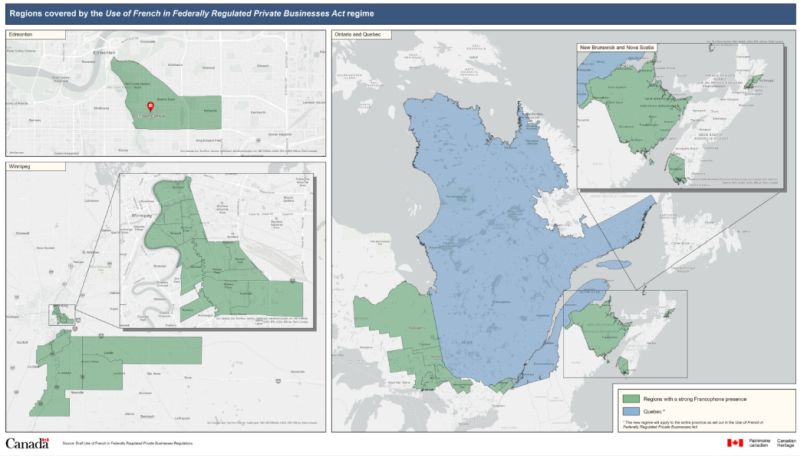
Map of the regions where the UFPBA regime will apply4
Choice of regime and obligations of FRPBs
In Québec, FRPBs will be able to choose between the federal regime (UFPBA) and the provincial regime (Charter of the French Language). Those already registered with the Office québécois de la langue française can keep their status if they notify the Minister of Canadian Heritage (Minister) in writing. Those that opt for the federal regime, however, will have to file an initial declaration describing their operations in Québec, and update it annually. The Minister will then issue a certificate of registration.
In RSFPs outside Québec, except for New Brunswick, FRPBs will have similar obligations. They must file an initial declaration describing their operations and update it annually. The Minister will then issue a certificate of registration. These businesses must also provide additional information, including the addresses of their points of service, workplaces and websites, their social media platforms, and their telephone numbers.
Consumer rights to services in French
The UFPBA guarantees that every consumer located in Québec or in an RSFP has the right to communicate in French with, and receive services in French from, FRPBs operating in that region. Businesses will therefore need to actively inform their customers of this policy at all points of service in Québec or an RSFP. In Québec, French must be markedly predominant over other languages on commercial signage. However, these rights do not preclude consumers from communicating in English or another language if the business can provide services in that language.
These obligations will apply to interprovincial passenger transportation by aircraft, coach, train or ferry, whether originating in or terminating in Québec or an RSFP. International routes will be excluded.
Employee rights and language of work
The UFPBA will grant employees who occupy a position in a workplace located in Québec or an RSFP the right to work and be supervised in French. These employees also have the right to receive all relevant communications and documents from their employer in French, including employment contracts, offers of employment, training documents, collective agreements, and notices of termination of employment. However, the use of another language will remain possible with mutual agreement between the employer and employee.
The proposed regulations clarify the definition of “employee”, which includes a person placed by a temporary help agency. The proposed regulations also exclude any means of transportation from the definition of “workplace.”
The UFPBA will require businesses to establish a committee to support the management group in fostering the use of French in the workplace. In Quebéc, this requirement applies to FRPBs with 100 or more employees. In the RSFPs, it applies to businesses with at least 100 employees across all RSFPs and 500 employees across Canada. The committee must be established within six months of the business becoming subject to the UFPBA. It must meet at least twice a year and be composed of an equal number of employer and employee representatives. The committee must also produce a triennial report detailing the measures taken to carry out its mandate.
When developing these measures, the committee must consider the unique circumstances of certain employees, including those approaching retirement, those with at least 20 years of service with the same employer, and those with long-term or recurring physical, mental or learning impairments that could hinder their ability to learn French despite the accommodations in place.
In Québec, the committee must provide an overview of the language situation in the business to obtain a certificate of generalization of the use of French. If the certificate is denied, the business will have one year to document its progress and submit a new report. The certificate may be suspended or revoked if the use of French ceases to be generalized.
Exemptions
Some FRPBs will be excluded from the scope of the UFPBA. This includes broadcasting undertakings, federal institutions and Crown corporations that are already governed by the Official Languages Act, Indigenous organizations, businesses operating in an Indigenous territory, and entities whose activities are exclusively related to the production or distribution of cultural property in a language other than French.
Other, more targeted exemptions will affect only the language-of-work obligations. These exemptions will apply to FRPBs whose activities are exclusively related to international business in which the use of a language other than French is predominant. They will also apply to workplaces that are governed by research protocols or international standards that require the use of a language other than French. To qualify for one of these exemptions, businesses must inform the Minister of that intention in the first instance and every five years thereafter.
Conclusion
The tabling of the proposed regulations is a significant step toward the implementation of the UFPBA. The proposed regulations specify the thresholds for coverage, the rights of consumers and employees, and the language obligations in the workplace. They also establish the framework that FRPBs must incorporate into their operations in Québec and the RSFPs. Before adoption, the proposed regulations will be published in the Canada Gazette, opening a 30-day consultation period.
Although the UFPBA’s effective date is still unknown, FRPBs operating in Québec and RSFPs should start preparing for these changes now. We are available to help you analyze your obligations and prepare for this new legislative and regulatory framework.
Footnotes
1 See also the news release from the Department of Canadian Heritage dated April 15, 2026.
2 Use of French in Federally Regulated Private Businesses Act, SC 2023, c 15, s 54.
3 The areas around St. Boniface, Norwood, Norwood East, Glenlawn, Niakwa Park, Maginot, Windsor Park, Niakwa Place, Norberry, Southdale and Lorette, Îles des Chênes, Landmark and St. Adolphe.
4 This map is taken from a publication by the Department of Canadian Heritage dated April 15, 2026, Federal language laws: Modernization and new obligations.
The content of this article is intended to provide a general guide to the subject matter. Specialist advice should be sought about your specific circumstances.
[View Source]
