

Introduction
Building wealth takes years of discipline, sacrifice, dedication and intentional decisionmaking. Without a clear estate plan, succession challenges can erode a person’s legacy and result in the dissipation of assets. This is particularly relevant in Nigeria, where customary land tenure, overlapping legal regimes governing land, recurrent intestate succession disputes and multijurisdictional asset ownership create additional layers of complexity. To navigate this landscape effectively, two principal estate planning tools warrant careful consideration: wills and trusts. Although they are sometimes used interchangeably in conversation, they serve distinct purposes and operate differently in practice. Choosing the right mechanism can significantly influence how your estate is administered.
We increasingly see families adopt estate planning as wealth structures grow more complex. The bigger risk is not the absence of documents; it is relying on outdated wills or informal arrangements that no longer reflect current family or financial realities. This often contributes to avoidable disputes and delays in succession, underscoring the need for regularly reviewed and properly structured estate plans that reflect both present intentions and future contingencies.
This article explains the differences between these key estate planning tools so you can choose the one that best protects your legacy and supports your succession strategy.
Understanding Wills: What You Need to Know
A will is a legal instrument that comes into effect upon the death of a person, known as the testator, and sets out their final wishes regarding the disposition of their properties and assets. It can cover current and future property and empowers the testator to distribute their estate to chosen beneficiaries according to their precise instructions. Beyond asset distribution, a Will can also serve as an instrument for issuing posthumous instructions, such as arrangements for the testator’s funeral, including burial locations and funeral procedures. Such provisions help to guide surviving family members and ensure that the testator’s last wishes are honoured.
Under Nigerian law, a will is valid only if the testator had the capacity to execute it at the time of execution, acted freely and without undue influence or coercion, and complied with all applicable statutory formalities. A valid will must also be signed by the testator and witnessed by at least two independent individuals who attest that it was executed voluntarily. These requirements help establish the authenticity of the document and provide safeguards against potential disputes or claims of coercion or incapacity. The testator may amend or revoke the will at any time during their lifetime, provided they remain of sound mind.
Aside from the witnesses, executors play a key role in this process. Executors administer the estate through probate, which validates the will and authorises them to act. They are either appointed by being expressly named in a will, impliedly through its provisions, or selected by a nominee who has been empowered to appoint the executors on behalf of the testator. In instances where a will does not specify an executor, the law provides that a competent court has the authority to designate one to administer the testator’s estate.
Understanding Trust Structures
A trust is a legal arrangement in which a trustee, who can be an individual or a legal entity, holds, manages, and ultimately distributes assets for the benefit of another party, known as the beneficiary. The settlor creates the trust, sets out the terms, appoints the trustee, and names the beneficiaries who will benefit from the trust. The trustee acts as custodian, managing and investing the assets according to the settlor’s instructions.
In Nigeria, trusts are broadly categorised into private trusts and public trusts. However, for estate planning purposes, private trusts are predominantly used. A private trust may be created during the settlor’s lifetime, often referred to as a ‘living’ trust or ‘inter vivos’ trust, or it may be established upon the testator’s death, following the directions set out in a will, commonly known as a testamentary trust. For a private trust to be considered valid and enforceable under Nigerian law, it must fulfil several essential criteria:
- Certainty of Intention: The settlor must exhibit an unequivocal intention to create a trust. This intention may be explicitly stated in a formal document or inferred from the settlor’s actions and conduct.
- Certainty of Subject Matter: The property or assets intended to form the trust must be identifiable at the time of the trust’s creation. If the property cannot be identified or is non-existent, the trust will fail.
- Certainty of Objects: The beneficiaries who are meant to benefit from the trust must be specifically identified or be ascertainable. Without a clear identification of the beneficiaries, the trust may be deemed void.
To create a trust, the settlor must transfer legal title to the trustee. This initial transfer is carried out through a binding instrument. For example, when real property is involved, a deed of assent is required to formally vest title in the trustee. However, for a testamentary trust that does not involve real property, the will’s provisions serve to transfer the property to the appointed trustees upon the testator’s death and after probate is completed.
Where trustees are individuals, they must be of legal age and have the requisite capacity to act. Trustees may also be trust corporations that are legally authorised to perform trustee functions. In a living trust, the settlor may serve as the initial trustee and retain the power to appoint additional trustees as required. A trustee may be replaced due to death, refusal to act, unfitness, court-ordered removal, discharge, or in any other manner provided in the trust instrument. Where necessary, trust property may be transferred by vesting declaration, conveyance to a new trustee, or a High Court vesting order.
Wills and Trusts: How They Differ
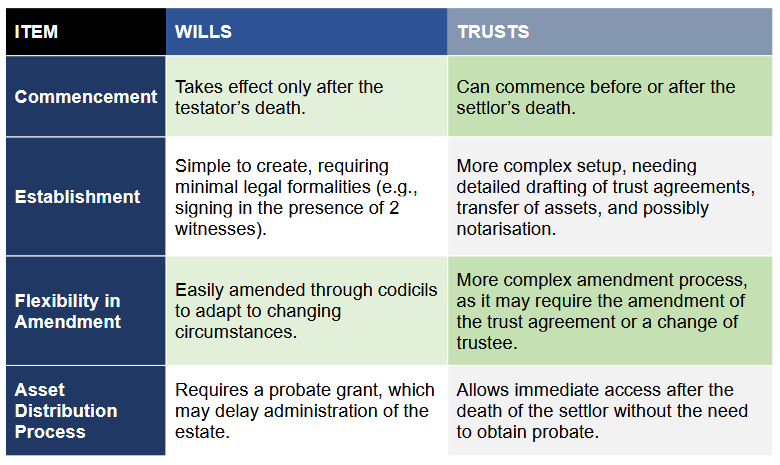
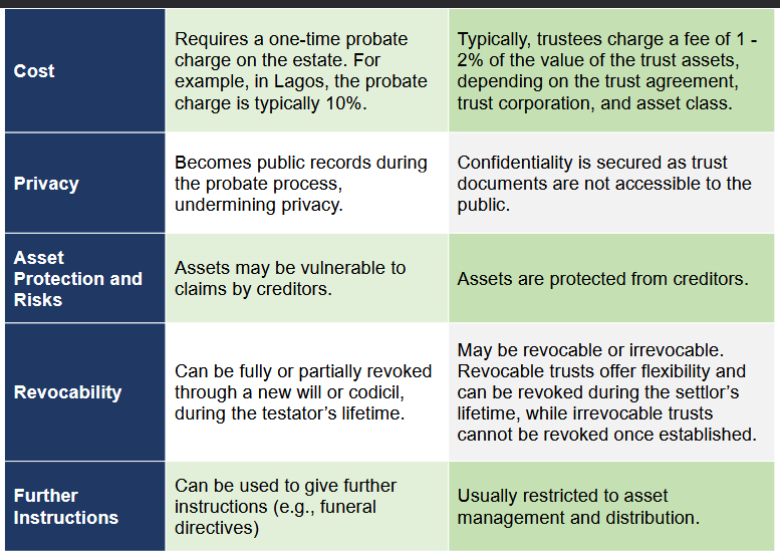
For estate planning purposes, wills and trusts are not mutually exclusive and often work best together as part of a coordinated strategy for giving effect to a person’s wishes. A will can transfer assets to beneficiaries, while a trust can manage those assets before and after death, setting out conditions, timing and structured distributions. This approach is particularly useful for minors, vulnerable beneficiaries and long-term asset preservation.
Unlike a will, which only takes effect after death and requires probate, a trust can operate during the settlor’s lifetime and beyond, providing continuous management, privacy, and control. Used together, they ensure a settlor’s legacy is both transferred and responsibly preserved for the future. We have set out the key differences between a will and a trust below:
To view the full article click here
The content of this article is intended to provide a general guide to the subject matter. Specialist advice should be sought about your specific circumstances.
[View Source]