

TCPAWorld and Troutman Amin, LLP are always at the forefront of telecom and TCPA.
You’ll notice, however, that while other firms were discussing the upcoming “nuclear” revocation ruling from the FCC we had stayed eerily silent on the subject. You probably wondered why.
Well we had it on pretty good authority that rule was not going to move forward but we couldn’t discuss publicly until now.
The FCC has just revealed the critical revisions to its TCPA revocation/opt out rules it has been working on– an they are massive and wonderful for callers and consumers alike.
The new rules align with common sense and assure a consumer’s expectations are followed and that a business can swiftly honor a valid revocation effort.
The new rule–which is set to be adopted at the September open meeting– will provide as follows:
- When a consumer opts out of an informational text campaign the opt out only impacts that specific type of informational message– not all messages as the “nuclear” rule was set to require;
- When a consumer opts out of a marketing message, however, all future marketing from that entity must cease; but
- Businesses can set an “exclusive” means to opt out (either via keyword or keypunch response) and need not honor any revocation request made via a different method.
Absolutely huge changes here. And critically important for businesses to understand how these rules will play out in the real world.
A little more color on each of these rules.
As to the “informational” message limitation callers may now “interpret a revocation request as applying only to the specific category of informational robocalls to which the revocation was directed and not all robocalls.” See ruling par. 10. Although the Commission uses the phrase “robocall” it applies equally to automated texts to the extent those messages are covered by 227(b). See fn 1.
However the Commission is clear that a response to a “marketing” message creates a revocation to all future marketing: “Revocation requests made in response to robocalls that contain an advertisement or constitute telemarketing revoke consent to all future robocalls containing an advertisement or that constitute telemarketing from that caller.” Notice this is framed as a CALLER specific revocation requirement– but one wonders whether it might extend to a party the caller is calling on behalf of. This is especially true as the commission goes on to state “we remind telemarketers that our rules require that a residential subscriber’s do-notcall request shall apply to the particular entity making the call (or on whose behalf a call is made), as well as affiliated entities if the consumer reasonably would expect them to be included. par. “Hmmm.
The best news for callers, however, is definitely the ability to use a designated opt out mechanism and to honor only revocations made through that opt out means: “Using an automated, interactive voice or key-press activated opt-out mechanism in response to a robocall, (2) using specific standardized words in response to an incoming text, and/or (3) using a website or telephone number provided by the caller to process opt-out requests, so long as the caller clearly and conspicuously discloses the designated method for revoking consent on the call or in the text. Callers that designate any of these three exclusive means to revoke consent will not be required to process revocation requests made by any other means.” Just fantastic–and common sense–stuff here.
These changes combined should really help make sense of the opt out rules for consumers and businesses alike. Most importantly these changes should CRUSH the frivolous TCPA litigation arising out of free form opt out requests.
Will be interesting to see how these new rule changes apply to existing litigation.
It appears the changes might be intended to be prospective only as the Commission notes “the revised rule amendments will become effective 30 days after Federal Register publication.” Still that’s great news because it means the rule modification to section 64.1200(a)(10) should supersede the delayed effective date of the relevant portion of that rule that was previously extended to January 31, 2027.
In other words–nuclear revocation is dead and common sense has returned to the TCPAWorld.
Want to thank the FCC and Chairman Carr for their great work on this.
And you will all notice that R.E.A.C.H.’s comment was cited SIX times in support of critical portions of the rule change– you’re welcome. 
If you’d like to join R.E.A.C.H. and help drive forward critical changes like these please do join at reachmbc.com.
Also the Commission has issued a new NPRM with several major additional changes– I break that down here.
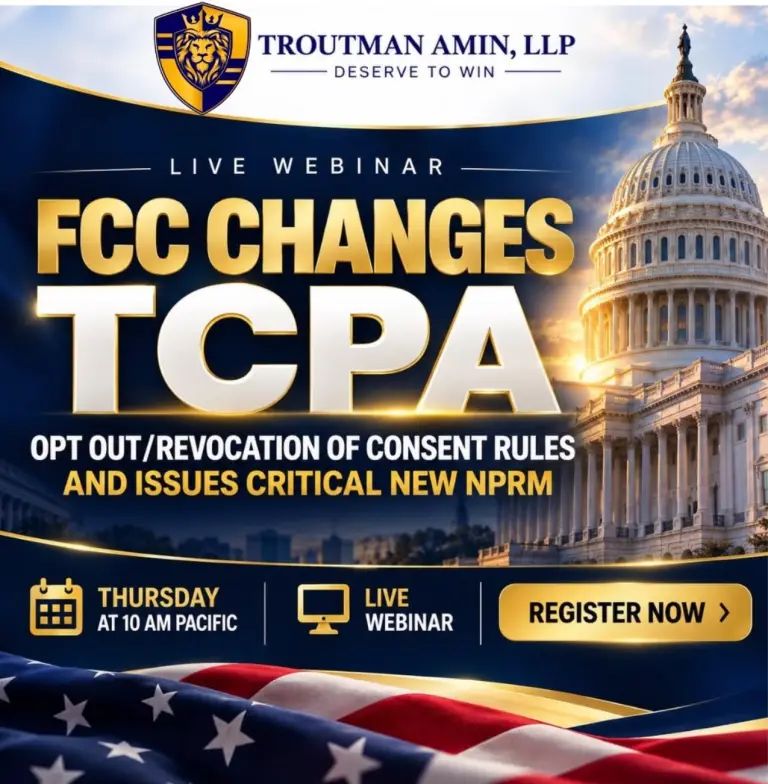
This Thursday (Sept. 17, 2026) at 10 am pacific Troutman Amin, LLP will be putting on a CRITICAL webinar you all should attend. Registration is FREE for the first 500 registrants and then $199.00 thereafter. So get in early and get in free.
See you then.
Full ruling here: Revocation Rule Change
Chat soon!
The content of this article is intended to provide a general guide to the subject matter. Specialist advice should be sought about your specific circumstances.
[View Source]