

- within Consumer Protection topic(s)
- in United States
- in United States
- with readers working within the Business & Consumer Services, Healthcare and Technology industries
- within Tax topic(s)
- with Finance and Tax Executives
Plaintiffs have been sending demand letters and filing lawsuits alleging violations of California’s Automatic Renewal Law (ARL), Cal. Bus. & Prof. Code §§ 17600 et seq., and the Consumers Legal Remedies Act (CLRA), Cal. Civ. Code §§ 1750 et seq. These demands focus on online checkout flows for recurring subscriptions where the company allegedly fails to provide the required “clear and conspicuous” disclosures about automatic renewal terms right next to the “PAY NOW” button. The letters and lawsuits often claim the business lacks an easy online cancellation method and fails to send a retainable post-transaction acknowledgment.
A representative example of one of these demand letters from Kevin J. Cole, Esq. of KJC Law Group is excerpted below. It states that the consumer signed up for a weekly subscription, but the checkout page did not display the five mandatory automatic-renewal disclosures in visual proximity to the consent prompt.
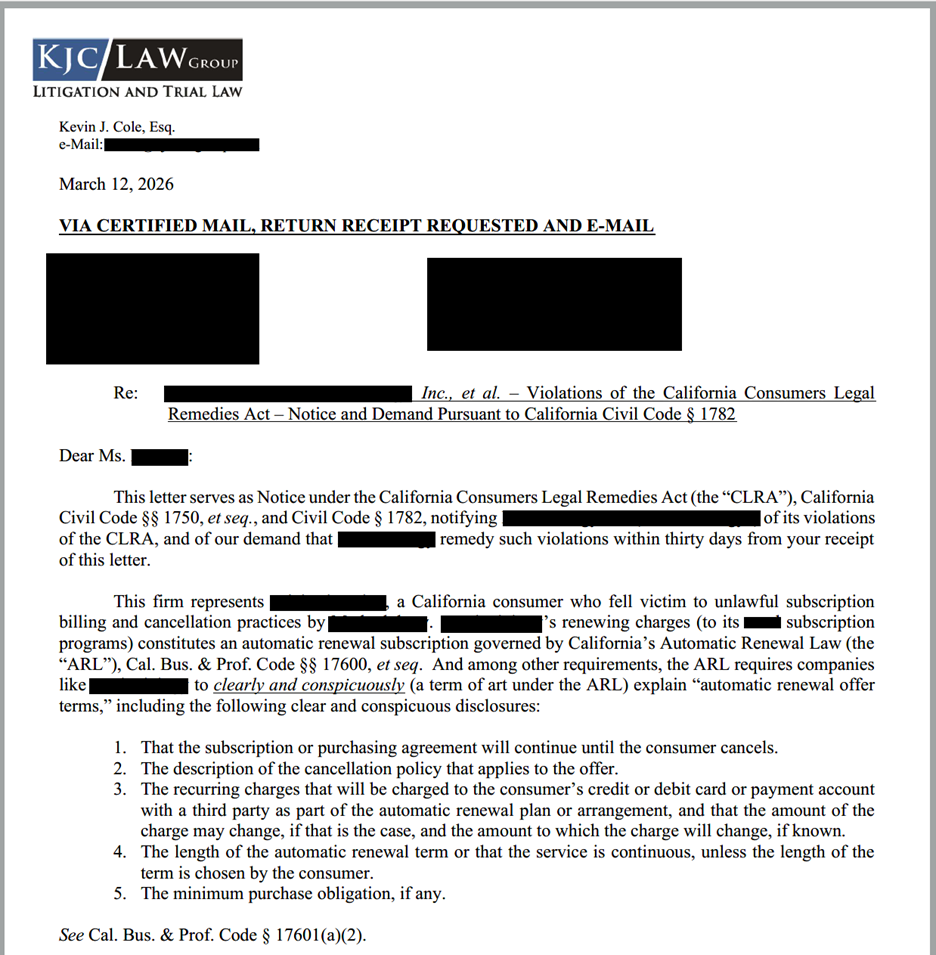
These demands are part of a steady influx of ARL-based claims targeting meal kits, streaming services, gym memberships, and other recurring subscription model businesses. While not every letter results in an immediate lawsuit, many do. Plaintiffs’ firms are leveraging the ARL’s strict technical requirements to support CLRA claims for restitution on behalf of statewide or nationwide classes.
ARL Law Basics:
California’s Automatic Renewal Law, enacted to protect consumers from surprise recurring charges, imposes precise obligations on any business offering a subscription or automatic renewal plan. Under Cal. Bus. & Prof. Code § 17601(a)(2), the business must clearly and conspicuously disclose:
- That the subscription continues until the consumer cancels;
- The cancellation policy;
- The recurring charges (and any changes);
- The length of the renewal term (or that the service is continuous); and
- Any minimum purchase obligation.
These disclosures must appear before the contract is fulfilled and in “visual proximity” to the request for consent (§ 17602(a)(1)). “Clearly and conspicuously” means larger type, contrasting font/color, or symbols that call attention to the language (§ 17601(a)(3)). The law also requires an easy-to-use online cancellation mechanism—either a prominent direct link/button in the account or an immediately accessible termination email (§ 17602(d))—and a retainable post-transaction acknowledgment containing the terms and cancellation instructions (§ 17602(a)(3)).
Failure to comply with any of these provisions can support a CLRA claim under §§ 1770(a)(5) & (14) for unlawful or deceptive practices. Courts have recognized that ARL violations can form the basis for CLRA liability (see King v. Bumble Trading, Inc., 393 F. Supp. 3d 856 (N.D. Cal. 2019)). Statutory remedies under CLRA § 1780 include actual damages, injunctive relief, full restitution, attorneys’ fees, and punitive damages. Because the requirements are technical and strictly construed, even well-intentioned businesses using standard e-commerce platforms can find themselves exposed.
What California businesses should do if they receive an ARL/CLRA demand letter:
- Do not ignore it. These letters are the required 30-day notice under CLRA § 1782 and are designed to prompt swift action. Ignoring them can lead to a lawsuit being filed in California state or federal court, where the combination of restitution demands, class allegations, and fee-shifting creates significant exposure.
- Preserve evidence immediately. Capture screenshots and records of your current website checkout flow, subscription enrollment pages, confirmation emails, account settings, and cancellation options. Document all third-party payment processors and any consent language. Do not modify the live site in a way that could be construed as spoliation without first preserving the existing configuration. But it is a good idea to make corrections, if needed, to comply with the statute provided you preserve evidence of changes.
- Assess potential liability with experienced counsel. Key issues include:
- Whether the automatic renewal terms were presented in visual proximity to the “PAY NOW” button and met the “clear and conspicuous” standard;
- Whether affirmative consent to the recurring charges was obtained before billing;
- Whether an easy, exclusively online cancellation mechanism was available (prominent link/button or instant termination email);
- Whether a retainable post-transaction acknowledgment was sent; and
- The strength of any class-wide exposure or standing defenses.
- Consider proactive compliance steps. Many businesses are now conducting ARL-specific website audits to ensure disclosures appear immediately above or adjacent to the consent button in larger or contrasting type. Others are implementing one-click cancellation buttons in customer accounts, automated confirmation emails with cancellation instructions, and granular consent flows before the first charge. Updating terms of service or privacy policies alone is usually insufficient—compliance must be built into the purchase path itself.
- Evaluate settlement or defense strategy. If the claim has technical merit, early resolution can often be achieved with a full release, no admission of liability, and targeted website fixes. If the claim lacks merit or the exposure is limited, a strong defense—including a motion to dismiss if sued—may be the better path. Experienced ARL and consumer-defense counsel can evaluate the specific facts of your checkout process and recommend the most efficient response.
The content of this article is intended to provide a general guide to the subject matter. Specialist advice should be sought about your specific circumstances.
