

Introduction
Merger and acquisitions (M&A) in Europe and the Middle East have seen a marked slowdown in 2022 as corporate and financial acquirers turned cautious amid rising economic anxiety.
Dealmaking in the region dropped by 11% from January to October 2022, compared with the same period of 2021, according to MergerMarket data1 . Private equity-led activity took the biggest hit, falling by 23% in value in the period, and contributing heavily to the overall decline.
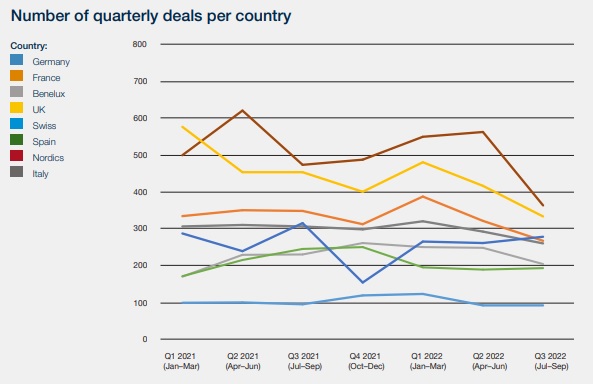
While M&A activity remained resilient in the first months of 2022, it lost momentum as macroeconomic conditions deteriorated throughout the year. This was reflected in the third-quarter numbers, which plunged sharply compared with the prior quarter.
Comparisons with 2021 – an extraordinarily robust year for M&A given the strong economic rebound following Covid and abundant liquidity in the market – should be made with caution.
However, there is no doubt that the M&A backdrop has changed fundamentally, with surging inflation, rising interest rates and a higher cost of financing applying the breaks to the acquisition frenzy of the past
If these challenges persist over the coming months, then we could see a more significant underperformance vis-à-vis the recent historic average. Conversely, an improved economic environment can quickly reverse this downward trend and put deal levels more in line with pre-pandemic years. In this article, we will explore the reasons behind the recent cooldown in deals, the key trends in the M&A market in 2022 and how they are likely to shape activity in 2023.
M&A Activity in 2022
Multiple economic and financial headwinds have complicated dealmaking globally in 2022. Europe in particular has been beset by its unique set of challenges, including a severe cost-of-living crisis, monetary tightening and the ongoing war in Ukraine. The latter has disrupted the supply chains and energy markets in the region more than in any other.
Official forecasts predict an even tougher period in 2023, with growth in the 19-nation euro zone projected to slow to 0.5%, from 3.1% in 2022 and 5.2% in 2021, according to the International Monetary Fund (IMF). Headline inflation is expected to remain stubbornly high in 2023, at 5.5% from an average of 8.1% in the previous year, according to the European Central Bank (ECB).
Another key deterrent to dealmaking has been the tightening of credit conditions, with banks pulling back the financing of leveraged buyouts amid rising interest rates and a broader risk-off environment. Leveraged loans issued to fund PE acquisitions have largely dried up across Europe and the Middle East. When available, the EBITDA multiples which can be financed have dropped, meaning a higher equity cheque and therefore reduced returns for PE houses. Large-cap deals have been particularly affected, dragging deal value numbers down.
By the numbers
This worsening backdrop for M&A was reflected in the third quarter figures more than in any previous quarter in 2022. Diclosed value of deals in the period dropped 35% compared with the third quarter of last year, according to MergerMaket data. In number of transactions, there was a 25% year-to-year decline.
Again, the slowdown in PE dealmaking was more pronounced than that of the overall market, with deals plunging 65% in value and 33% in numbers in the third quarter versus the same period of 2021. In comparison, corporate-led deals declined 12% and 16% over that quarter.
These numbers may suggest a healthier level of appetite among trade buyers compared to their financial sponsor counterparts. This could be partly explained by the difficulties faced in underwriting debt for the leveraged buyouts that sustain PE activity, as mentioned previously. In addition, the market dislocation may be creating more opportunities for corporate buyers – especially those with large cash reserves – to invest in assets seen as good strategic fits.
Examples of recent transactions completed by trade buyers include Thermo Fisher's acquisition of Nordic Capital-owned The Binding Site, a UK-based specialty diagnostic platform. In the mid-market, French glass manufacturer Verallia bought Allied Glass from PE house Sun European.
Looking at year-to-date2 overall numbers, M&A deals declined 11% in both value and volume compared to the same period last year, to €1.02 trillion and 3,639 transactions respectively.
Anecdotally, we saw a clear bifurcation in the M&A market in relation to the size of the deals, especially after the summer. Large-cap transactions have seen a sharp decline as public debt markets closed down, whilst mid-cap activity has proved more resilient. One of the main reasons for that is the availability of funding for smaller deals via cash-rich private credit funds.
The market dislocation may be creating more opportunities for corporate buyers – especially those with large cash reserves – to invest in assets seen as good strategic fits.
Countries & sectors
Dealmaking in specific countries has largely mirrored the region-wide trend, easing off considerably throughout 2022 compared with the previous year.
In the Middle East however, the number of deals decreased only slightly from 366 in the nine months to September 2021 to 343 in the nine months to September 2022. Companies in Israel, United Arab Emirates and Saudi Arabia were the most targeted by buyers, accounting for 54.2%, 20.7% and 9% of total deals in the region.
Middle East activity was positively impacted by the strong macroeconomic environment, as oil exporting countries benefited from recovery in oil prices post-Covid and the Russia-Ukraine conflict. Dealmaking also continues to be supported by regional governments' efforts to diversify their economy and shift away from dependency on oil, including fiscal reforms aimed at bolstering cooperation between the private and public sectors.
As the economic climate grew tougher, we observed that the majority of M&A activity across both Europe and the Middle East concentrated in recession-proof sectors including software & technology and healthcare. Infrastructure transactions have also been a bright spot.
For high-performing companies in those industries, high multiples are still available.
In other sectors, many sellers are still opting to wait out the market instead of selling at lower prices, leading to a growing number of pulled processes. However, more recently, we saw that slowly but surely the sell-side is starting to lower their price expectations, in line with the new deal environment.
Click here to continue reading . . .
The content of this article is intended to provide a general guide to the subject matter. Specialist advice should be sought about your specific circumstances.

