

- in Europe
- within Criminal Law and Environment topic(s)
- with readers working within the Aerospace & Defence and Insurance industries
Swiss Taxes in a nutshell
Switzerland offers a stable, predictable and internationally competitive tax environment shaped by its federal structure. Corporate and personal taxation is levied at federal, cantonal and municipal level, resulting in significant regional differences and, at the same time, planning flexibility for businesses and individuals.
For companies, Switzerland combines moderate effective corporate tax rates, targeted innovation incentives and a high degree of legal certainty. Even in the context of the OECD’s Pillar II minimum taxation, Switzerland remains attractive by shifting the focus from headline tax rates towards location-based promotion measures, including innovation, sustainability and talent development.
For private individuals, the overall tax burden depends heavily on the place of residence, with material differences across cantons for income and wealth taxation. At the same time, Switzerland maintains long-standing features such as the general exemption of private capital gains and the possibility of lump-sum taxation for qualifying individuals.
Overall, Switzerland continues to position itself as a reliable, competitive and future-oriented tax location for multinational enterprises, entrepreneurs and internationally mobile individuals.
Corporate Tax Overview
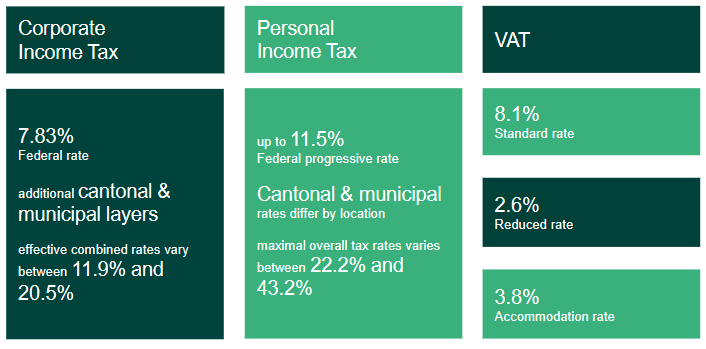
Switzerland’s corporate tax system combines a uniform federal corporate income tax with cantonal and municipal taxes, resulting in materially different effective tax burdens depending on location. The framework is complemented by innovation incentives, participation relief, and a practice-oriented ruling system. For larger groups, Pillar Two adds an additional layer of analysis.
The framework is further complemented by:
- Participation relief: to mitigate economic double taxation on qualifying dividend income and capital gains, • Innovation incentives: notably IP box regimes and R&D super deductions, where available, • Reorganisation and immigration step-up: allowing hidden reserves to be recognised tax-neutrally in certain inbound or restructuring scenarios and amortised tax-effectively over time, and • Financing and treasury structuring flexibility: subject to Swiss transfer pricing, withholding tax and thin-capitalisation considerations.
Pillar II – Minimum taxation for Multinational Enterprises (MNE's)
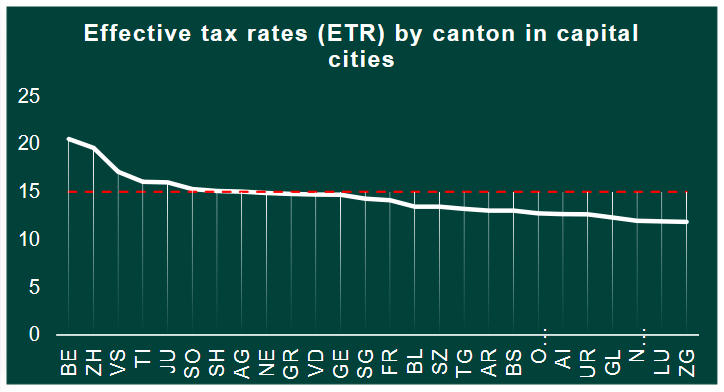
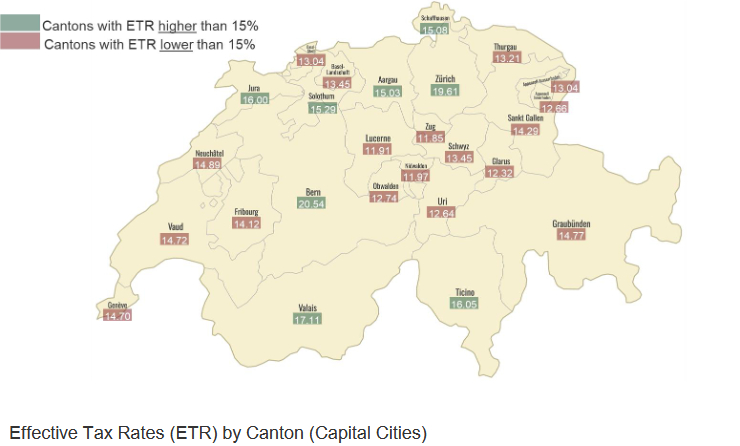
Pillar Two introduces a global minimum tax of 15% for multinational groups with consolidated revenues above EUR 750 million. Switzerland has implemented a Qualified Domestic Minimum Top-Up Tax (QDMTT) to ensure that any top-up tax on Swiss profits is collected domestically. Since 2025, Switzerland also applies the Income Inclusion Rule (IIR) to certain foreign subsidiaries held by Swiss parent companies.
Pillar Two changes how tax is collected - not why Switzerland remains attractive. In response, Switzerland is placing greater emphasis on broader location factors and non-fiscal competitiveness, including:
- Innovation & research
- Sustainability
- Infrastructure expansion
- Education & talent development
- Social & family-friendly frameworks
VAT - Quick Overview
Swiss VAT
Swiss VAT is a consumption tax applied to most supplies of goods and services in Switzerland. VAT is charged on domestic transactions, the import of goods, and the acquisition of services from abroad under the reverse-charge mechanism. The tax payable equals output VAT minus input VAT, allowing businesses to deduct VAT incurred on qualifying purchases.
VAT Rates
- 8.1% standard rate
- 2.6% reduced rate (e.g., food, medication, books)
- 3.8% special rate for accommodation
Key principle
Businesses must register for VAT unless their worldwide turnover from taxable supplies is below CHF 100,000.
What does it mean for Companies?
Location matters
Effective corporate tax rates are largely driven by cantonal and municipal taxes, not by the federal rate alone.
Reorganisations can be tax-efficient
Immigration step-up rules may allow hidden reserves to be recognised tax- neutrally upon relocation to Switzerland and amortised in later years.
Capital tax requires attention
While often creditable against income tax, capital tax remains a relevant factor in corporate structuring.
Administration supports execution
Switzerland generally offers a predictable and business-friendly tax administration, including established cantonal practice and practical implementation experience in cross-border and restructuring scenarios.
To view the full article click here
The content of this article is intended to provide a general guide to the subject matter. Specialist advice should be sought about your specific circumstances.
[View Source]
