
- with readers working within the Basic Industries industries
Discover how to avoid costly mistakes and leverage the latest EU developments to your advantage with our guide to EU registered and unregistered design rights and the Hague system for international design filings.
Design rights may not always have enjoyed the same prominence as patent and trademark registrations, but this has been quietly changing. The number of design filings is increasing year after year; in particular, through international filing systems, such as the Hague Agreement Concerning the International Deposit of Industrial Designs.
As Questel's Elena Galletti and Brandstock Legal's Rebeca Bonet covered in our recent webinar on how to 'Future-Proof Your EU Designs,' the Hague Agreement (along with the Paris Convention for the Protection of Industrial Property) represents a pivotal channel for brand owners, especially as new countries in Asia, Africa, and South America accede to the system.
The Hague System in Numbers
Design right registrations reached new heights in 2024, according to the annual review of the World Intellectual Property Organization (WIPO):
- +10.3% International applications (9,455)
- +5.7% International registrations (8,847)
- +11.7% Designations in international applications (43,028)
- +5.5% Designations in international registrations (39,074)
- +6.4% Renewals of international registrations (5,949)
- +8.8% International registrations in force (61,761)
- +6.8% Designs contained in international applications (27,161)
- +2% Designs contained in international registrations (25,759)
- +15.1% Designs contained in designations in international applications (118,667
- +0.7% Designs contained in designations in international registrations (103,882)
- +5.5% Designs contained in renewals of international registrations (22,986)
- +5.7% Designs contained in international registrations in force
(226,164)
Source: WIPO Hague Yearly Review 2025
The Hague System: Regional Filing Trends
Did you know? Applicants based in Europe file approximately 60% of the world's design rights, and many of those companies opt to file those rights via the Hague system, favoring its more uniform standard of protection, duration, formalities, and examination procedures, as well as its global reach. However, the Hague system is not only of interest to European organizations.
According to WIPO's latest report (released after the webinar), China surpassed Germany as the top applicant for the first time in 2024, followed by the United States, Switzerland, and Italy. It attributes the significant rise in Asia's share of designs in applications in 2024 over the last 10 years to the successive accession of the Republic of Korea in 2014, Japan in 2015, and China in 2022.
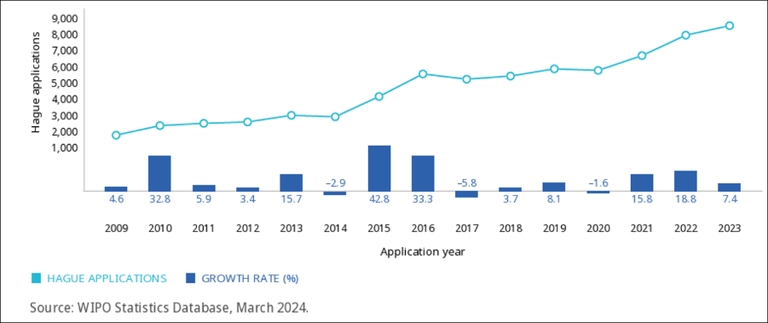
As a whole, Europe (EUIPO) also remains the most designated Hague member in international applications (followed by the UK and US), illustrating the continued significance of this market, including for the top applicants from 2022-2024: Procter & Gamble (US), Porsche (Germany), LG Electronics (Republic of Korea), Ferrari (Italy), and Huawei Technologies (China).
Class 12 (transport) remains the most popular class for registrations, followed by recording & communication equipment (class 14), household goods (class 7), furnishing (class 6), and packages & containers (class 9).
Using the Hague System: Three Tips for Applicants
Applicants can opt for the international Hague system (covering 96 territories, including the EUIPO and OAPI) or file a national/regional application (the so-called Paris route). Currently, roughly 40% of applications are filed via the Hague Agreement, and 60% via the Paris route.
- 1. International applications can be filed in English, French, or Spanish, although English remains the most popular language (90%).
- 2. International registrations are valid initially for a period of five years and can be renewed for at least two additional five-year periods. The maximum duration of protection in any Hague member's jurisdiction can vary according to its local law.
- 3. Applicants from non-member countries can file applications for international registrations, provided they have a real and effective industrial or commercial establishment within the jurisdiction of a Hague member state.
For our webinar, we asked Rebeca Bonet, Legal Manager at Brandstock Legal's Spanish Desk, to share the perspective of a qualified legal advisor, including how to meet the relevant registration requirements for design rights1.
Need-to-Know: What Is an EU Industrial Design?
—EU Definition: The appearance of the whole or a part of a product resulting from the features of, in particular, the lines, contours, colors, shape, texture, or materials of the product itself or its ornamentation (Article 2, European Design Reform).
—Key Characteristics:
- Visual nature only (not functional).
- Protects aesthetic aspects (visible features), such as shape, color, and materials.
- Must be novel and have individual character.
—Registration Requirements:
- Novel: Identical design must not have been made available to the public before the filing date.
- Individual character: The overall impression given to the informed user (regular consumer or professional) must differ from prior designs.
- Visible during normal use: For example, if a design applies to a component part, it must be visible to users during normal use.
- Formal requirements: Visual representation, product indication
(Locarno Classification), and fee payment.
—Unregistered (UEUD) Vs Registered (REUD) Design Rights:
- Unlike EU registered designs (which start from the registration date), UEUDs come into effect on their first disclosure in the EU.
- UEUDs last for three years, whereas REUDs can last up to 25 years (renewable every 5 years).
- REUDs provide a broader scope of protection (including intentional copying and independent creation); protection for UEUDs is limited to deliberate copying.
- REUDs provide evidence of registration and thus stronger enforceability; UEUDs require proof of disclosure and copying.
- The choice between UEUDs and REUDs will largely depend on the length of the product's lifecycle, intended speed-to-market, and budget constraints, versus the potential long-term value of the design and plans for commercialization or licensing.
How to Maximize Your Design Registrations
When considering maximizing geographical coverage, Rebeca discussed three strategic steps she recommends to clients:
- Start with an EU Design Filing
File with deferred publication (up to 30 months) covering all 27 EU member states. This establishes a confidential priority. - Assess Key Markets
Evaluate market interest, enforcement needs, and risk exposure during the six-month priority window. - Expand via Hague System
Use for streamlined international coverage. Choose national filings only when necessary.
The key benefits of this approach are cost efficiency (avoid unnecessary filings in irrelevant markets), tailored protection (match protection to actual business needs), business alignment (protection strategy follows commercial expansion plans), and time optimization (accelerate registration in priority markets).
Are You Planning to File Design(s) in 2026?
When we asked attendees of our 2025 webinar, 67% said that yes, they planned to file a design in the near future. What about you?
How Questel Can Support Your Design Activities
Questel offers several services and platforms to support design applications and portfolio management, including search, drawing, administrative support, and renewals.
—Design Search
Novelty is an essential requirement of design protection, so it's essential to keep ahead of existing and new design registrations, which is no mean feat given the number of designs hitting the market.
Using our powerful search platforms (Orbit Intelligence and Markify ProSearch"), our team of search specialists conducts preliminary (to define the scope) followed by detailed searches to compare designs to prior art.
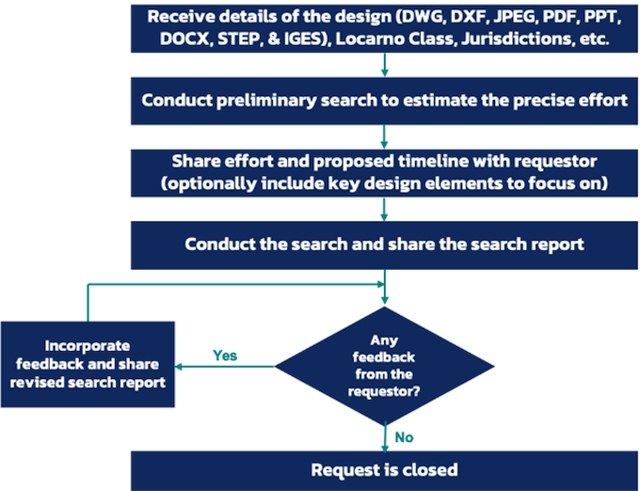
Results are typically delivered within two to three weeks, although urgent deadlines can be accommodated (see sample below). Choose between a Word or Excel file, including a ranked list of relevant documents (with PDF copies), bibliographic details of relevant search results, and search queries used.
5 Reasons to Choose Questel for Design Right Search
Before giving a legal opinion, filing an application, or defending against infringement, let us get you the quality search results you require! By choosing Questel, you can benefit from:
- #1. Our decades of expertise in searching designs in diverse Locarno/National Classifications.
- #2. Manual review of all the results in relevant classifications for exhaustiveness.
- #3. AI-powered image analysis in Markify.
- #4. A service tailored to your specific requirements.
- #5. A single point of contact, instruction, invoice...
Looking For a Do-it-Yourself Solution?
If you prefer to run design searches yourself, we also offer our global trademark and industrial designs search platform Markify as a software-as-a-service, meaning you can choose a do-it-yourself solution either as a subscription (ProSearch") or by ordering a one-off report (Comprehensive Search).
- Choose between subscription or pay-as-you-go options.
- Customizable reports with automatic ranking based on the level of risk.
- Powerful AI image similarity algorithm trained on real examples of conflicts.
- Via ProSearch" subscription, search industrial designs via Image and/or words in title/description, Locarno classes, designer, owner, dates...
- Search our Comprehensive database for designs, trademarks, domain names, business names, pharma-in-use, and social apps (modules are autonomous: pick up what you need).
EU Design Reform: In a Nutshell
The new European Design Regulation 2024/2822 (EUDR) came into effect on May 1, 2025, with differing timeframes for provisions that require implementing secondary legislation (including a key milestone on July 1, 2026, for new forms of digital designs, covering non-physical products, for example, digital products, interacting environments, and virtual reality designs).
The European Design Directive 2024/2823 (EUDD) came into force on December 8, 2024, but EU member states were given 36 months (i.e., until December 9, 2027) to transpose it into national legislation (which may include the administrative cancellation proceedings and the spare parts clause).
Three key terminology changes:
- 'European Union Designs' replaced 'Community Designs' to align with current EU trademark terminology.
- 'EU Design Courts' is the new name for the design courts, emphasizing their specialized role in EU design law.
- A new symbol Ⓓ was introduced for designs, similar to ® for trademarks.
A simplified application process:
- Multiple designs from different classes can now be filed in a single application.
- Up to 50 designs can be included in one application, regardless of product type.
- 3D views and digital formats are accepted, with no limit on the number of views.
—Design Drawing
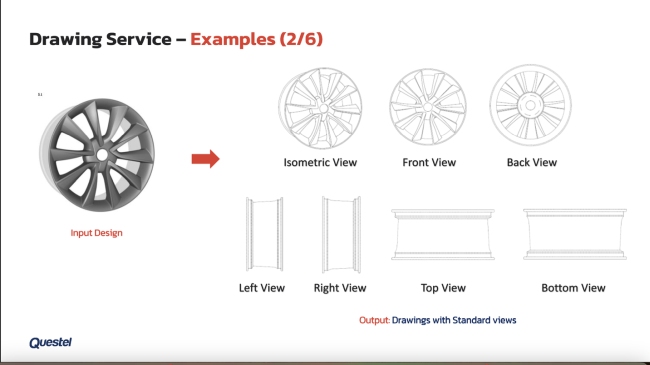
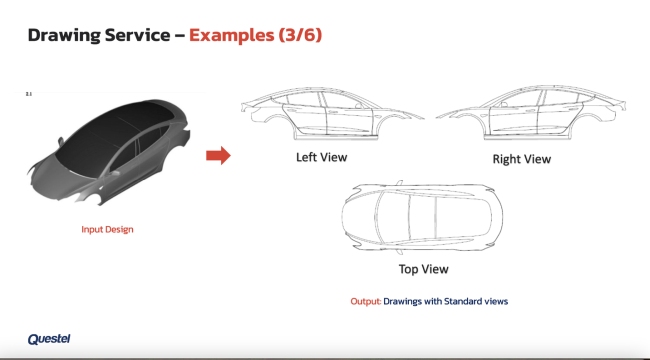
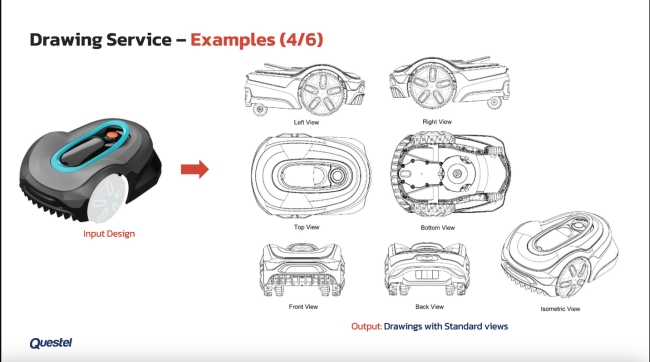
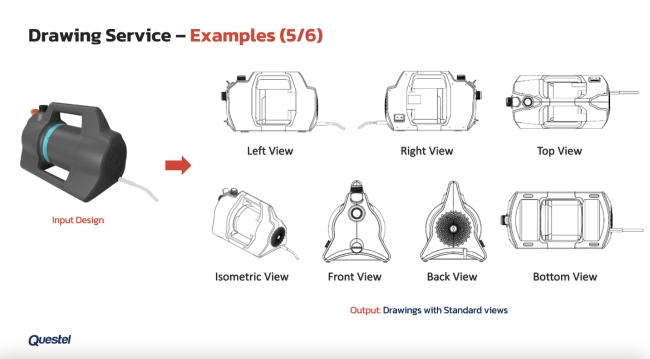
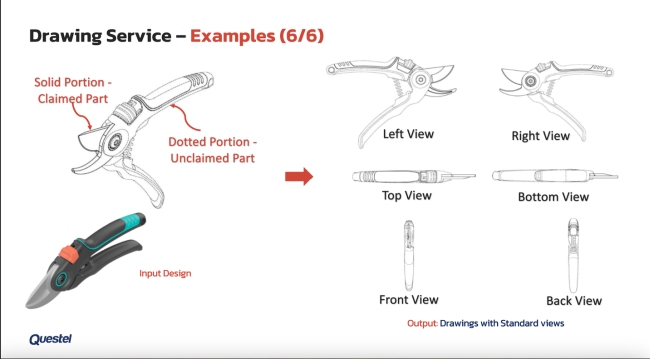
When it comes to drawings, we follow a tried-and-tested methodology:
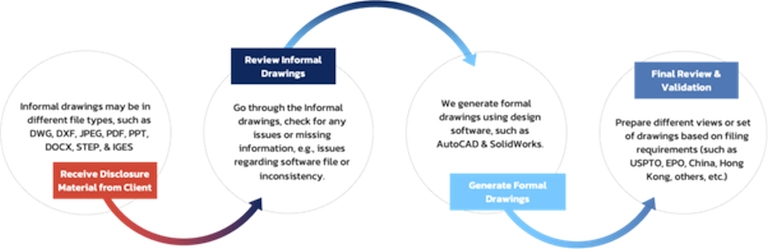
—> Input Required: Design (DWG, DXF,
JPEG, PDF, PPT, DOCX, STEP, & IGES)
—> Output: Design Drawing in PDF or JPEG
format that can be filed in Hague System (Line Drawings or
Photographs)
Our expert illustrators have worked on nearly 1,500+ design patent applications in the last five years. Your designated illustration team will support you until project completion, including handling any modifications required during prosecution or at any stage.
Benefit from added cost savings. We provide multiple sets of drawings that can be filed at the USPTO, EPO, CNIPA, Hong Kong IPD, and others at competitive pricing.
Drawing Service—Examples
Example 1
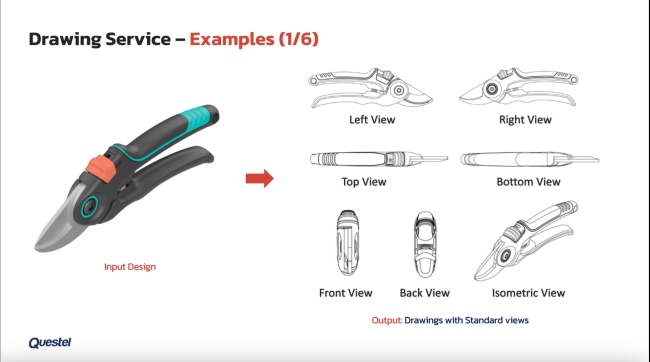
Example 2-6
—Administrative Support
Our full-time team of paralegals and administrative support specialists can alleviate your burden by taking responsibility for updating your IP management system (IPMS) or our Equinox IPMS with all relevant information, including filing and prosecution activities after design search and drawing.
Our team can monitor your mailbox, ensure your archive is in good shape, and make sure that all relevant tasks are performed within the relevant deadlines. They will keep track of all the updates on every single case, set reminders and specific reporting dashboards, and can also send instructions to your local partners on your behalf.
Read Our Case Studies in IP Administration
Discover three IP administration use cases that showcase the difference that Questel's IP administrative services can make to your internal processes and workload.
—Design Renewals
Our renewal services cover design rights, as well as patents, trademarks, and domain names, and the beauty of partnering with Questel is that we deliver worldwide coverage via a single point of contact.
Our dedicated team has decades of experience working solely on renewals:
- We can handle all maintenance formalities (affidavits, declarations of use) and recordals, as well as full portfolio data verification, as required.
- We offer a flexible choice of agents and billing solutions. We can work directly with our chosen agents or through our partner network, depending on your specific requirements.
- Our dedicated document service covers on-demand handling of notarization and legalization formalities, including translations.
- For ease of monitoring, our dedicated renewals platforms are available 24/7 and free of charge and can be connected to your IPMS (via secure API connection) for maximum efficiency.
- Due to economies of scale, we offer a very competitive and transparent pricing model, including ensuring that our quotes are up to date with the latest official fees.
- We can double-check all agent invoices for you and provide a consolidated invoice for easy budgeting.
Start Your Journey to IP Renewals Efficiency
Delegate your IP renewals with complete confidence that they will be handled on time and cost-effectively, with minimal demand on your resources. Questel offers a wide range of global IP renewal services; choose the level of support that best meets your needs.
Start future-proofing your EU design rights today by watching our dedicated webinar on EU designs or contacting our subject matter experts for tailored support.
Footnote
1. Questel does not provide any legal services. Legal services are provided by independent IP attorneys on the basis of a separate engagement agreement between you and, if you wish to, a partner IP attorney firm.
The content of this article is intended to provide a general guide to the subject matter. Specialist advice should be sought about your specific circumstances.