

- within Intellectual Property topic(s)
- in United States
- with readers working within the Banking & Credit and Business & Consumer Services industries
- within Intellectual Property topic(s)
- with Inhouse Counsel
With contributions from Cassidy Bignell, an articling student at Dale & Lessmann
Have you ever watched a video online and wondered whether what you were seeing was real? With the proliferation of generative artificial intelligence, that distinction is becoming increasingly difficult to draw.
Deepfakes (hyper-realistic synthetic images, videos, and audio recordings that depict individuals saying or doing things they never did) have moved from novelty to mainstream concern, particularly for high-profile figures in sports, entertainment, and other industries where personal brand carries significant commercial value. The question for rights holders is no longer whether deepfakes pose a risk, but how to mitigate that risk through deliberate legal strategy.
Taylor Swift's recent filings with the United States Patent and Trademark Office offer a compelling model. Among her 178 registrations and pending applications, TAS Rights Management, the owner of Swifts trademarks, has recently filed applications covering two audio clips and one image tied to her voice and likeness, further strengthening her celebrity IP portfolio. The two audio clips capture Swift stating: "Hey, it's Taylor Swift" and “Hey, it’s Taylor.” The accompanying image depicts one of her signature stage looks from the Eras Tour: Swift in a sequined ensemble, holding a pink guitar.
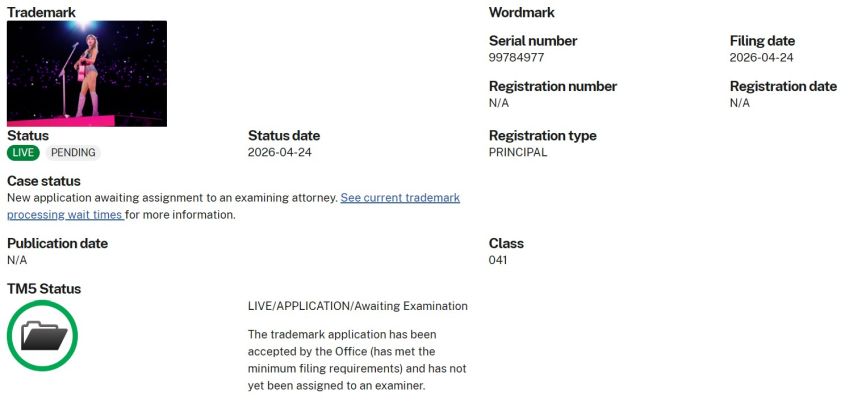
These filings reflect a sophisticated understanding of the limits of traditional intellectual property protection. Historically, artists have relied principally on copyright to safeguard creative output. Copyright, however, protects original works fixed in a tangible medium of expression; it generally does not extend to a person's voice, face, or likeness considered in isolation. AI-generated content that imitates an individual's voice or appearance, without reproducing a copyrighted work, frequently falls outside the protective reach of copyright law. By securing trademark rights in elements of her persona, Swift positions herself to act against unauthorized uses, including deepfakes, that risk consumer confusion or damage to her brand.
In Canada, the legal framework supporting this kind of protection has expanded considerably. Broadened definitions of "trademark" and "sign" introduced by major amendments to the Trademarks Act in June 2019 have enabled the registration of marks that were previously not registrable or had limited recognition, including sounds, scents, tastes, textures, holograms, moving images (motion), three-dimensional shapes, modes of packaging, the specific positioning of a sign, and the use of a colour itself as a trademark without a defined shape or design. For brand owners and individuals seeking to protect distinctive elements of their persona, voice clips, signature visual elements, characteristic colours, or sonic identifiers among them, these amendments have opened registration strategies that were previously unavailable and have meaningfully strengthened the toolkit for responding to AI-generated impersonation.
Swift's strategy is instructive across any industry in which brand, persona, or likeness carries commercial value.
- Franchise owners have a stake in these issues: the value of a franchise rests on the strength and integrity of a brand they license rather than own, and false media misrepresenting a spokesperson, mascot, or executive can cascade across an entire network of locations almost overnight. That risk cuts in two directions. Franchisors typically owe explicit contractual obligations under their franchise agreements to maintain, defend, and enforce the licensed marks, duties that have grown materially more demanding in the AI era. Franchisees, for their part, bear the immediate financial consequences when synthetic content goes viral: foot traffic, sales, and consumer goodwill can drop across the system within hours, well before any takedown or correction can catch up.
A robust trademark portfolio provides the legal foundation to control how a brand is presented and to challenge unauthorized or misleading uses across digital platforms. The most resilient portfolios extend well beyond core word marks and logos to capture the full range of brand identifiers, such as distinctive packaging, signature colours, jingles and sonic branding, mascots, taglines, and other non-traditional signs, each of which can be imitated, distorted, or weaponized by AI-generated content. In a deepfake era, the marks a franchise system has not registered are often the ones most exposed.
- In an athlete’s world, name, image, and likeness (NIL) rights have become core commercial assets, allowing athletes to control, and profit from, the use of their identity, including their name, image, voice, and broader public persona. Protecting NIL against unauthorized exploitation, particularly AI-generated content, is increasingly essential to both reputation and revenue, and the implications extend well beyond the individual athlete.
Sponsors and endorsement partners face their own exposure. An exclusive endorsement deal can be devalued by a deepfake depicting the athlete endorsing a competitor, and broadcasters must contend with fake recreations of game footage and on-air commentary that erode the value of legitimate licensing rights. The financial stakes are substantial. Endorsement income often eclipses playing salary by orders of magnitude, Caitlin Clark, for example, reportedly earned approximately USD $16 million in endorsement income in 2025, compared with a playing salary and bonus of approximately USD $119,000.
- Teams and leagues share a parallel interest in protecting club marks, mascots, uniform designs, and the visual hallmarks that bind a player to a franchise: an AI-generated clip of a star athlete in team kit endorsing a controversial product can cause reputational damage to the individual and the institution simultaneously. Players' associations play a central role in negotiating and policing group licensing rights, where collective enforcement against fake or misleading AI-generated content is often more efficient than individual action.
Generative AI is advancing faster than legal frameworks can change, and the gap between the two is where reputational and commercial harm now does its work. We invite brand owners, celebrities, athletes, sports organizations, franchisors, and their management teams to contact our intellectual property team for a confidential review of where your portfolio is strongest, where it is exposed, and what steps will most effectively prepare you for what is coming next. The most valuable conversations on this front are the ones that happen before a deepfake surfaces—not after.
The content of this article is intended to provide a general guide to the subject matter. Specialist advice should be sought about your specific circumstances.
[View Source]