- with Senior Company Executives, HR and Finance and Tax Executives
- in Canada
- with readers working within the Accounting & Consultancy and Securities & Investment industries
Download a PDF copy of this Blog here.
When it comes to Tax Audits, most Tax Auditors — whether from the federal Canada Revenue Agency (“CRA”) or provincial counterparts auditing for tobacco, fuel or other provincial compliance matters —operate within a four-year general limitation period.
In this Tax Audits Series Report, we review the general statute of limitations rules applicable to tax audits, as well as the key exceptions that allow Tax Auditors to reassess beyond that four-year period.
The General Four-Year Limitation Period
Under both the Excise Tax Act ( “ETA”) and the Income Tax Act (“ITA”), the CRA is generally statute-barred from auditing or issuing further reassessments in respect of a year or reporting period more than four years in the past (exactly when the four year rule starts is a bit tricky and depends on the specific tax legislation at issue, but for the pusposes of this article, we will say it is about four years in the past).
The policy rationale behind this limitation period is straightforward: taxpayers and registrants are entitled to certainty and finality after a reasonable period of time.
The Key Exception: Misrepresentation and Fraud
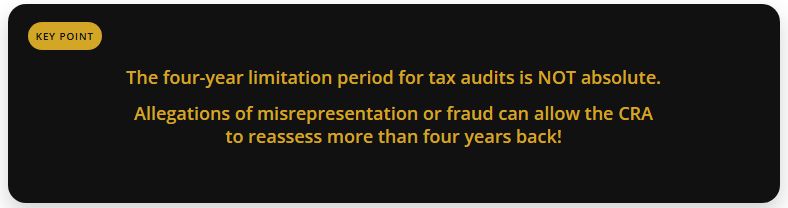
One of the more important qualifications to the four-year rule is the exception for misrepresentation attributable to neglect, carelessness, wilful default, or fraud. Where the CRA – or other Tax Auditor, as similar rules tend to appear in provincial taxing legislation – alleges that a taxpayer has made a misrepresentation falling within these categories, the normal reassessment period effectively falls away. In those circumstances, the Tax Auditor may reassess “at any time”, without being constrained by the usual four-year limitation period. This is a powerful tool, in practice allowing Tax Auditors to revisit taxation years or reporting periods that would otherwise be closed, significantly expanding the scope of the audit.
Practical Implications for Taxpayers
The existence of these exceptions has extremely significant consequences for taxpayers and businesses under audit. First, taxpayers should not assume that the passage of time alone provides complete protection. Even older taxation years may remain exposed where the CRA is prepared to assert misrepresentation.
Second, once the CRA raises allegations of misrepresentation or fraud, the burden effectively shifts to the taxpayer to challenge those assertions, in order to forestall an assessment. (The rule actually shifts back to the tax authority on legal appeal.)
Finally, note that the threshold for “misrepresentation” is not limited to intentional wrongdoing. Findings of carelessness or neglect — which can arise in a variety of circumstances — may be sufficient to permit a reassessment beyond the normal limitation period
Takeaways
For many taxpayers, the four-year limitations period represents a degree of finality. Once it passes, they assume that the relevant taxation years or reporting periods are effectively “closed”. However, that assumption is not always correct. Federal and provincial taxing authorities retain the ability to reassess beyond that period where they can establish misrepresentation, neglect, carelessness, or fraud.
Taxpayers facing audit activity — particularly for older years — should be aware of these risks and seek advice from Experienced Tax Counsel where these issues arise.
For help with Tax Audit matters, please click here.
For an updated Index of Our Tax Audits Series, click here.
The content of this article is intended to provide a general guide to the subject matter. Specialist advice should be sought about your specific circumstances.
[View Source]