
- in Asia
- with readers working within the Construction & Engineering industries
- with Senior Company Executives, HR and Finance and Tax Executives
Public Safety Canada has issued its 2025 annual report to Parliament (the "PSC Report") on its administration of the Fighting Against Forced Labour and Child Labour in Supply Chains Act (the "Supply Chains Act"), summarizing key findings and insights based on the thousands of reports it received for this reporting year. The PSC Report provides helpful insight into Public Safety Canada's views on not just the reports they've received, but also their approach to compliance and enforcement of the Supply Chains Act as we enter the third year of its implementation.
However, as the implementation of the Supply Chains Act is stabilizing, new legislation has been introduced in Parliament that would impose certain due diligence obligations related to modern slavery risks. Bill C-251 was introduced this fall and, if enacted, will establish a presumption that goods from designated countries, areas, or entities are produced wholly or in part by forced or child labour and therefore are prohibited from importation into Canada. In order to rebut that presumption, importers will have to demonstrate to the Canada Border Services Agency ("CBSA") that they have performed effective due diligence on their supply chain.
While Bill C-251 remains at the early stages of the legislative process as a private member's bill, its introduction signals growing cross-party consensus and public demand for more effective enforcement. All importers, as well as other businesses subject to the Supply Chains Act, should closely monitor developments, as the proposed changes could impose new compliance obligations and reshape risk management strategies.
In this update, we unpack these developments and examine what they mean for the landscape of Canada's modern slavery regime.
A Review of the PSC Report
The PSC Report provides some helpful insights into not only the reports that Public Safety Canada received, but also the work PSC has done this past year on the administration of the Supply Chains Act.
Compliance and Education
Public Safety Canada notes in the PSC Report that it has continued to focus its efforts on facilitating compliance through awareness-raising efforts and refined guidance. In the past year, the department:
- Delivered information sessions to over 1,000 participants.
- Released updated guidance in November 2024, clarifying key definitions and expectations (as we discussed in our client alert at that time, Modern Slavery Alert: Public Safety Canada Makes Significant Changes to its Guidance on the Supply Chains Act,).
- Launched a quarterly newsletter to share updates and best practices.
- Responded to over 1,500 public inquiries, helping organizations interpret and apply the law.
These figures support Public Safety Canada's stated position of spending these first few years emphasizing education and collaboration over immediately resorting to enforcement actions; the PSC Report reveals that in 2025, no orders were issued under Section 18, which empowers the Minister to require non-compliant entities to take corrective measures, and no charges were laid under Section 19, which establishes offences for failing to comply with reporting obligations, obstructing enforcement, or ignoring ministerial orders - each punishable by a fine of up to $250,000.
The 2025 Reporting Cycle in Numbers
The 2025 reporting cycle saw 4,313 reports submitted, representing a modest decrease from the previous year (5,795 reports were submitted in the 2024 reporting cycle). This slight drop is likely due to the issuance of updated guidance from Public Safety Canada, referenced above, which specified that entities involved solely in selling and distributing are not subject to the reporting obligation.
The report also provides a breakdown of the sectors most represented among reporting entities:
- Manufacturing (24.9% of entities)
- Wholesale Trade (11.8% of entities)
- Retail Trade (8.9% of entities)
- Mining, quarrying, and oil and gas extraction (6.5% of entities)
- Transportation and warehousing (5.8% of entities)
Among those entities that have begun the work of identifying sources of risk (which was the case for 82.3% of entities in 2025, up from 77% in 2024), the PSC Report breaks down the most commonly cited risk indicators as follows:
|
Risk Factor |
% of Entities Reporting as Risk |
|
Raw materials or commodities |
34.1% |
|
Sector or industry |
30.4% |
|
Tier one suppliers |
29.7% |
|
Geographic location |
29.6% |
|
Types of products sourced |
28.5% |
In terms of the steps taken to prevent and reduce such risks, the most common method was embedding responsible business conduct into policies and management systems (reported by 96.9% of organizations), followed by identifying adverse impacts in operations, supply chains, and business relationships (reported by 49.8% of organizations).
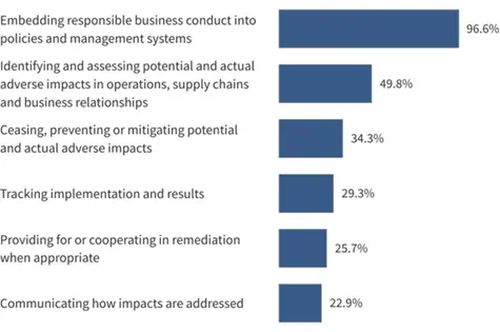
51.2% of entities confirmed that they have policies to assess the effectiveness of their internal controls to prevent forced and child labour, most commonly by conducting regular audits (76%) and tracking performance indicators (37.4%).
Multi-Jurisdictional Modern Slavery Reporting Template
In addition to the takeaways above, the PSC Report also highlights the release of the multi-jurisdictional modern slavery reporting template, developed jointly by Canada, the UK, and Australia. This tool allows companies operating in multiple jurisdictions to prepare a single, harmonized report that satisfies all three regimes. For more on this topic, see our earlier publication: Supply Chains Act Alert: Canada, UK, and Australia Jointly Release New Multi-Jurisdictional Modern Slavery Reporting Template.
Potential Importation Implications from Bill C-251
As the implementation of the Supply Chains Act reaches some level of stability, if enacted, Bill C-251 will introduce additional modern slavery related obligations for Canadian companies. This bill significantly expands the federal government's authority to restrict imports with potential ties to forced labour and child labour. Specifically, Bill C-251 would introduce a mechanism that would allow the Minister of Public Safety to designate certain entities, areas, or even entire countries as producing goods presumed by default to be mined, manufactured, or produced wholly or in part by forced labour or child labour.
If Bill C-251 is enacted, all goods originating from these designated jurisdictions would be presumptively prohibited from entering Canada. To allow the goods to be imported into Canada, the importer must rebut the presumption by demonstrating to the CBSA that they have certain supply chain monitoring measures in place and establishing that they have undertaken all required due diligence, with further details to be set out in subsequent regulations. As such, for companies whose supply chain are exposed to these designated jurisdictions, Bill C-251 would effectively impose a due diligence obligation related to forced labour and child labour.
We note that this bill has been put forward as a private member's bill by Member of Parliament Simon-Pierre Savard-Tremblay, a member of Bloc-Quebecois' caucus. Because it is not a bill put forward by the government, and it may not reflect the Canadian government's views or priorities on this issue. There is therefore a material possibility that it will not receive sufficient support to be passed through the House of Commons. However, Bill S-211 (which enacted the Supply Chains Act) did successfully make it through the House of Commons despite also being a private member's bill, demonstrating general consensus on this issue across political parties in Canada. As this bill extends well beyond Bill S-211 reporting requirements and grants fairly broad powers to the government in prohibiting imports from certain countries, it will be interesting to see how much support it receives in the House - we anticipate that it may encounter greater resistance than Bill S-211.
To view the original article click here
The content of this article is intended to provide a general guide to the subject matter. Specialist advice should be sought about your specific circumstances.
[View Source]