Nearly six decades after Canadian space icon John Chapman imagined a Canada bound together by “strands in space,” space policy has re-emerged as a central question of national cohesion, security, and economic strategy. Whether those strands become the backbone of Canada’s future will depend on the federal government’s ability to execute—and sustain—its ambitious space objectives.
Canada has long grappled with fundamental questions about its purpose in space, particularly whether a meaningful distinction can be drawn between purely civilian and defence space assets. Such questions were central to parliamentary debates leading up to the passage of the Canadian Space Agency Act in 1990, which considered whether the mandate of the newly created Canadian Space Agency (CSA) should be expressly limited by statute to non-military purposes.1
Although these motions were ultimately defeated, the global security environment of recent years has effectively collapsed any remaining distinction between civilian and defence space technologies. Dual-use is now the dominant framing across Canada’s space and defence circles, as space increasingly becomes a contested and operationally critical domain for national security, economic growth, and strategic relevance.
In this context, recent federal policy decisions, including the space-related measures set out in Budget 2025, signal a strategic recalibration following years of reliance on foreign capabilities and underinvestment in sovereign assets. This recalibration is occurring within an intensifying environment of increasing power competition, rising unilateralism, and greater trade and security uncertainty.
Canada’s current space posture reflects a convergence of historical development, recent federal policy decisions, and evolving economic conditions in the space sector. It is also shaped by a growing emphasis on domestic capacity and deeper integration with European space and security partnerships.
1. Canada’s space story: From early promise to strategic reset
Canada’s modern presence in space began on September 21, 1962, with the launch of Alouette-1, a scientific satellite designed to study the Earth’s ionosphere, the part of the upper atmosphere that influences radio communication. With that mission, Canada became the third nation in the world to design, build, and operate its own satellite after the United States and the Soviet Union. Originally only intended as a one-year mission, Alouette-1 would continue to transmit valuable data for the next decade. The success of Alouette-1 generated a wave of technological optimism in Canada and reinforced the belief that space could serve not only scientific discovery, but also communications, nation building, and economic development across a vast and sparsely populated country. Canada’s growing ambitions as a space nation gained further traction with additional launches in the following years, notably Anik A1, which made Canada the first nation to place a domestic communications satellite into geostationary orbit. Later, Canada’s reputation in space science expanded through Canadarm, an advanced robotic system that helped assemble the International Space Station. More recently, Canada has contributed critical sensor, imaging, and spectroscopic capabilities to the James Webb Space Telescope, which was launched on Christmas 2021, and is now extending this legacy through Canadarm3, a next-generation robotic system being developed for the Lunar Gateway that will support deep-space operations around the Moon.
To understand how Canada arrived here, it is helpful to return to the formative years of its space program. In 1967, a team of scientists led by John Chapman delivered a comprehensive space research report to the Science Council of Canada, a federal government advisory board later dissolved in 1993.
Special Study No. 1, Upper Atmosphere and Space Programs in Canada2, commonly known as the Chapman Report, reviewed and assessed Canadian-financed research and development related to space, evaluated the contribution of space projects to scientific knowledge, education, and Canada’s economic interests, and provided actionable recommendations for Canada’s future as a space nation. Then, as in the decades that followed, a central question of the report was whether Canada should “make or buy” its critical space technologies.3
The Chapman Report’s response to this question was to draw a clear distinction between open scientific discovery and strategically sensitive technology, and argue that true sovereignty in space would depend on Canada’s ability to nurture and control key technological capabilities at home.4 The report’s emphasis on domestic control of satellite communications, industrial development, and long-term technological self-reliance now reads as an early articulation of the sovereignty and security debates that are reshaping Canada’s space posture today. Fifty-nine years later, the Chapman Report’s recommendations have become encapsulated under various measures of Budget 2025, such as the Buy Canadian Policy and investments to develop sovereign launch capabilities.
As the early era of optimism in Canada’s global leadership in space technology faded, other nations moved more deliberately to nurture their domestic space sectors. France consolidated its position as Europe’s principal launch power through leadership of the Ariane program at the Guiana Space Centre, while Italy became the lead nation for the Vega small-satellite launcher through Avio, securing an independent European launch pathway. Japan developed and now operates fully sovereign launch vehicles through JAXA and Mitsubishi, ensuring autonomous access to orbit for both civil and defence missions. In November 2025, Germany announced plans to invest approximately €35 billion in defence-related space and military technologies over the next five years.5 The United Kingdom conducted its first orbital launch attempt in 2023 and continues to advance domestic launch capability through multiple spaceports in Scotland, supported by regulatory reforms and commercial launch providers. The United States’ leadership in space is well established, combining NASA’s mission depth with commercially operated launch systems developed by companies such as SpaceX and Blue Origin, which now provide routine, reusable launch services and underpin national access to space.
Perhaps even more consequential for Canada than the advances of historically peer space nations are the rapid progress of emerging middle and regional powers in the space sector. Türkiye has announced record space investments for 2026 in support of its objective to achieve a lunar landing by 2028. The United Arab Emirates, in partnership with Japan, plans to launch six spacecraft in 2028 as part of the MBR Explorer mission, beginning a 13-year journey to the main asteroid belt beyond Mars. Singapore’s Next Bound of Development strategy sets out a focused approach to space, prioritizing technologies that address terrestrial challenges such as sustainability, maritime awareness, and communications. Indonesia has emphasized that the development of a spaceport is a strategic national mandate.
In the decades ahead, a nation without a spaceport may very well find itself as constrained as one without an airport, cut off from independent access to new economic opportunities and increasingly reliant on others for access to a domain that underpins both future prosperity and security. In an era characterized by a “rupture” of the rules-based order,6 independent access to space is the only guarantor of a country’s ability to protect its strategic interests, sustain technological sovereignty, and participate on equal footing in the emerging space economy.
Canada’s peers and competitors are accelerating their space investments at a pace that leaves little room for delay. Any failure to fully implement the space-related measures in Budget 2025 risks widening existing gaps in capability and strategic relevance, while allowing emerging space nations to narrow or overtake Canada’s current advantages. For example, although the Chapman Report expressly called for the development of sovereign launch capabilities nearly six decades ago,7 Canada today remains the only member of the G7 without independent access to space8.
Undoubtedly, Canada is now at a point where there is, to echo Hans Zimmer’s score in Interstellar, “No Time for Caution.” The decades of lost opportunities and diminished competitiveness now form the backdrop to a deliberate national effort to reposition space as a strategic priority. Budget 2025 provides momentum for Canada's new strategic space posture, which places significant emphasis on defence modernization, digital sovereignty, cyber resilience, Arctic monitoring, and the protection of critical infrastructure. Each of these policy priorities depends fundamentally on resilient satellite systems, secure space-based communications, and persistent Earth-observation capabilities, which in turn require sustained investment in the development of Canada’s industrial and technological capacity.
In parallel to these domestic measures, Canada is embedding itself within European space-security architectures through its integration into Security Action for Europe (SAFE), the European Union’s flagship defence-industrial financing and procurement framework, which was endorsed by EU member states in December 2025 and formalized in February 2026, and through a $664.6 million investment in a new comprehensive partnership with the European Space Agency (ESA). Crucially, Canada’s participation in SAFE, together with its expanded engagement with the ESA, creates a new channel for export growth for Canadian space companies.
Nearly 60 years after the Chapman Report identified the strategic imperative for Canada to control the space technologies central to defining its future and security, Canada is now pursuing measures to translate that long-standing logic into modern space policy. While significant work remains, success will depend on a few factors, including:
- Effective execution of Budget 2025: The federal government’s ability to translate Budget 2025 objectives into operational programs, procurements, and project delivery.
- Regulatory clarity and implementation capacity: The timely adoption of clear regulatory regimes necessary to support Budget 2025 implementation and provide certainty to industry.
- Predictable procurement for SMEs: The development of a sustained procurement of services strategy, which supports predictable revenue streams which enables SMEs to scale and attract private investment.
2. Budget 2025: Space as strategic infrastructure
Budget 2025 introduced a wide suite of investments intended to rebuild domestic defence capacity, accelerate dual-use innovation, strengthen industrial resilience, and expand Canada’s ability to participate in allied security architectures. Several of these measures have direct or indirect implications for the growth, competitiveness, and international positioning of Canada’s space sector.9 The five principal investment streams are outlined below.
Dual-use innovation and technology development
- $656.9 million over five years to Innovation, Science and Economic Development Canada to develop and commercialize dual civilian-military technologies across aerospace, cyber, artificial intelligence, biodefence, life sciences, automotive, and marine sectors.
- A new policy direction that prioritizes domestic innovation and encourages Canadian firms to scale technologies with both commercial and national security applications.
Financing and mobilization of small and medium-sized enterprises
- $1.0 billion in 2025 to establish the Defence and Security Business Mobilization Program at the Business Development Bank of Canada (BDC), providing loans, venture capital, and advisory services for SMEs contributing to defence and security capabilities.
- Buy Canadian Policy that directs federal procurement officials to select Canadian suppliers by default, wherever possible, in order to reinforce domestic supply chains and strengthen local industrial capacity.
Defence industrial restructuring and procurement reform
- Creation of a national Defence Industrial Strategy—now published and entering implementation—backed by $6.6 billion over five years to rebuild production capacity, increase supply-chain resilience, and foster long-term growth in strategic manufacturing sectors.
- Establishment of the Defence Investment Agency, which is now operational and supporting procurement and investment activities, to streamline procurement, accelerate program approvals, reduce administrative delays, and prioritize industrial activity in aerospace, advanced manufacturing, and shipbuilding.
Digital, security, and infrastructure modernization
- $10.9 billion over five years for digital infrastructure upgrades across the Department of National Defence (DND), the Canadian Armed Forces (CAF), and national security agencies.
- Investments aimed at strengthening secure communications, cyber readiness, data management, and the digital backbone needed for modern military and space-enabled operations.
Sovereign access to space and orbital capability
- $182.6 million over three years to the DND to establish a sovereign space launch capability within Canada.
- Support for infrastructure, regulatory development, early-stage launch operations, and integration with broader Arctic, surveillance, and communications missions.
3. Investing in sovereign launch and space capabilities
Through the Innovation for Defence Excellence and Security (IDEaS) program, Canada is advancing its space and defence capabilities through targeted initiatives such as the Launch the North and Shields Up! Challenges. Led by the DND and the CAF, Launch the North is focused on accelerating the development of Canadian-designed launch vehicles and enabling technologies, with the objective of launching Canadian payloads from Canadian soil and achieving an initial light-lift operational capability as early as 2028. The challenge made available funding of up to $100 million per project, with selected proponents advancing to subsequent development stages following the initial proposal phase in early 2026.
In parallel with these capability-building efforts, the federal government has begun to establish the legal framework required to support domestic launch activity. In April 2026, the federal government introduced Bill C-28, the proposed Canadian Space Launch Act,10 which is currently before Parliament and would establish Canada’s first dedicated regulatory regime for space launch and re-entry. Together, these measures signal a shift from policy ambition toward the development of a fully operational and regulated domestic launch ecosystem.
Recognizing that militaries of Western democracies, including Canada, are increasingly dependent on capabilities that are delivered or enabled by space-based systems and their associated space and ground infrastructure (e.g., communications, surveillance, environmental monitoring, and navigation), DND and CAF have also launched a complementary initiative focused on developing new and innovative capabilities that can be incorporated into the design and operation of Canada’s space-based systems to defend and protect satellites from a range of natural and human-made threats. Results for this challenge have been published on the IDEaS website.
These innovation efforts are complemented by recent federal action to strengthen space-enabled defence infrastructure in operational environments. In December 2025, the federal government announced a strategic partnership with Canadian space and satellite companies to enhance military satellite communications in the Arctic under the Enhanced Satellite Communications Project – Polar.11
Moreover, as climate change accelerates, the Arctic is attracting increasing strategic attention due to expanding access to natural resources, longer navigable seasons, and the growing viability of Arctic shipping routes, particularly the Northwest Passage (NWP). While Canada considers the NWP to be internal waters subject to full Canadian sovereignty, the United States and others consider the waterway through Canada’s Arctic Archipelago as an international strait. In this context, the development of credible defence and space capabilities is essential to Canada’s ability to assert sovereignty in the North, where, given the re-emergence of Realpolitik as a dominant feature of global geopolitics, effective control and sustained presence increasingly outweigh legal claims alone.
These concerns are reinforced by findings highlighted in a June 2023 parliamentary report, Arctic Security Under Threat.12 The report acknowledged that satellites are essential to Arctic surveillance and communications, and noted that although DND has committed to procuring next-generation capabilities through initiatives such as the Defence Enhanced Surveillance from Space Project (DESSP), initial operational capability is not expected until 2035.13 DESSP is intended to deliver next-generation space-based surveillance by integrating radar and identification capabilities, with a focus on low-latency, all-weather Arctic monitoring and interoperability with allied systems.14 In the context of heightened strategic competition in the Arctic, where some have even classified themselves as a “Near-Arctic State,”15 and where the current U.S. administration has actively sought to expand its presence in Greenland for “national security,”16 much to the consternation of its traditional allies,17 it is critical that the federal government effectively implement the space-related measures announced in Budget 2025 to ensure that Canada is positioned to assert effective control over its Arctic territory. Given that, initiatives such as IDEaS and Shields Up! are important steps in the right direction to strengthen Canada’s domestic capacity to independently protect and advance its national interests in a shifting global order.
4. Pivot to Europe: Canada’s entry into Europe’s defence-Space industrial complex
Lord Palmerston’s famous maxim that nations hold no eternal allies, only eternal interests, is playing out in real time as Canada seeks to recalibrate its critical security relationships away from increasingly uncertain security partnerships and toward Europe. In this context, Canada and its European partners have found growing alignment in their assessment of common threats and broader geopolitical priorities. The close of 2025 saw the emergence of new collaborations between Canada and the European Union, following a sustained Canadian pivot toward Europe and European markets, that are beginning to shape the trajectory of Canada’s space and defence sectors for decades to come.
Following the conclusion of negotiations in late 2025, Canada and the European Union formalized Canada’s inclusion into SAFE, a central pillar of the European Union’s Readiness 2030 strategy to scale defence spend and production capacity through pooled financing, aggregated demand and cross‑border integration.18 In total, Readiness 2030 aims to leverage up to $1.3 trillion to strengthen Europe’s defence capacity, including over $244 billion from SAFE. This includes European Union loans and other fiscal measures to draw in public and private capital.19 On February 11, 2026, the Council adopted a decision authorizing the European Union to sign the bilateral agreement between the EU and Canada on the participation of Canadian companies and products originating from Canada in procurement under the SAFE Instrument.20 The agreement was subsequently signed on February 14, 2026.
SAFE recognizes space as strategic defence infrastructure and identifies space asset protection as a priority category for procurement. For Canada, participation unlocks access to low-interest financing for joint procurement, enables Canadian defence companies to compete for contracts in participating states, and helps diversify and strengthen supply chains for the CAF. It also provides European defence primes, investors and private equity funds with a clear institutional framework to partner with and invest in Canadian space-sector defence companies.
On November 18, 2025, Canada announced $528.5 million in investments into the European Space Agency (ESA) to support the development of dual‑use space technologies within this broader policy context.21 On November 28, 2025, this figure rose to $664.6 million following the ESA Ministerial Council meeting on November 27, 2025.22 This investment is concentrated across six program pillars: Earth Observation, Satellite Communications, Exploration, Technology, Space Safety and Navigation, with the largest envelopes directed to Earth Observation and Satellite Communications, followed by Exploration. Targeted but smaller lines in Technology, Space Safety and Navigation round out the portfolio (see Table 1).
The goal is to advance dual‑use technologies, enhance R&D, and position Canadian businesses to compete for high‑value contracts in the European market. ESA’s pay-to-play and geo-return model means that Canada’s financial contributions are largely returned to Canadian industry, net of administrative overhead, through ESA contracts awarded to Canadian firms.
Table 1: Canada’s program area investments in the ESA.23
| Program area | Investment (CAD) | Investment (EUR) |
|---|---|---|
| Earth Observation | $189.9M | €116.5M |
| Satellite Communications | $131.2M | €80.5M |
| Exploration | $122.3M | €75.0M |
| Navigation | $9.0M | €5.5M |
| Technology (GSTP) | $73.4M | €45.0M |
| Space Safety | $48.9M | €30.0M |
The CSA reported that these contracts have historically generated significant downstream commercial benefits, with Canadian companies earning, on average, approximately $3 in commercial revenue for every $1 awarded through ESA contracts.24
ESA procurement opportunities
Canada’s enhanced ESA participation unlocks new procurement and funding pathways for Canadian space companies.25
- esa‑star publication and registration: Companies can register as potential contractors, browse ESA tenders, and submit bids through the esa‑star portal (ESA’s System for Tendering and Registration). Opportunities include open competitions across ESA directorates and programs, with detailed notices and timelines posted on the portal.
- Open Discovery/OSIP pipeline: In addition to formal tenders, ESA’s Open Discovery Ideas Channel via the Open Space Innovation Platform (OSIP) enables organizations to submit innovative concepts into ESA’s R&D pipeline through themed calls and continuous channels. This acts as an accessible on‑ramp for early‑stage ideas and novel technologies.
- Program‑specific access and support: Many ESA program elements funded by Canada, such as ARTES 4.0 (including Industrial Competitiveness, Space for 5G/6G, 4S security, and ScyLight optical/quantum), GSTP (Develop/Make/Fly, including a Resilience & Security component) will issue competitive calls. For several of these, a CSA letter of support is required for Canadian participation, and awards are allocated consistent with ESA’s geo‑return principle that favours contractors from contributing states, including Canada.
- Market access and partnerships: Under ACCESS, Canadian space companies can compete for high-value contracts across ESA’s program portfolio, while also benefiting from established industry networks, business support services, and commercialization pathways. ACCESS is structured around two complementary components tailored to different stages of company development: ScaleUp, which supports firms seeking to grow and industrialize their capabilities, and Business Applications and Space Solutions, a program which focuses on deploying space-based solutions to address commercial and public-sector needs.
Overall, SAFE’s defence-industrial integration and Canada’s expanded investment in ESA establish a new institutional pathway for Canadian space companies to finance development, compete for European tenders through esa-star, deploy innovation via OSIP, and pursue geo-return contract opportunities across ESA’s major programs.
The effectiveness of these mechanisms, including their implementation, uptake across the Canadian space sector, and success in securing Canadian participation in European projects, will be key indicators to watch in the coming years. So, while the programs are ambitious in design, their practical execution will ultimately be determinative.
Gowling WLG will continue to monitor the implementation of these programs and the opportunities they present for Canadian space companies to expand their European footprint.
5. Canadian space economy: Current trends
In November 2025, the CSA published its annual State of the Canadian Space Sector report.26 The report specifies that in 2023, the Canadian space sector contributed $3.4 billion to Canada’s real GDP, representing a 4.1 per cent increase over the previous year, with the sector’s revenue exceeding $5.1 billion. From 2019 to 2023, the sector’s contribution to real GDP increased by 8.4 per cent, corresponding to a compound annual growth rate of 2 per cent. Of the total 2023 GDP contribution, $1.8 billion was generated directly by space sector activity, $0.81 billion by supply chain industries, and $0.81 billion by consumer spending associated with sector employment. This reflects a total economic multiplier of 1.9, meaning that every dollar of GDP generated by the space sector produced an additional $0.90 in economic output across the broader Canadian economy.27
Of the $5.1 billion in space revenue, $2.2 billion, or 43 per cent were attributable to exports, an increase of 9.4 per cent from the previous year. By the numbers:
- North America remained the primary destination for Canadian space exports in 2023, accounting for 65 per cent of total export revenues, or $1.42 billion, an increase of 18 per cent from the previous year.
- Europe remained Canada's second largest market for space exports, which decreased by 3 per cent to $424 million in 2023.
- Exports to Asia increased modestly to $179 million, or 8 per cent of total exports, while Central America, South America, and the Caribbean accounted for $111 million, or 5 per cent.
- Exports to the Middle East, Oceania, and Africa remained small in absolute terms, each representing less than 1 per cent of total export revenues.
From a longer-term perspective, exports to North America have now fully recovered from pandemic-era declines and exceed 2019 levels by 9 per cent, while exports to Asia remain 47 per cent below 2019 levels (see Figure 3). This sustained decline likely reflects a combination of growing regional competition from emerging space nations, the maturation of Indigenous space industries within several APAC economies, and shifting procurement preferences toward suppliers with closer supply-chain proximity and integrated regional logistics networks. Although we note, that, since 2022, Singapore has invested approximately USD $162 million to advance its space capabilities, with its national strategy expressly calling for international partnerships,28 creating potential market opportunities for Canadian space companies to explore.
In this context, Canada’s participation in European procurement programs becomes particularly significant, as it provides Canadian space companies with structured access to a large, institutionally supported market at a time when supply-chain localization and predictability in long-term relationships are increasingly shaping global procurement and security decisions.
Figure 3: Share of total exports by region in 202329
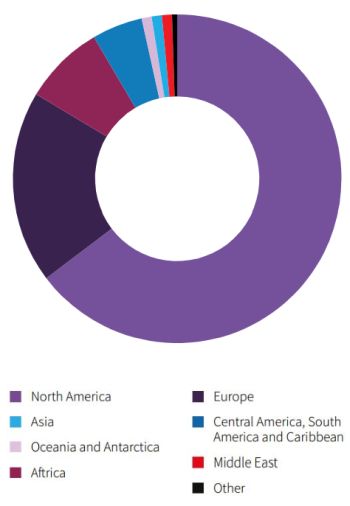
Figure 4: Proportion of revenues by sector of activity in 2023.30
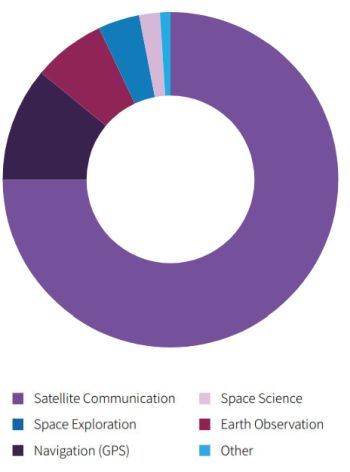
By sector of activity, space revenues were distributed as follows:
- Satellite communications continued to dominate the Canadian space economy in 2023, generating $3.6 billion in revenues, or 71 per cent of total space revenues, despite a year-over-year decline of 5 per cent.
- Navigation services represented the second-largest sector at $688 million, accounting for 13 per cent of total revenues and recording strong growth of 25 per cent.
- Earth observation generated $366 million, or 7 per cent of revenues, with moderate growth of 5 per cent. Space exploration revenues rose to $308 million, representing 6 per cent of the total and reflecting the fastest growth rate among major sectors at 33 per cent.
- Space science revenues remained comparatively small at $100 million, or 2 per cent of total revenues, while activities classified as “Other” accounted for $34 million, or 1 per cent.
Overall, the 2023 revenue distribution highlights the continued concentration of the sector in communications and navigation, alongside faster relative growth in exploration-related activities (see Figure 4). Canada’s participation in European procurement programs in addition to the domestic Buy Canadian Policy is expected to reinforce demand in these same segments through defence-oriented procurement, dual-use systems, and export-linked industrial collaboration over the medium term.
The implication for Canada’s space sector is straightforward. Competitiveness will depend on the ability to innovate, design, build, and sell technologies and related services at scale through both domestic and allied procurement programs, as well as on the capacity to scale commercial offerings and secure long-term customers in international markets. Canada’s formal integration into SAFE and expanding relationships with the ESA is expected to open new demand channels for Canadian-developed space technologies. As SAFE-supported procurement and joint development programs expand through the latter half of the decade, Canadian exports to Europe are likely to grow from recent levels, particularly in satellite communications, Earth observation, navigation, secure data systems, and space-domain awareness capabilities.
Looking ahead, three principal structural factors will be critical for the sector’s outlook:
- The scale and continuity of public investment in space-related infrastructure and programs.
- The ability of federally funded initiatives to effectively support the long-term growth of SMEs to scale into mid-sized and large enterprises.
- Clear access pathways to international procurement and partnership opportunities, particularly under Canada’s new partnerships with the European Union.
As space activity becomes more closely linked to digital infrastructure, climate monitoring, communications resilience, and security applications, demand is expected to expand across both upstream manufacturing and downstream services. At the same time, constraints related to capital access, supply chain depth, workforce availability, and sovereign manufacturing capacity are likely to remain relevant considerations for long-term growth. That said, the new transatlantic defence-space linkages and renewed domestic public investment point to a more active growth environment for the Canadian space economy into the latter parts of this decade.
6. Conclusions and key takeaways
Nearly six decades after the Chapman Report addressed the question of whether Canada should “make or buy” its critical space technologies, the strategic imperative has now evolved into one of “make and sell” on a global scale.
Through the space-related commitments embedded in Budget 2025, and through deeper defence-industrial integration with the European Union, Canada is positioning its space sector not only as a sovereign capability, but as an export-oriented contributor to allied security.
Below, we’ve highlighted some key takeaways from these developments for Canadian space companies and stakeholders.
- Expanded access to European institutional markets: SAFE creates new pathways into European Union defence and security procurement for eligible Canadian firms through joint programs, supply chain participation, and co-development opportunities.
- Increased investment in domestic capabilities: The $1 billion Defence and Security Business Mobilization Program delivered through the BDC provides direct financing and support to Canadian SMEs operating in defence and security sectors. Additional financing pathways are available for Canadian space companies through other measures under Budget 2025.
- Rising demand for security-linked space capabilities: Growth is expected in secure satellite communications, Earth observation, navigation, space-domain awareness, and data infrastructure supporting defence and critical infrastructure protection.
- Greater role for dual-use technologies: Technologies developed for civil or commercial purposes are increasingly positioned for security and resilience applications.
- Longer program timelines and revenue visibility: Defence and institutional procurement typically involve multi-year funding horizons, which may improve revenue predictability for firms that qualify.
- Higher regulatory and compliance expectations: Participation in security-oriented programs will require increased attention to export controls, data security, supply chain integrity, and government contracting standards.
- Increased importance of international partnerships: Collaboration with European primes, research institutions, and integrators is likely to become a central growth strategy under SAFE-linked programs.
- Continued reliance on export markets: International demand will remain a primary driver of sector growth, with Europe expected to play a larger role over the medium term.
- Ongoing scaling challenges for SMEs: Access to capital, workforce availability, and manufacturing depth will remain key constraints as firms attempt to scale into larger institutional and defence markets.
Gowling WLG is an international law firm with a presence across Canada, the United Kingdom, the European Union member states, the Middle East, and East Asia.
Our global team of space sector professionals across corporate, commercial, regulatory, international trade, government relations and lobbying, data protection and intellectual property practice groups would be pleased to speak with readers interested in the developments discussed in this article, whether to explore accessing Canadian funding for space projects, export opportunities under European procurement programs, or consider what these changes mean for their business and growth strategy.
Footnotes
- House of Commons, Canada, Debates of the House of Commons, 34-2, vol 19 (June 20, 1991) at 71.
- Science Council of Canada, Upper Atmosphere and Space Programs in Canada: Report of the Space Research Advisory Committee, [Chapman Report], (Ottawa: Queen's Printer, 1967).
- Ibid.
- Ibid.
- Jeff Foust, “What Germany's $41 Billion Investment in Space Could Mean for Europe,” SpaceNews, (2024).
- Mark Carney, “Principled and pragmatic: Canada's path,” Office of the Prime Minister of Canada. (January 20, 2026).
- Supra, note 2.
- Lieutenant-Colonel Donald M. Hemmings, Canada's Lack of Domestic Space Launch Capability Constitutes a National Security Concern, (Canadian Forces College, Joint Command and Staff Programme, Exercise Solo Flight paper, 2023-2025).
- Government of Canada, Budget 2025: Building One Canadian Economy, (Ottawa: Department of Finance Canada, 2025).
- “Government of Canada,” “Minister MacKinnon announces sovereign space launch capabilities through the Canadian Space Launch Act,” (Ottawa: Transport Canada, April 21, 2026).
- Government of Canada, “Government of Canada Announces Strategic Partnership to Strengthen Military Communications in the Arctic,” (Ottawa: Public Services and Procurement Canada, December 9, 2025).
- Canada, Parliament, Senate, Standing Committee on National Security, Defence and Veterans Affairs, Arctic Security Under Threat: Urgent needs in a changing geopolitical and environmental landscape, (June 28, 2023).
- Ibid.
- Canada, National Defence, Defence Enhanced Surveillance from Space Project (DESSP), Defence Capabilities Blueprint, Government of Canada.
- Government of the People's Republic of China, State Council of the People's Republic of China, China's Arctic Policy, (January 26, 2018).
- CBC News, “Trump's appointment of special envoy to Greenland sparks diplomatic backlash,” CBC, (December 22, 2025).
- Miranda Bryant, “Denmark sets up ‘night watch' to monitor Trump after Greenland row,” The Guardian, (November 27, 2025).
- Prime Minister of Canada, “Prime Minister Carney Secures Canada's Participation in European Union Defence and Security Initiatives” (December 1, 2025).
- Ibid.
- Council of the European Union, “SAFE: Council clears path for financial assistance to eight member states and concluding the Canada agreement,” (February 11, 2026).
- Canadian Space Agency, “Canada Deepens Space Ties with Europe Through Historic Investment,” (Longueuil, Quebec: Canadian Space Agency, November 18, 2025).
- Canadian Space Agency, “Canada Confirms Historic Space Investment at European Space Agency's Ministerial Council,” (Longueuil, Quebec: Canadian Space Agency, November 28, 2025).
- Canadian Space Agency, Canada-ESA Cooperation Agreement Overview, (December 11, 2025).
- Ibid.
- Ibid.
- Canadian Space Agency, Industry Snapshot: Canada's Space Sector 2024, (Saint-Hubert, QC: Canadian Space Agency, 2024).
- Ibid.
- Office for Space Technology & Industry (Singapore), Singapore's Space Sector: Next Bound of Development, (February 26, 2025).
- Ibid.
- Ibid.
The content of this article is intended to provide a general guide to the subject matter. Specialist advice should be sought about your specific circumstances.
[View Source]