

Update 19 August 2026:
The government has temporarily paused Subclass 462 Work and Holiday Maker visa applications for passport holders from 24 countries. Read more.
Australia’s migration program has always evolved in response to changing economic, demographic, and global conditions. But in 2026, the direction of migration policy is less clear than it has been in recent years.
Elements of the government’s 2023 Migration Strategy, including its focus on regional migration, have been overshadowed by evolving policy settings aimed at reducing Net Overseas Migration (NOM)—a concept that has attracted significant political and media attention in the past year despite often being misunderstood.
This uncertainty has been compounded by delays to key government announcements. A National Press Club address by the Home Affairs Minister that was expected to clarify the government’s strategy for reducing NOM was postponed while policy settings remained under review.
In the absence of clear policy direction, public debate over migration has intensified, with political parties, industry groups, business councils, and community organisations advocating for different and often competing approaches.
Understanding the facts behind the headlines is essential for employers and visa applicants navigating the Australian immigration system.
The facts: Clarifying key migration concepts
While Net Overseas Migration (NOM) and the Permanent Migration Program are different measures of Australian immigration, they are linked and frequently conflated in public debate.
Net Overseas Migration (NOM)
Refers to population changes driven by the net difference between the number of international arrivals and departures over a 12-month period.
A positive number means more people moved to a country than left. It encompasses all travellers, including temporary visa holders, Australian citizens, and permanent residents.
Permanent Migration Program
The Permanent Migration Program is a forecast of the annual number of permanent visas granted to migrants.
It is separate from Net Overseas Migration (NOM), which measures overall population change from international movements by migrants and Australian citizens.
Read about Australia’s Permanent Migration Program settings.
NOM trends
Statistics and trends provide important context on the drivers to reduce NOM from its post-pandemic peak to more sustainable levels, its current status, and why migration targets have become a key focus of public debate.
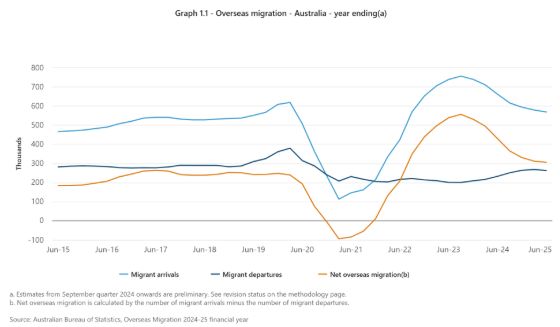
NOM outcomes
- 2018-19 NOM: 241,000
- 2019-20 NOM: 194,400
- 2020-21 NOM: 17,400 (Border restrictions)
- 2021-2022 NOM: 170,900
- 2022-23 NOM: 538,000 (Record high)
- 2023-24 NOM: 429,000
- 2024-25 NOM: 306,000
Source: Australian Bureau of Statistics, Dec 2025 and FY 2024-25, 2025 Population Statement, Treasure Ministers, Jan 2026.
NOM forecasts
The government is committed to reducing the NOM to 225,000 people per year by 2027/28—a target originally set to be achieved in 2026/27.
NOM forecasts were revised as part of its 2025/26 Federal Budget announcements due to more travellers staying in Australia post-covid than expected.
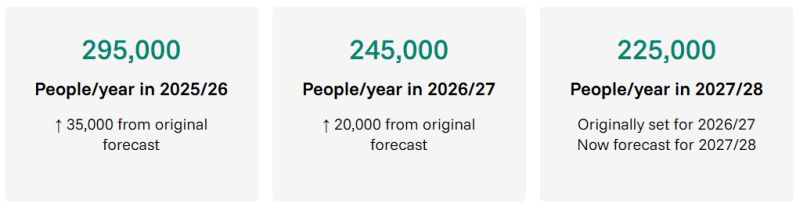
Source: 2026-27 Federal Budget.
Government reforms
Pre-2026:
- Medium to long-term migration strategy that considered housing/infrastructure impacts.
- Greater scrutiny applied to Student Visa applications.
- Tightened temporary Graduate Visa eligibility.
- Restricted ‘visa-hopping’ from some temporary visas to Student Visas.
- New 482 Skills in Demand Visa to better target rather than reduce skilled migration.
Recent (2026):
- Onshore visa applicants prioritised for processing. Read more.
- 70% of places in 2026/27 Permanent Migration Program allocated to onshore applicants. Read more.
- Increased fees for several visa applications. Read more.
- Tightened Training Visa requirements. Read more.
Changes on the horizon:
- Working Holiday Maker program reforms, such as expanding the ballot system.
- ‘Points test’ changes to raise the bar to qualify for Independent Skilled Migration Visas.
- Continued focus on visa integrity, particularly for workplace compliance and Student Visas.
Source: 2026-27 Federal Budget and 2023 Migration Strategy.
What remains uncertain: Policy development
NOM outcomes achieved ahead of the 2028 Federal Election will be pivotal. As calls to manage NOM intensify from multiple stakeholders, it is unclear whether the government will expand existing reforms or pursue new measures to lower migration levels.
External pressures do not signal future policy changes, but they provide insight into competing forces shaping the migration debate and possible future policy direction.
External pressures and influences
Political
Opposition and other political parties are gaining support by advocating stronger migration restrictions:
- Reduce NOM by aligning migration levels to the number of new homes built and reducing Working Holiday Program and international student numbers. A NOM target was announced by the Shadow Housing Minister on 12 August, but it was later revealed his shadow cabinet had not been consulted.
- Reduce NOM by tightening student, graduate and temporary visa settings further, including removing the ability to add family on Student Visa applications. There is some confusion in the media regarding whether proposed migration targets apply to permanent migration or NOM.
Economic
Productivity and economic growth debates:
- Economic pressures relating to housing affordability and supply and cost of living.
- Costs of providing infrastructure and public services to a rapidly growing population.
- Regional disparities leading to debate that migration settings should support regional Australia.
- International education is one of Australia’s largest export industries and a key pillar of the economy.
- Skilled migration is essential in addressing labour shortages and supporting productivity.
Business
Business groups are advocating for migration settings that address labour shortages and fill critical skills gaps.
- Significant reductions in NOM could constrain economic growth and productivity.
- International workers are vital to industries such as construction, resources, healthcare, aged care, technology, hospitality, agriculture and education.
- A targeted skills program directs skills to where they are needed the most.
- Working holiday makers provide a labour source for agriculture, tourism, and regional businesses.
- Flow-on effects of large reductions in international student and working holiday maker numbers on workforce availability.
Academic and industry
Some academic and industry voices offer competing views on how Australia should manage NOM.
- Professor Alan Gamlen argues that migration policy should focus less on NOM targets and more on meeting labour market needs.
- Former Deputy Secretary of Immigration Abul Rizvi argues that the government must continuously and actively manage NOM and population growth. He also advocates for reducing Australia’s Bridging Visa backlog, which exceeded 400,000 people in 2025.
Social and community
- Humanitarian and social advocacy for Australia to maintain its commitments and multicultural identity.
- Regional community needs, particularly for areas experiencing population decline or workforce shortages.
- Demographic challenges to offset an ageing population and support long-term economic and community wellbeing.
- Public confidence in the migration system via settings that align with community expectations, such as access to public services and housing/rent affordability.
Navigating change: A constant in Australian migration
The current environment highlights the need for clearer policy direction. Pressure on the government to further reduce NOM is intensifying—but while migration numbers make headlines, the reality is far more complex.
Changes aimed at reducing NOM can have very different impacts across industries, regions, businesses, and communities. A lower NOM figure does not automatically translate into better outcomes if critical workforce needs remain unmet.
The government is expected to provide an update on its approach to managing NOM. To date, the clearest indication of policy direction has been two ministerial directions instructing the Department how to process visa applications in the skilled and family programs.
The Department is adjusting its processing arrangements to implement the new ministerial directions, and the full impact is yet to be seen.
Businesses and individuals are asking whether offshore applications are continuing to be processed and what impact the new priorities may have—especially how long processing times will take.
Our FAQs provide some practical information, but key variables, such as the ongoing volume of onshore versus offshore applications and the proportion of priority occupations, remain unknown and will ultimately impact visa processing.
Employers and visa applicants should closely monitor visa processing trends and timeframes in the months ahead.
As migration advisers, Interstaff provide factual guidance and practical immigration context, helping businesses and individuals understand policy developments as they emerge so they can navigate change with confidence.
Sustainable people strategy: Global talent
Interstaff’s Registered Migration Agents support employers requiring sustainable global talent strategy to strengthen workforce capabilities.
Access our immigration insights to explore:
- Migrant workforce and labour market updates
- Work rights and visa conditions
- Temporary and permanent visa pathways
The content of this article is intended to provide a general guide to the subject matter. Specialist advice should be sought about your specific circumstances.
[View Source]