

The 2025 Skills in Demand Report released by Jobs and Skills Australia in May 2026 provides a data-driven assessment of the reformed 482 visa program since it was established in December 2024.
The report evaluates the performance of the three Skills in Demand visa streams—the Core Skills, Specialist Skills, and Labour Agreement Streams. Read more about the visa framework here.
Key findings from the report:
- Indexed salary thresholds are strengthening nominated remuneration outcomes
- The transition to the Core Skills Occupation List (CSOL) has resulted in modest shifts in occupational composition
- Increased usage of Labour Agreements reflects growing employer demand for flexible migration pathways
The data suggests the SID visa program aligns with the Government’s Migration Strategy objectives in supporting businesses to address targeted skill shortages.
Interstaff examines these findings in greater detail, exploring snapshots of each stream and their influence in the labour market.
Salary impacts
The SID visa framework requires sponsored workers to be paid market-aligned salaries comparable to Australian employees, while also meeting the minimum income threshold applicable to their visa stream—either the Core Skills Income Threshold (CSIT) or Specialist Skills Income Threshold (SSIT). Read more here.
Under the SID reforms, the CSIT replaced the former Temporary Skilled Migration Income Threshold (TSMIT) and continued annual indexation that was introduced in 2023.
Department of Home Affairs data in the report indicates these changes have driven an increase in employer-sponsored salaries. Exceptions apply where Labour Agreements allow for negotiated concessions to the standard income requirements.

Source: Department of Home Affairs data, 2025 Skills in Demand Report – Jobs and Skills Australia.
Industry impacts
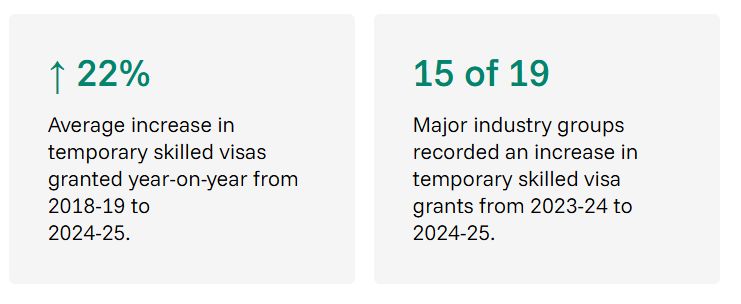
The report also shows a steady increase in the volume of temporary skilled visas granted for most industries since 2018-19.
Sustained growth across industries suggests the minimum income thresholds have not been set at too high of a level for businesses.
| Industry | Percentage change in 457/482 visa grants 2023-24 to 2024-25 |
|---|---|
| Accommodation and Food Services | ↑ 125% |
| Public Administration and Safety | ↑ 75% |
| Arts and Recreation Services | ↑ 64% |
| Administrative and Support Services | ↑ 55% |
| Rental, Hiring and Real Estate Services | ↑ 49% |
Source: Department of Home Affairs data, 2025 Skills in Demand Report – Jobs and Skills Australia.
Many of the top occupations for temporary skilled visa grants were recorded as having a national shortage rating in 2024.
This suggests the SID visa program is easing skill shortages as intended, although Jobs and Skills Australia noted further review is needed for Chefs, Cafe and Restaurant Managers, and Cooks, where no consistent link was found between skilled migration and vacancy levels.
Most visas were granted for occupations that were also listed on historical skilled migration occupation lists, suggesting the introduction of the CSOL in December 2024 had little impact on recent growth in visa grants.
At a Glance
SID Visa: Core Skills Stream and the labour market
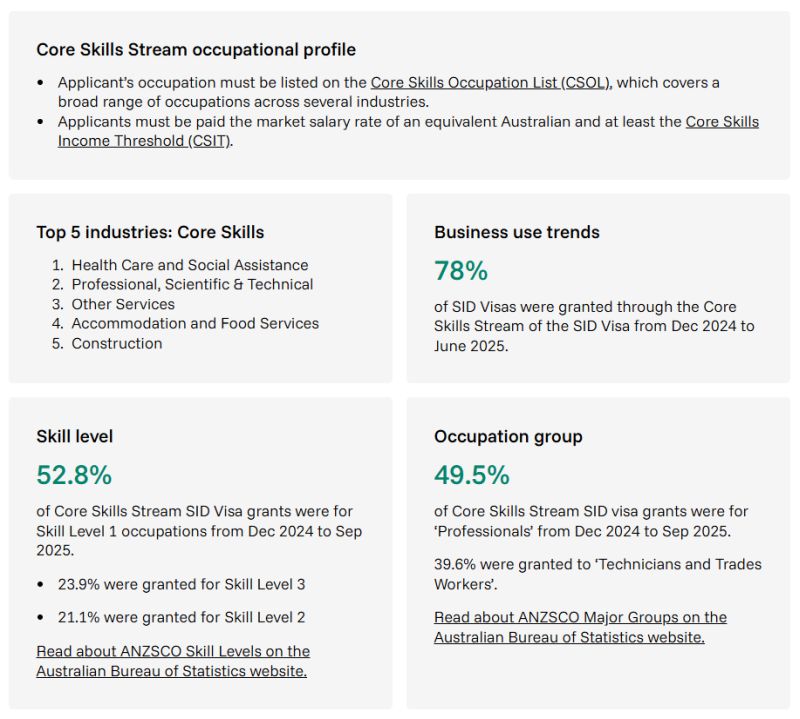
Read about ANZSCO Major Groups on the Australian Bureau of Statistics website.
| Top 10 occupations for Core Skills Stream SID visa grants: 7 Dec 2024 to 30 Sep 2025 |
|---|
| 1. Chef |
| 2. Resident Medical Officer |
| 3. Motor Mechanic (General) |
| 4. Mechanical Engineering Technician |
| 5. Software Engineer |
| 6. Child Care Worker |
| 7. Registered Nurse (Aged Care) |
| 8. Cook |
| 9. ICT Business Analyst |
| 10. Accountant (General) |
Department of Home Affairs data, 2025 Skills in Demand Report – Jobs and Skills Australia.
SID Visa: Specialist Skills Stream and the labour market
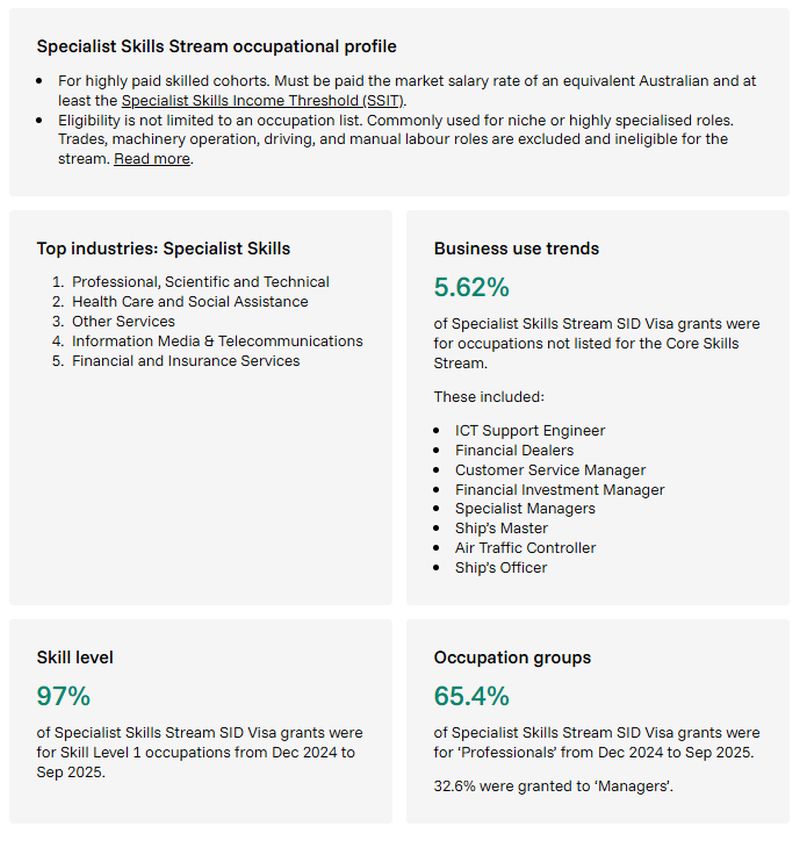
| Top 10 occupations for Specialist Skills Stream SID visa grants: 7 Dec 2024 to 30 Sep 2025 |
|---|
| 1. General Practitioner |
| 2. Corporate General Manager |
| 3. Management Consultant |
| 4. Sales and Marketing Manager |
| 5. Software Engineer |
| 6. ICT Business Analyst |
| 7. Engineering Manager |
| 8. Resident Medical Officer |
| 9. Finance Manager |
| 10. Chief Executive or Managing Director |
Source: Department of Home Affairs data, 2025 Skills in Demand Report – Jobs and Skills Australia.
SID Visa: Labour Agreement Stream and the labour market
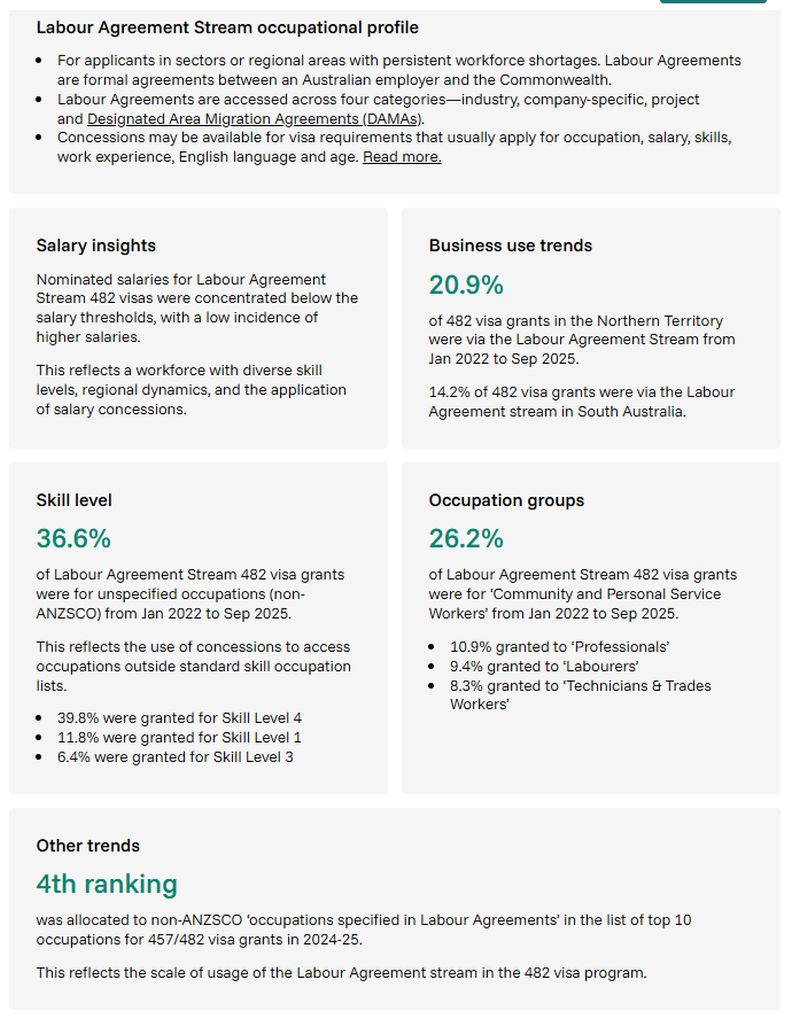
Source: Department of Home Affairs data, 2025 Skills in Demand Report – Jobs and Skills Australia.
How effective is Australia’s skilled migration program?
The 2025 Skills in Demand Report indicates the Core and Specialist Skills Streams of the SID visa program are predominantly used for higher skill occupation groups (Skill Level 1).
While the higher income threshold required by the Specialist Skills Stream helps to meet objectives in the government’s Migration Strategy to streamline visa processing to highly paid skilled applicants, this visa stream option appears to be underused compared to the Core Skills Stream.
Given the faster visa processing times, it is more advantageous for an employer to use the Specialist Skills Stream in cases where the higher income threshold can be met.
As noted in the report, businesses appear to be meeting indexed income thresholds, even where this requires paying above the average weekly earnings rates listed on Jobs and Skills Australia.
For example, for Chefs, which are among the top five occupations in the 2024-25 SID visa program, Jobs and Skills Australia data shows the average weekly earnings rate is $1,423, which is lower than the current Core Skills Income Threshold (CSIT) of $76,515 (due to be indexed further on 1 July 2026).
This suggests strong demand and business need, with employers willing to pay a premium for specific skills. However, as thresholds rise further, it will be interesting to see whether market rates will keep at pace with the indexed thresholds.
Sustainable people strategy: Global talent
Interstaff supports employers requiring sustainable global talent strategy to strengthen workforce capabilities.
Access our immigration insights to explore:
- Tools for understanding labour market trends
- Work rights and visa conditions
- Temporary and permanent visa pathways
The content of this article is intended to provide a general guide to the subject matter. Specialist advice should be sought about your specific circumstances.
[View Source]