
Article Summary
A loan default does not automatically mean that your lender can immediately repossess your property or force a mortgagee sale. In many cases, borrowers can still negotiate with the bank after a loan default, particularly if they act promptly and present a realistic proposal supported by current financial information.
Depending on the circumstances, available options may include temporary repayment arrangements, hardship assistance under the National Credit Code, loan restructuring, refinancing, or negotiating sufficient time to complete a voluntary sale. Consumer borrowers may also have important statutory rights under the National Credit Code, including the ability to give a hardship notice and request that the credit provider consider changes to the credit contract.
If negotiations do not resolve the default, lenders may enforce their contractual and statutory rights by issuing default notices, commencing court proceedings where required, taking possession of secured property, exercising a power of sale, and pursuing any remaining shortfall debt. In Queensland, mortgage enforcement is also regulated by the Property Law Act 2023 (Qld), which imposes statutory duties on mortgagees exercising a power of sale.
Acting early, understanding your legal rights, and obtaining legal advice before enforcement progresses can significantly improve your prospects of negotiating a favourable outcome and preserving your equity.
Negotiations With the Bank After Loan Default
You can often negotiate with the bank after a loan default, and doing so as early as possible usually provides the greatest opportunity to avoid costly enforcement action. A default does not automatically result in repossession, court proceedings, or the forced sale of secured property. However, once formal enforcement begins, the lender’s negotiating position generally strengthens, while the borrower’s negotiating leverage diminishes. Acting promptly can preserve options such as repayment arrangements, hardship assistance (where available), loan restructuring, refinancing, or an agreed private sale before additional legal costs, interest, and enforcement rights further reduce your flexibility.
If you have received a loan default notice and your home or other assets may be at risk, contact us today for a free consultation with a member of our experienced insolvency team.
Can You Still Negotiate After a Loan Default?
Yes. A loan default does not automatically end your ability to negotiate with the bank. In many cases, lenders remain willing to consider commercially sensible proposals because achieving repayment without court proceedings, possession, or a mortgagee sale is often faster, less expensive, and less risky than formal enforcement. The central question for the lender is whether a negotiated outcome is more likely to maximise recovery of the debt than exercising its contractual enforcement rights.
Banks generally assess objective commercial factors rather than personal circumstances alone. A realistic repayment proposal, evidence of temporary financial difficulty, available equity, or a credible refinancing plan is more likely to attract consideration than unsupported assurances that future payments will improve.
Negotiations may involve revised repayment arrangements, temporary hardship assistance, loan restructuring, refinancing discussions, or sufficient time to complete a voluntary sale.
For credit contracts regulated by the National Credit Code, a debtor who considers that they are, or will be, unable to meet their contractual obligations may give the credit provider a hardship notice under s 72. The notice may be given orally or in writing. The credit provider must then consider whether the contract should be changed and comply with the applicable notice requirements. The Code generally applies where credit is provided to a natural person or strata corporation wholly or predominantly for personal, domestic or household purposes, to acquire or improve residential investment property, or to refinance credit used for those purposes. Credit provided wholly or predominantly for ordinary business purposes will generally fall outside the Code, although other contractual, regulatory or dispute-resolution obligations may still apply.
In Queensland, mortgage enforcement may be governed by the mortgage and loan documents, the Property Law Act 2023 (Qld), the National Credit Code where it applies, and other applicable legislation. Where court proceedings are required, the procedure is also governed by the Uniform Civil Procedure Rules 1999 (Qld).
What Options Can You Negotiate With the Bank?
After a loan default, borrowers often have more than one possible path forward. The most appropriate option depends on factors such as the type of loan, the borrower’s financial position, and the lender’s willingness to negotiate. The following comparison table summarises the most common negotiation options, when they are typically available, and the practical advantages and limitations of each. It is intended to help borrowers identify which solution may best suit their circumstances before enforcement action progresses.
| Option | When It May Be Available | Main Benefit | Key Limitation |
| Temporary Repayment Arrangement | Short-term financial hardship with capacity to resume repayments | May prevent immediate enforcement while arrears are addressed | Usually discretionary unless statutory hardship provisions apply |
| Hardship Variation | Eligible consumer loans regulated by the National Credit Code | May reduce, postpone or vary repayments | Not generally available for commercial lending |
| Loan Restructuring | Ongoing affordability issues but viable long-term repayment capacity | Creates a more sustainable repayment structure | Requires lender approval and financial assessment |
| Refinancing | Sufficient equity and ability to obtain alternative finance | May replace the existing loan and avoid enforcement | More difficult once defaults or enforcement proceedings progress |
| Voluntary Sale | Loan is no longer affordable and sale is unavoidable | May preserve more equity than a mortgagee sale | Requires sufficient time before enforcement action advances |
Temporary Repayment Arrangements
One of the most common outcomes is a temporary repayment arrangement. Depending on the circumstances, the lender may agree to reduced repayments, short-term payment deferrals, an interest-only period, or, in some cases, capitalise arrears by adding overdue amounts to the loan balance. These arrangements are usually intended to address temporary financial difficulties rather than permanently reduce the debt. Unless a borrower has statutory hardship rights under the National Credit Code, these concessions remain a matter of the lender’s commercial discretion.
This option is usually strongest when the loan default is recent, and the borrower can show the difficulty is temporary.
Loan Restructuring
Where financial difficulties are likely to continue, a broader loan restructure may be appropriate. This can include extending the loan term, changing repayment frequency to better match income, consolidating multiple facilities, or varying the security supporting the loan. Before agreeing, lenders commonly assess the borrower’s current financial position, repayment capacity, available equity, credit history, and whether the proposed restructure improves the likelihood of full recovery.
Hardship Assistance Under the National Credit Code
A debtor under a credit contract regulated by the National Credit Code may give the credit provider a hardship notice under s 72 if the debtor considers that they are, or will be, unable to meet their obligations. The notice may be given orally or in writing. The credit provider may request relevant information about the debtor’s inability to meet the obligations and about how the contract might be changed. In practice, providing current financial information, supporting material and a realistic proposal will usually assist the lender’s assessment. If the parties agree, the contract may be changed by reducing or postponing repayments or by adopting another arrangement appropriate to the circumstances. ps 73–75 deal with notification of agreed changes, applications to the court and the variation of court-ordered changes.
Can the bank refuse a hardship application?
Yes. A credit provider is not required to agree to change the contract. It may decline, for example, where the debtor does not provide information properly requested under s 72, where the credit provider does not accept that there is a reasonable basis for the debtor’s inability to meet the obligations, or where it reasonably believes that the debtor would remain unable to meet the obligations even if the contract were changed. Subject to the statutory exceptions, the credit provider must give the debtor notice of its decision within the applicable period. If no change is agreed, the notice must state the reasons for that decision and provide information about the Australian Financial Complaints Authority and the debtor’s rights under that scheme.
Voluntary Sale
If ongoing repayments are no longer realistic, negotiating sufficient time to complete a voluntary sale may produce a better financial outcome than waiting for a mortgagee sale. If a mortgagee sale is imminent, acting quickly can be critical. Our guide on How to Stop a Mortgagee Sale in Queensland explains the legal remedies that may be available before the property is sold. A private sale generally gives the borrower greater involvement in the timing, presentation and marketing of the property and may reduce some enforcement expenses. Whether it ultimately preserves more equity than a mortgagee sale will depend on the sale price, timing, costs, market conditions and the lender’s requirements.
What Factors Influence Whether the Bank Will Negotiate After Loan Default?
Borrowers often assume that negotiations depend solely on how sympathetic the bank is to their circumstances. In practice, lenders make commercial decisions based on risk, recoverability, and the likelihood that a proposed arrangement will succeed. This infographic explains the key factors lenders commonly consider when deciding whether to negotiate after a loan default.
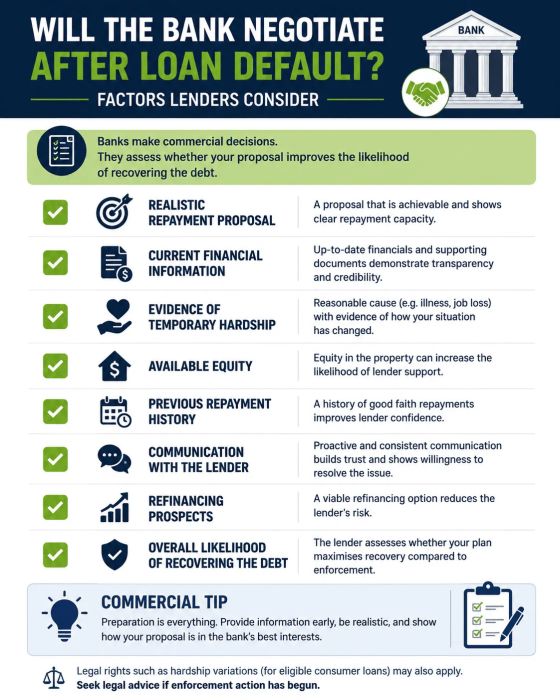
A lender’s decision to negotiate is primarily a commercial one. Rather than focusing on whether a borrower’s situation is unfortunate, the bank will assess whether a negotiated outcome is likely to maximise recovery of the debt while avoiding the cost, delay, and uncertainty of enforcement proceedings.
Borrowers are usually in a stronger negotiating position if they present a realistic repayment proposal supported by current financial information, evidence that any hardship is temporary, details of available equity, and a consistent payment history. Open communication also matters. Ignoring correspondence or providing incomplete financial disclosure often reduces lender confidence and may accelerate enforcement.
Refinancing prospects can also influence negotiations. If there is a genuine possibility of refinancing within a reasonable timeframe, a lender may be more willing to allow additional time rather than immediately pursuing possession or sale.
In practice, early engagement is one of the most important factors. Before judgment or possession proceedings commence, lenders usually have greater flexibility to negotiate practical solutions. Once enforcement has progressed, legal costs increase, additional contractual enforcement rights may become available for exercise, and the borrower’s negotiating leverage will often diminish.
What Happens If Negotiations Fail?
If negotiations do not resolve the default, the lender may proceed to exercise its contractual and statutory enforcement rights. This commonly begins with a default notice identifying the breach and allowing an opportunity to remedy it. For a Queensland mortgage to which s 114 of the Property Law Act 2023 (Qld) applies, the mortgagee must generally give notice stating the nature of the default and requiring it to be remedied within 30 days before exercising the power of sale. For a credit contract or mortgage regulated by the National Credit Code, s 88 also generally requires a compliant default notice allowing at least 30 days to remedy the default before enforcement proceedings begin, subject to statutory exceptions. If the default is not remedied, the lender may be entitled to accelerate the debt and pursue possession, appointment of a receiver, sale of the secured property, or recovery of any remaining shortfall.
If you would like to understand what happens after a repossessed property is sold, including whether you remain liable for any outstanding balance, read our article on Mortgage Sale Debt and Liability After Repossession.
For consumer loans, enforcement must comply with the National Consumer Credit Protection Act 2009 (Cth) and the National Credit Code. Commercial lending is generally governed by the loan and mortgage documents together with applicable property legislation.
In Queensland, a mortgagee exercising a power of sale is subject to the statutory duty in s 116 of the Property Law Act 2023 (Qld). The mortgagee must take reasonable care to obtain the property’s market value at the time of sale. If the mortgage is a prescribed mortgage, additional statutory requirements may apply, including obligations relating to advertising, obtaining reliable evidence of value, maintaining the property, selling by auction unless another method is appropriate, and complying with any further prescribed requirements. The mortgagee must generally give the mortgagor an approved notice about the sale within 28 days after the sale.
These statutory obligations operate alongside the established principles discussed in cases such as Forsyth v Blundell (1973) 129 CLR 477; [1973] HCA 20 and Pendlebury v Colonial Mutual Life Assurance Society Ltd (1912) 13 CLR 676; [1912] HCA 9. Those authorities establish that a mortgagee is not a trustee of the power of sale for the mortgagor and may act to recover its own debt, but must not act fraudulently, wilfully or recklessly so as to sacrifice the mortgagor’s interests. In a current Queensland article, however, the express duty imposed by s 116 should be treated as the primary statement of the mortgagee’s sale obligation.
Common Mistakes Seen in Practice
One of the most common mistakes I see is borrowers waiting until court proceedings or possession action has commenced before seeking advice. By that stage, legal costs have usually increased and many practical negotiation options have narrowed. Early engagement will usually provide greater flexibility and more time to investigate repayment, refinancing, restructuring or sale options.
Another recurring issue is presenting unrealistic repayment proposals that are unsupported by financial information. Lenders expect borrowers to demonstrate how repayments will actually be made, not simply promise that circumstances will improve. Attempting to conceal assets, income or liabilities can also undermine credibility and bring negotiations to an end.
I also regularly encounter borrowers who assume that any hardship request indefinitely prevents enforcement or that informal conversations with the bank suspend their contractual obligations. That is not correct. For a credit contract regulated by the National Credit Code, a qualifying hardship notice can impose temporary restrictions on the commencement of enforcement proceedings under s 89A. Those restrictions are subject to statutory conditions and do not permanently extinguish the lender’s enforcement rights. Informal negotiations, by themselves, should not be treated as an agreement to suspend enforcement unless the lender has clearly confirmed that position.
Finally, many borrowers delay exploring refinancing until equity has diminished or overlook the exposure of family members who have provided personal guarantees. If you have signed a personal guarantee for business or investment borrowing, our article Personal Guarantees: What Assets Are At Risk? explains which personal assets may be exposed if the underlying debt cannot be repaid.
In my experience, identifying these issues early often produces significantly better commercial outcomes than reacting after enforcement has already begun.
Common Misconceptions About Negotiating After Loan Default
Several common misconceptions can lead borrowers to make costly decisions. A lender is not generally required to accept a repayment or restructuring proposal merely because a borrower has defaulted, although statutory duties to consider and respond to a hardship notice may apply under the National Credit Code. Receiving a default notice does not necessarily mean that repossession or sale is inevitable if the default can be remedied or another arrangement can be reached. A qualifying hardship notice may temporarily restrict the commencement of enforcement under s 89A, but it does not permanently prevent the lender from enforcing its rights. Delaying action in the hope that circumstances improve can reduce the options available. Where a sale is unavoidable, an early negotiated private sale may provide greater control and reduce enforcement expenses, although the outcome will depend on the property, the market and the terms permitted by the lender.
What Should You Do Immediately After Receiving a Loan Default Notice?
Receiving a loan default notice can be stressful, but the decisions you make over the following days can significantly affect the outcome. Acting promptly may preserve opportunities to negotiate with the lender, refinance the loan, or resolve the default before enforcement action progresses. Delaying your response, on the other hand, can reduce your available options and increase legal costs.
The following practical steps are usually worth considering as soon as you receive a default notice.
Carefully Read the Default Notice
Begin by reading the notice carefully. Check the amount said to be outstanding, identify the nature of the alleged default, and note the date by which the default must be remedied. Keep copies of the notice and any accompanying correspondence. If you believe the notice contains errors or does not comply with the applicable legal requirements, obtain legal advice before assuming it is valid.
Contact the Lender Promptly
Early communication often improves the prospects of reaching a practical solution. Explain your circumstances honestly and ask whether temporary repayment arrangements, hardship assistance, loan restructuring, or additional time may be available. Confirm any agreement reached with the lender in writing and retain copies of all correspondence.
Gather Your Financial Information
Lenders are far more likely to consider a proposal that is supported by current financial information. Gather recent bank statements, evidence of income, details of your assets and liabilities, and a realistic household budget. If you intend to seek hardship assistance or negotiate revised repayment arrangements, having this information readily available can help the process move more quickly.
Consider Your Available Options
Depending on your circumstances, there may be several ways to resolve the default. These may include catching up on arrears, applying for hardship assistance (where available), negotiating revised repayment terms, refinancing with another lender, or arranging a voluntary sale of the secured property. The most appropriate option will depend upon your financial position, the amount of available equity, and the lender’s willingness to negotiate.
Do Not Ignore the Notice
One of the most costly mistakes borrowers make is assuming that the problem will resolve itself or that the lender will simply wait. Ignoring a default notice may allow the lender to continue exercising its contractual and statutory enforcement rights once the relevant notice periods have expired. Responding promptly generally preserves more options than waiting until possession proceedings or a mortgagee sale is imminent.
Obtain Legal Advice Early
If the default is substantial, enforcement proceedings have commenced, or you are unsure of your rights, obtaining legal advice as early as possible is often worthwhile. A solicitor can review the loan and security documents, assess whether statutory protections apply, advise on any defects in the enforcement process, assist with negotiations, and help you identify practical options before your negotiating position becomes more limited.
By acting promptly, maintaining open communication with the lender, and obtaining appropriate advice where necessary, borrowers can often preserve more options than if they wait until enforcement action is well underway.
Key Takeaways
Negotiating with the bank often remains possible after a loan default, but acting early usually preserves the greatest range of options. Statutory hardship protections are limited and may not apply to every loan. Well-prepared financial information and realistic proposals can significantly influence a lender’s response. Once enforcement proceedings begin, obtaining timely legal advice becomes increasingly important to protect your position and remaining equity.
Frequently Asked Questions
The following frequently asked questions address common concerns after a loan default, including whether the bank must negotiate, what happens if a default notice is ignored, whether hardship assistance or refinancing may still be available, and when enforcement action can lead to repossession, mortgagee sale or shortfall debt.
Can I negotiate with the bank after a loan default?
Yes. A loan default does not automatically prevent further negotiations. Depending on your circumstances, the bank may consider repayment arrangements, a hardship variation (for eligible consumer loans), refinancing, loan restructuring, or allowing time for a voluntary sale. Acting promptly usually gives you the greatest negotiating leverage.
What happens if I ignore a default notice?
Ignoring a default notice can allow the lender to exercise its contractual enforcement rights. Where you believe a default notice has not complied with the law or your loan agreement, our article on Challenging a Mortgage Default Notice in Queensland explains when enforcement may be disputed and the steps available to borrowers.
This may include accelerating the loan, commencing court proceedings where required, taking possession of secured property, selling it under a power of sale, and pursuing you for any remaining shortfall debt if the sale proceeds are insufficient.
Can the bank refuse to negotiate after a loan default?
Yes. A lender is not generally required to accept a borrower’s proposed arrangement. However, specific statutory obligations may apply. Under s 72 of the National Credit Code, a regulated credit provider must consider and respond to a qualifying hardship notice. In addition, a debtor, mortgagor or guarantor who has received a default notice under s 88 may request under s 94 that the credit provider negotiate a postponement of enforcement. The credit provider must respond to that request within the prescribed period, although it is not necessarily required to agree to negotiate or to grant the postponement.
Can I apply for financial hardship after receiving a default notice?
Yes. If your credit contract is regulated by the National Credit Code and you consider that you are, or will be, unable to meet your obligations, you may give the credit provider a hardship notice under s 72. The notice may be given orally or in writing. You should act promptly and provide any relevant financial information requested by the credit provider, together with a realistic proposal where possible.
How long do I have to negotiate before the bank starts enforcement?
The available time depends on your loan agreement, the nature of the default, and the lender’s actions. Negotiations are usually most effective before judgment, possession proceedings, or a mortgagee sale begins. Delaying your response generally reduces your available options and bargaining position.
Can I refinance my loan after defaulting?
Sometimes. Refinancing may still be available if you have sufficient equity, stable income, and a lender willing to accept your application. The sooner refinancing is explored after default, the greater the likelihood of preserving your options before enforcement progresses.
Will negotiating with the bank stop repossession?
Not automatically. Unless the lender agrees to suspend enforcement or a legal requirement applies, negotiations alone do not necessarily prevent the lender from exercising its contractual or statutory enforcement rights. Any agreement to pause enforcement should be confirmed in writing.
What happens if the bank sells my property for less than I owe?
If the net sale proceeds do not discharge the secured debt, the borrower will ordinarily remain liable for the resulting shortfall, together with any interest, costs or enforcement expenses that are lawfully recoverable. The precise amount and the lender’s ability to recover it will depend on the loan and security documents, the proper application of the sale proceeds, any statutory restrictions, and the borrower’s financial or insolvency position.
Is selling my property voluntarily better than waiting for a mortgagee sale?
Often, yes. A negotiated private sale may, in some circumstances, achieve a higher sale price, reduce enforcement costs, and preserve more equity than a mortgagee sale. Whether this is the best option depends on your financial position, available time, and the lender’s willingness to allow the sale to proceed.
When should I obtain legal advice after a loan default?
If the default is significant or enforcement action has commenced, obtaining legal advice early is often beneficial. A solicitor can assess your contractual rights, advise whether statutory hardship protections apply, assist with negotiations, identify refinancing or settlement options, and help you respond to enforcement proceedings before your options become more limited.
The content of this article is intended to provide a general guide to the subject matter. Specialist advice should be sought about your specific circumstances.
[View Source]