

As we previously covered, the Supreme Court’s decision in Mullin v. Doe cleared the way for the Department of Homeland Security (DHS) to terminate Temporary Protected Status (TPS) designations. Our initial analysis can be found at this link.
On July 10, USCIS issued additional guidance confirming that affected TPS beneficiaries may continue to rely on TPS-related employment authorization documentation during the pendency of the current court orders and implementation process.
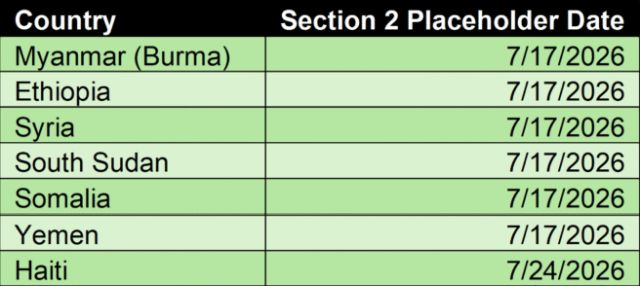
The most important takeaway from the July 10 guidance is that USCIS has issued new placeholder dates extending TPS-related employment authorization through July 17, 2026, for Myanmar (Burma), Ethiopia, Syria, South Sudan, Somalia, and Yemen, and through July 24, 2026, for Haiti. We have already seen confusion regarding prior dates. They are not deadlines for suspension or termination and should not be treated as the date on which affected employees lose work authorization. Rather, they are placeholder dates that DHS may update as the remaining litigation and implementation efforts proceed.
Specifically, Employment Authorization Documents (EADs) bearing category code A12 or C19 for individuals from Haiti, Syria, Yemen, South Sudan, Ethiopia, Myanmar (Burma), and Somalia are currently extended through the dates listed below.
DHS is actively seeking to dissolve the remaining injunctions. If those injunctions are lifted and the relevant TPS designations are terminated, affected individuals may lose TPS-based authorization to live and work in the United States unless they qualify for another immigration status or source of work authorization. Once the injunctions are lifted and DHS implements the termination of the relevant TPS designations, employers generally will be required to reverify affected employees at the appropriate time and may need to suspend or terminate employment for individuals who cannot demonstrate continuing work authorization
What Do Employers Need to Do Now?
A. New Hires Who Present an Impacted TPS EAD
For employers completing Forms I-9 for new hires during this interim period, USCIS instructs employers to enter “as per court order” for the Expiration Date in Section 1 and the “Section 2 Placeholder Date” from the below chart in Section 2 along with a note in the additional information box.
Note that, while a refusal to hire based solely on anticipated future TPS-related work authorization issues may not, in every circumstance, create liability under 8 U.S.C. § 8 U.S.C. § 1324b(a)(1), several states, including Illinois and Washington, maintain broad protections relating to citizenship or immigration status that may apply to TPS beneficiaries. Employers considering hiring, onboarding, or employment decisions based on anticipated future work authorization concerns should consult with experienced counsel before taking action.
B. Existing Employees Who Completed Form I-9 with a TPS EAD
While likely done at this point, employers should be identifying all TPS populations to ensure consistent workforce planning as we expect lower courts to eventually dissolve these injunctions. In addition to evaluating workforce needs, employers should review reverification procedures and prepare for situations in which employees are unable to demonstrate continuing work authorization once the injunctions are lifted. Lastly, employers who have a large number of impacted employees should have a draft reverification plan in place, as these individuals will have to be reverified (where possible) in a compressed timeline.
Compliance Reminders
Employers should not suspend or terminate impacted employees at this time. Again, the dates issued by DHS are just placeholders. However, we strongly encourage employers to coordinate with relevant stakeholders now to plan for the imminent loss of work authorization due to court action or DHS implementation efforts. This also includes working with talent acquisition stakeholders to build and train a “pipeline” of new hires to backfill impacted roles and operations stakeholders to determine and mitigate workforce gaps.
The Seyfarth team is monitoring developments closely and will publish additional guidance as more information becomes available.
The content of this article is intended to provide a general guide to the subject matter. Specialist advice should be sought about your specific circumstances.
[View Source]


