
- within Immigration topic(s)
- in United States
- in United States
- within Law Department Performance, Litigation and Mediation & Arbitration topic(s)
- with Senior Company Executives and HR
- with readers working within the Healthcare industries
The H-1B nonimmigrant category1 has been a target of extreme scrutiny under the current administration. H-1B sponsoring employers face a variety of new considerations affecting their petition beneficiaries such as: potential eligibility for selection in the annual H-1B lottery for cap-subject employers, costs of filing due to the H-1B Proclamation implementing the $100,000.00 payment, ability to travel internationally and return to the U.S. in H-1B status, ability to qualify for extension or change of nonimmigrant status with U.S. Citizenship and Immigration Services (USCIS) while in the U.S., the timely adjudication of filings with USCIS, and the ability to qualify for visa issuance at U.S. consular posts abroad. For that matter, the eligibility of H-4 spouses to extend their work eligibility has also been affected.
Below is a Top Ten Punch List to consider as we start the New Year:
- Payment of the $100,000.000 H-1B Proclamation Payment or Approval of a National Interest Exception (NIE) –
Before filing an I-129 petition with USCIS to request an H-1B approval of the category, an extension of H-1B status, or a change to H-1B nonimmigrant status, even cap-exempt employers (e.g. qualifying Institutions of Higher Education, nonprofit organizations related to or affiliated with an Institution of Higher Education, and nonprofit or government research organizations) must consider whether the I-129 beneficiary had an H-1B visa, pending I-129 petition with UCSCIS, or was present in the U.S. at 12:01 am eastern daylight time on Sunday, September 21, 2025 (Proclamation Effective Date).2 This analysis is critical to determine if a $100,000.00 payment or an approved NIE is required for approval.3
It is essential to note that the H-1B Proclamation is currently subject to several ongoing lawsuits; however, the Proclamation's payment and associated process remain in effect to date. We may have changes to the requirement via litigation results. The initial ruling in the Chamber of Commerce lawsuit, dated December 23, 2025, supported the executive branch's authority to issue the stated H-1B Proclamation.
- Global Nurse Force et al. v. Donald Trump et al., U.S. Dist. Ct. for the N.D. of CA, Case No. 3:25-cv-08454, filed October 3, 2025.
- Chamber of Commerce, et al. v. U.S. Department of Homeland Security, et al., U.S. Dist. Ct. for the Dist. Of Columbia, Civ. Action No. 25-cv-3675 (BAH), filed October 16, 2025.
- State of California, et al. v. Kristi Noem, DHS Secretary, et al., No. 1:25-cv-13829, U.S. Dist. Ct. for the Dist. of MA, Case No. 1:25-cv-13829, filed December 12, 2025. (20 States Case) Note that 20 states are included in this lawsuit. The states are California, Massachusetts, Arizona, Colorado, Connecticut, Delaware, Hawaii, Illinois, Maryland, Michigan, Minnesota, Nevada, New Jersey, New York, North Carolina, Oregon, Rhode Island, Vermont, Washington, and Wisconsin.
Who is subject to the H-1B Proclamation?
- H-1B I-129 petitions filed on or after September 21, 2025, for individuals who are outside the U.S. and do not hold a valid H-1B visa; and
- H-1B I-129 petitions requesting consular processing (visa issuance abroad), port of entry notification, or pre-flight inspection for beneficiaries inside the U.S.
Who is exempt from the H-1B Proclamation?
- H-1B visas issued before the Proclamation Effective Date.
- H-1B I-129 petitions filed before that date.
- Current H-1B visa holders as of the Proclamation Effective Date.
- H-1B I-129 petitions filed on or after the Proclamation Effective Date, requesting a change of status, amendment, or extension of stay for someone already in the U.S., if USCIS approves the request.
- H-1B I-129 beneficiaries approved for an amendment, change of status, or extension within the U.S., if they later travel abroad and return using the same H-1B approval.
- Rulemakings from the H-1B Proclamation
The H-1B Proclamation announced the following two prospective rulemakings.
- A rulemaking by the Department of Labor (DOL) "to revise and raise the prevailing wage levels in order to upskill the H-1B program and ensure that it is used to hire only the best of the best temporary foreign workers."4
- A rulemaking by the Department of Homeland Security (DHS) "to prioritize high-skilled, high-paid aliens in the H-1B lottery over those at lower wage levels."5
We are pending the DOL rulemaking, but DHS published a weighted selection rule for the H-1B lottery to be held in 2026 for the 2027 fiscal year on December 29, 2025.6 This final rule will be in place for the 2026 H-1B registration and selection process since it is effective on February 27, 2026.
- What to Expect from the 2026 Weighted Selection Process for the H-1B Lottery
The proposed weighted selection process with allow a beneficiary assigned a wage level IV to be entered in the selection pool four times, those assigned a level III wage level will be entered three times, and so on. The registration application process for the lottery will also include the selection of the relevant SOC code for the offered position in the area of intended employment. USCIS predicts a 48.33% reduction in the selection of Level I wage registrations in the H-1B lottery and a 55.02% increase in Level III selections and a 106.69% increase in Level 4 selections.
In applying the proposed weighted selection process to the healthcare industry, the American Hospital Association (AHA) in a letter to USCIS Director Joseph B. Edlow on October 4, 20257 noted that the latest congressional report from USCIS on the characteristics of those receiving H-1B visas shows that occupations in medicine and health had the largest variation in annual compensation between the 25th and 75th percentiles among the occupations included in their analysis.8 The report also reflects that the 2024 annual compensation for healthcare workers in the 25th and 50th percentiles was $20,000 lower than the annual compensation across all workers in the 25th and 50th percentiles.9 Based on the AHAs' review of DOL OEWS wage levels for H-1B recipients in healthcare occupations, approximately 67% of all H-1B workers (including pharmacists, technicians, physicians, and therapists) were paid Level 1 and II wage levels, while only 2.3% were paid a Level IV wage. Thus, cap-subject healthcare employers, for example, could expect further healthcare worker shortages based on the implementation of the new H-1B selection process for registration in the lottery.
- Adjudication Pauses Travel Ban Countries
On January 1, 2026, USCIS issued an updated Policy Memorandum (Jan. PM) to place a hold on the adjudication of applications filed for beneficiaries from additional high-risk countries.10 This PM is based on the December 16, 2025, Presidential Proclamation (PP) 10998 titled, "Restricting and Limiting the Entry of Foreign Nationals to Protect the Security of the United States," (PP Dec. Travel Ban).11 The PP Dec. Travel Ban expanded and continued the PP10949 issued on June 4, 2025, titled, "Restricting the Entry of Foreign Nationals to Protect the United States from Foreign Terrorists and Other National Security and Public Safety Threats," (PP June Travel Ban). Please refer to my earlier blog on this point.
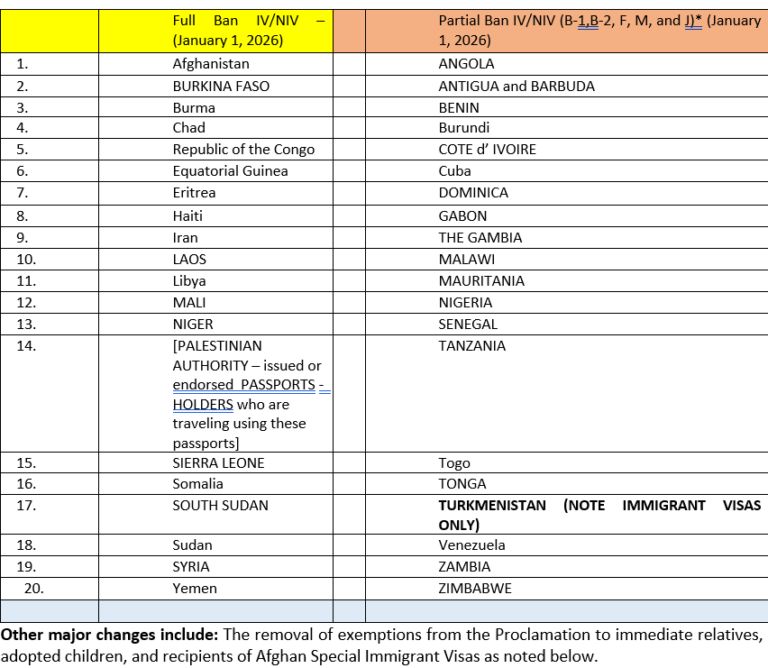
This Jan. PM clarifies that the pause for adjudications applies to the listed travel ban country nationals, including those with the listed travel ban nationality by country of birth, nationality, or "those who have acquired citizenship by investment (CBI), including those traveling on a Palestinian-Authority-issued document. The Jan. PM imposes a hold ON ALL PENDING BENEFIT applications regardless of entry date to the U.S. There is no specification of any projected longevity of the review period by USCIS.
The Jan. PM does not replace the former USCIS adjudication pause PM issued on December 2, 2025 (PM-602-0192),12 except as to the exceptions to the hold noted below. The Jan. PM also advises that within 90 days of the issuance of the PM, that "USCIS will prioritize a list for review, interview, re-interview, and referral to ICE and other law enforcement agencies as appropriate, and, in consultation with the Office of Policy and Strategy and the Fraud Detection andNational Security Directorate, issue operational guidance."
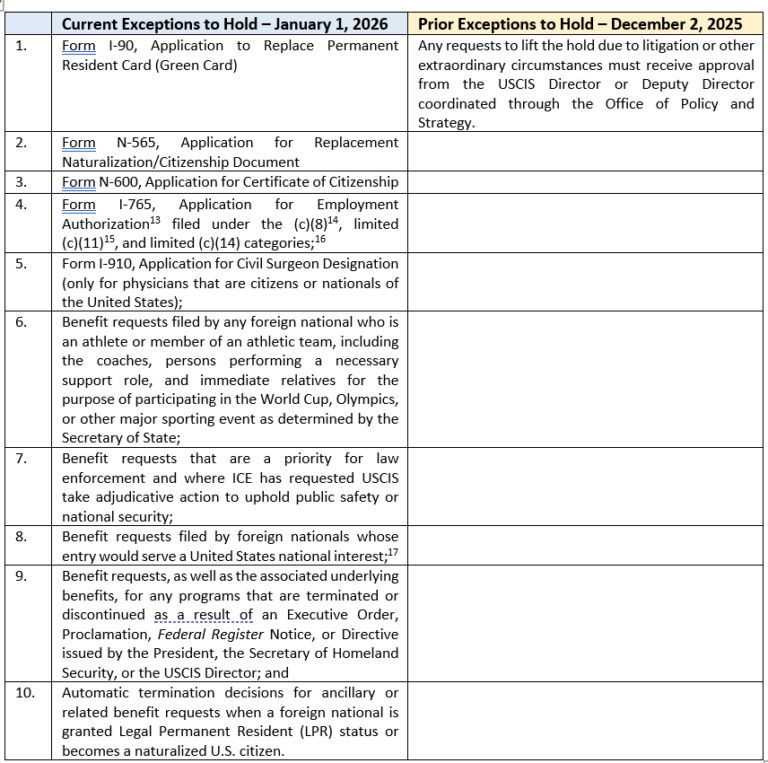
- The Travel Ban Countries as of January 1, 202618
WHO IS EXEMPT?
- U.S. Lawful Permanent Residents. Note that a holder of an immigrant visa is not a lawful permanent resident until admitted to the U.S. using their immigrant visa.
- Dual Nationals traveling to the U.S. on the passport of a country not subject to the Proclamation.
- Nonimmigrants traveling to the U.S. with a valid nonimmigrant visa in these categories: A-1, A-2, C-2, C-3, G-1, G-2, G-3, G-4, NATO-1, NATO‑2, NATO-3, NATO-4, NATO-5, or NATO-6.
- Athletes or members of an athletic team, including coaches, persons performing a necessary support role, and "immediate relatives" (e.g. spouse, parent, minor children?) traveling for the World Cup, Olympics, or other major sporting event as determined by the Secretary of State. (e.g., the 2026 FIFA World Cup). Please be aware of the FIFA Priority Appointment Scheduling System (PASS) announced by the Department of State (DOS) on November 17, 2025 https://www.state.gov/fifa-world-cup-26-visas and https://inside.fifa.com/organisation/media-releases/world-cup-2026-ticket-holders-prioritised-visa-appointments-united-states .
- Special Immigrant Visas for U.S. Government employees under 8 USC §1101(a)(27)(D).
- Immigrant visas for ethnic and religious minorities facing persecution in Iran.19
Exceptions to the suspension and limitation of entry may be made on a case-by-case basis for individuals if their travel would serve a U.S. national interest by the Attorney General, Secretary of State, Secretary of Homeland Security, or their designees, as applicable.20 (Within a 180 days of December 16, 2025 and every 180 days thereafter, the Secretary of State, in consultation with the Attorney General, the Secretary of Homeland Security, and the Director of National Intelligence, must submit a report to the President, through the Assistant to the President for Homeland Security, recommending whether any suspensions and limitations imposed by sections 2, 3, 4, and 5 of PP should be continued, terminated, modified, or supplemented.)
- C26 Work Authorization Category for H-4 Spouses of H-1Bs
The Interim Final Rule (IFR) became effective on October 30, 202521 as to certain Employment Authorization Document (EAD) renewal applications filed ON OR AFTER October 30, 2025 to end the automatic extension of work authorization by filing the I-765, Application for Employment Authorization, timely before the expiration the applicant's current EAD.22 This new rule not only ended the Biden-era 540-day extension policy, but also the 180-day period in effect in 2016.23 This change affects H-4 spouses eligible to apply for an EAD,24 in addition to E and L nonimmigrant spouses using an EAD for work authorization.
- Discretionary Analysis by USCIS and Consideration of Country Specific Facts/Circumstances
On November 27, 2025, USCIS announced in a Policy Alert (PA) that it would apply as part of its adjudication process, the assessment of country-specific facts and circumstances such as those outlined in PP 10949 regarding the travel ban to benefit adjudications. Discretionary benefit requests include, but are not limited to certain adjustment of status applications, extension of nonimmigrant stay, and change of nonimmigrant status.25 These country-specific factors, such as those specified in PP 10949, are considered as "significant negative factors."26 In these discretionary subject adjudications, even if the statutory eligibility requirements are met, USCIS may deny the benefit on discretionary grounds. Thus, USCIS adjudicating officers weigh all relevant positive and negative factors. USCIS stated in the PA that, "[t]here is no formula for determining the weight to be given a specific positive or negative factor. The weight given to each factor may vary depending on the facts of a particular case as well as the relationship of the factor to the other factors in the analysis."
Examples of Positive Factors:
- Strong family ties in the United States
- Evidence of long-term lawful presence and compliance with immigration law
- Employment history and economic contribution
- Community involvement or service
- Rehabilitation (if applicable)
- Serious medical conditions or treatment underway
- Ownership of property or a business
- Evidence of character or trustworthiness (letters of support, awards, etc.)
- Value and service to the community
Examples of Negative Factors:
- Use of aliases or inability to verify identity
- National security or public safety concerns
- Criminal history (even without conviction)
- Noncompliance with prior immigration obligations
- Espousal of anti-American views or association with groups considered security threats
- Origin from a country associated with terrorism, repatriation challenges, or strained diplomatic relations (per Proclamation)
Accordingly, practitioners should assess the potential application of the discretionary analysis and identify any additional evidence that may be necessary.
- Consular Considerations – Extreme Vetting/Social Media Settings
On December 3, 2025, DOS announced the implementation, effective December 15, 2025, of an expansion of an online presence review for all H-1B applicants and their dependents.27 Just as required previously for F, M, and J nonimmigrants, H-1B and H-4 visa applicants must adjust their privacy settings on their social media profiles to "public" prior to the visa interview dates, at the latest. The posted announcement ends with the warning that, " A U.S. visa is a privilege, not a right." This change has resulted in H-1B and H-4 visa scheduled interviews at consular posts in India, for example, being pushed by over six months or more. The consular posts attribute the delays to a reduction in their volume of potential daily visa adjudications. In response, the Indian External Affairs Ministry spokesperson stated the Indian Government is raising related concerns with the U.S.28
- In-Person Interviews and Third-Country National Restrictions
On July 25, 2025, the DOS required most non-immigrant visa applicants to undergo in-person interviews, including children under 14 and adults over 79. This change also affected the renewal of non-immigrant visa applications.29 This interview waiver was updated on September 18, effective for visa applications as of September 18, 2025, with modifications for H-2A visa renewals.30 Interview waivers were also only applicable if the visa applicant applied in their country of nationality or usual residence, had never been refused a visa (unless overcome or waived), and did not have apparent or potential ineligibility.
On December 12, effective immediately, DOS required all nonimmigrant visa applicants to schedule their visa interview appointments at a U.S. Embassy or Consulate in their country of nationality or residence.31 For nationals of certain countries where the U.S. government is not conducting routine visa operations, DOS-designated consular posts are available for non-immigrant visa applications for applicants from foreign countries. As to immigrants, a similar announcement was made, and starting November 1, 2025, the National Visa Center (NVC) may schedule immigrant visa applicants in their country of residence or, if requested, their country of nationality.32
- Consular Staffing Reductions and Alignment with Law Enforcement Agencies' Priorities
Since January 2025, more than 40,000 visas have been revoked, with many revocations accompanied by removal actions in the U.S. This number compares to 16,000 during the same period in 2024.33 In addition, based on a proposed Reduction in Force (RIF) by the State Department, the American Foreign Service Association (AFSA) filed a complaint and temporary restraining order (TRO) as to the RIF on December 3.34 The TRO was issued on December 4. In the AFSA report entitled "At the Breaking Point – The State of the U.S. Foreign Service in 2025, it reports that approximately a quarter of America's active Foreign Service officers have left government employment in 2025, and the U.S. Foreign Service is being systematically undermined by its own leadership. In less than a year's time, a quarter of the workforce has departed. Morale is dangerously low."35
With the increase in in-person interviews, the reduction in third-country national appointment availability, the expansion of extreme vetting requirements, and decreased consular staffing, it is likely that obtaining consular appointments on a timely basis will be challenging in 2026. However, the H-1B Proclamation, the 2026 lottery changes, the Travel Ban, and the USCIS adjudication pause may reduce some of the overall demand for consular visas as the year progresses. We will also need to monitor the impact of ongoing H-1B litigation and the potential extension of the H-1B Proclamation in September 2026. In the meantime, careful attention is required when reviewing the various issues affecting H-1B employers and their sponsored beneficiaries.
Footnotes
1. See https://www.uscis.gov/working-in-the-united-states/h-1b-specialty-occupations .
2. See H-1B Proclamation entitled, "Restriction on Entry of Certain Nonimmigrant Workers," which was issued on September 19, 2025. https://www.whitehouse.gov/presidential-actions/2025/09/restriction-on-entry-of-certain-nonimmigrant-workers/ .
3. See H-1B FAQ posted by USCIS on September 21, 2025 https://www.uscis.gov/newsroom/alerts/h-1b-faq .
4. Id.
5. Id.
6. See 90 Fed. Reg. 60864 (Dec. 29, 2025).
7. See https://www.aha.org/lettercomment/2025-10-24-aha-comments-dhs-proposed-h-1b-visa-weighted-selection-process and https://www.uscis.gov/sites/default/files/document/reports/ola_signed_h1b_characteristics_congressional_report_FY24.pdf .
8. Id.
9. Id.
10. See PM-602-0194, https://www.uscis.gov/sites/default/files/document/policy-alerts/PM-602-0194-PendingApplicationsAdditionalHighRiskCountries-20260101.pdf .
11. See https://travel.state.gov/content/travel/en/News/Intercountry-Adoption-News/presidential-proclamation-10998-on-restricting-and-limiting-the-.html, https://travel.state.gov/content/travel/en/News/visas-news/suspension-of-visa-issuance-to-foreign-nationals-to-protect-the-security-of-the-united-states.html?cq_ck=1766184906564, and https://www.whitehouse.gov/fact-sheets/2025/12/fact-sheet-president-donald-j-trump-further-restricts-and-limits-the-entry-of-foreign-nationals-to-protect-the-security-of-the-united-states/ .
13. See https://www.uscis.gov/employment-authorization .
14. See 8 CFR §274a.12(c)(8). Only applies to initial (c)(8) filings – Asylum application pending filed on/after Jan. 4, 1995. Asylumworks v. Mayorkas requires USCIS to process all initial Form I-765 filed under the (c)(8) category within 30 days.
15. See 8 CFR §274a.12(c)(11). Form I-765 filed under the (c)(11) category exceptions only apply when the request comes from law enforcement because the alien is assisting law enforcement, (c)(11) filings refer to public interest parolees.
16. See 8 CFR §274a.12(c)(14). Form I-765 filed under the (c)(14) category exceptions only apply when the request comes from law enforcement because the alien is assisting law enforcement. (c)(14) filings refer to deferred action beneficiaries.
17. "For example, a benefit request filed by an alien whose entry into the United States would provide significant benefit to the United States may include, but is not limited to, a scientist or medical researcher working on a critical public health project, an engineer with specialized skills needed for a key infrastructure initiative, or someone with unique expertise supporting U.S. national security or economic interests. This is a case-by-case determination and requires approval from the headquarters of the adjudicative directorate or program office."
18. See https://www.whitehouse.gov/fact-sheets/2025/12/fact-sheet-president-donald-j-trump-further-restricts-and-limits-the-entry-of-foreign-nationals-to-protect-the-security-of-the-united-states/ and https://www.whitehouse.gov/presidential-actions/2025/12/restricting-and-limiting-the-entry-of-foreign-nationals-to-protect-the-security-of-the-united-states/ .
20.Id. Note – Within a 180 days of December 16, 2025 and every 180 days thereafter, the Secretary of State, in consultation with the Attorney General, the Secretary of Homeland Security, and the Director of National Intelligence, must submit a report to the President, through the Assistant to the President for Homeland Security, recommending whether any suspensions and limitations imposed by sections 2, 3, 4, and 5 of PP should be continued, terminated, modified, or supplemented.
21. See 90 Fed. Reg. 48799 (Oct. 30, 2025)
23. See Orozco, Adriel, "USCIS ends Automatic Extensions for Most Work Permits, Placing Immigrant Workers and Employers in Limbo," published by the American Immigration Council (October 31, 2025) https://www.americanimmigrationcouncil.org/blog/uscis-ends-automatic-extensions-for-work-permits/ .
24. See https://www.uscis.gov/working-in-the-united-states/temporary-workers/h-1b-specialty-occupations/employment-authorization-for-certain-h-4-dependent-spouses The H-1B spouse must be a principal beneficiary of an approved I-140, Immigrant Petition for Alien Worker, or have been granted H-1B status under sections 106(a) and (b) of the American Competitiveness in the Twenty-first Century Act of 2000 as amended by the 21st Century Department of Justice Appropriations Authorization Act (AC21).
25. See https://www.uscis.gov/policy-manual/volume-1-part-e-chapter-8 Note that the I-129 form is not a discretionary benefit filing with some exceptions. "Certain immigration benefits are not discretionary.[7] In these cases, if the requestor properly filed and meets the eligibility requirements then USCIS must approve the benefit request. There is no discretionary analysis as part of the adjudication, and these requests cannot be denied as a matter of discretion."
26. See PA-2025-26 https://www.uscis.gov/sites/default/files/document/policy-manual-updates/20251127-Discretion.pdf .
29. See https://travel.state.gov/content/travel/en/News/visas-news/interview-waiver-update-july-25-2025.html .
30. See https://travel.state.gov/content/travel/en/News/visas-news/interview-waiver-update-sept-18-2025.html .
33. See An unidentified "senior State Department official" told Fox News in an email that roughly 6,000 student visas have been revoked since January 2025. Of those, the official said that about 4,000 were for DUI, assault charges, or overstay, and "between 200-300" revocations were due to "support for terrorism." Rubio's State Department Yanks More Than 6K Student Visas Due to Assault, Burglary, Support for Terrorism, Fox News (Aug. 18, 2025), https://www.foxnews.com/politics/rubios-state-department-yanks-more-than-6k-student-visas-due-assault-burglary-support-terrorism. In addition, these numbers were also reported in Frances Vinall in the article titled, Over 6,000 Student Visas Revoked for Crimes and Overstays, U.S. Says, WASH. POST (Aug. 19, 2025), https://www.washingtonpost.com/education/2025/08/19/student-visas-revoked-6000-trump/. The State Department it did not corroborate these figures in press briefings. There is little information about the total number of visa revocations since January (of which students are only a small portion), but the same unnamed official told Fox News the number was 40,000.
34. See https://www.afge.org/publication/state-department-violating-law-in-attempt-to-fire-foreign-service-officers-and-staff-unions-assert-in-amended-lawsuit/?
fbclid=IwY2xjawO2illeHRuA2FlbQIxMQBicmlkETFqU0cwaU9yelFtdHNoR25zc3J0YwZhcHBfaWQQMjIyMDM5MTc4ODIwMDg5MgABHjB8abMZElh
Z1OEGJbBWMC1wwf4G06GyDeoJhnV1ly2JuAT9kucsSbEwxZor_aem_SRzCLtRNse_IsvNFxfzeeg
and American Federation of Government Employees, AFL CIO v.
United States Office of Management and Budget (3:25-cv-08302,
(N.D. Cal.).
35. See https://afsa.org/at-the-breaking-point .
The content of this article is intended to provide a general guide to the subject matter. Specialist advice should be sought about your specific circumstances.
[View Source]