- with readers working within the Healthcare industries
- within Intellectual Property, Criminal Law and Strategy topic(s)
AI shopping agents are here. No longer a futuristic concept, these sophisticated tools are already reshaping how consumers discover, understand, and interact with products, and will soon revolutionise how we buy them. Crucially, agentic AI capabilities now also enable the AI agent to perform tasks on behalf of customers.
Two distinct types of agents are now emerging: customer-facing agents – where customers use tools like ChatGPT or Google Gemini to search, compare, and purchase products – and retailer-owned agents, such as Amazon's Rufus, which operate within retailers' own ecosystems to improve product discovery, service, and conversion. Over time, these two types will increasingly interact, with customer agents surfacing structured product data provided by retailer agents, comparing images, features, prices, and availability, and potentially negotiating prices or delivery windows in the near future. The future of commerce will increasingly be defined by how these agents communicate and transact across this new, AI-mediated channel.
As these agents take on more of the discovery journey, the very nature of search is undergoing a transformation. Answer engines are replacing search engines, as traditional, short keyword-based searches are replaced by natural, conversational, and multi-modal prompts – for example, "find me an art-deco influenced women's navy blue raincoat under £200, with 5-star reviews, available in size M that can be delivered by this weekend. Here is a photo of me – please consider what cut would be most flattering." What used to be a static list of website links is becoming an interactive, personalised exchange where the agent curates, compares, and refines results instantly. Discovery, advice, and purchase are converging into a single interaction.
Unlike traditional chatbots that rely on scripted responses, AI shopping agents are evolving from having conversations to performing tasks on behalf of customers, such as automatically adding items to a shopping cart (auto-carting) and even completing a purchase. The shift from simple assistance to autonomous actions is accelerating at remarkable speed. Recently,OpenAI announcedInstant Checkout for ChatGPT, which enables auto-carting and purchasing to take place within ChatGPT – rather than on the retailer website – and partners already include Etsy, Shopify, and Walmart. This marked the first scaled step into auto-carting and purchasing.
The impact of agents in shopping is already clear:traffic to retail sites from generative AI-powered chatbots serving as shopping assistants has increased by1,300% year-over-year. The shift from discovery to transaction has begun, and the adoption curve is accelerating more quickly than many anticipated. There is also growing evidence that shoppers who visit a retailer's website via a generative AI tool are higher-quality visitors, with longer dwell times, higher page views, and lower bounce rates.
But with this shift comes new risks. Customer agents will increasingly search across multiple retailer sites, surfacing product descriptions, specifications, pricing, and availability in easy-to-compare summaries for customers to evaluate. Retailers that don't provide accurate and transparent product data risk becoming invisible or second-tier options for these systems. As discovery becomes more functional and data-driven, the traditional power of a brand may also weaken if consumer perception is increasingly influenced by product data elements, such as price, inventory position, fabric composition, rating, and transit time, rather than by emotional storytelling.
Of course, retail has always been a disrupted industry. From the early days of mail-order catalogues to phone orders, e-commerce, and mobile shopping, each step has represented a seismic shift that expanded a retailer's addressable customer base while increasing the speed at which they could reach them.
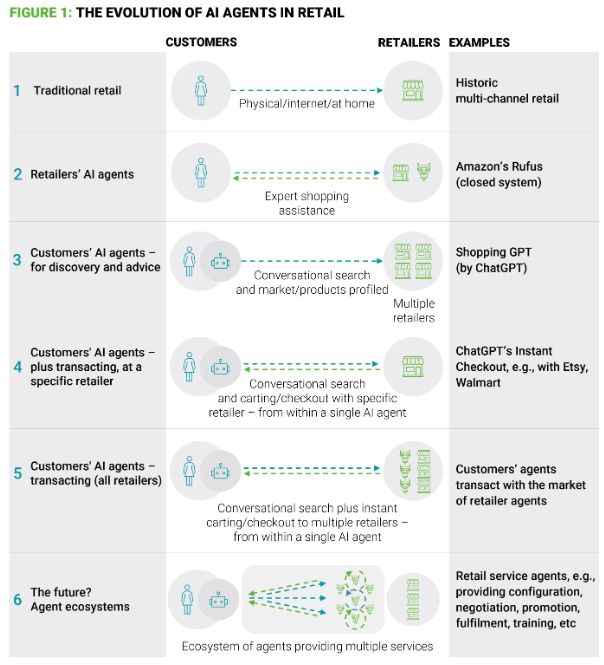
However, this is also a moment that calls for urgent attention. AI-driven purchasing is accelerating at a rate faster than any previous disruption.AlixPartners' 2024 Digital Disruption Surveyfound that retailers who adapt early to new technologies consistently outperform their peers in both growth and profitability, while those who fail to adapt risk losing relevance.
What AI shopping agents will mean for customers and retailers
Retailers have long focused on reducing friction in the shopping experience, and AI shopping agents represent the next frontier in that evolution. These agents are not only streamlining existing processes but also introducing entirely new, tailored experiences, spanning discovery to checkout. Agents are becoming a new channel – in effect, a new set of customers.
Emerging applications of AI shopping agents
Envision how this evolution will unfold in real-world scenarios:
- Personalised product discovery:Through AI interfaces like ChatGPT, a user might prompt: "Find me a stroller safe for newborns, under £500, fits in a small car boot, and available for delivery this week." The AI agent evaluates the query and delivers two curated options complete with stock availability, all within seconds, eliminating the need for the user to visit multiple websites or perform comparisons manually.
- Customised solutions:On an AI-powered e-commerce platform, a skincare conversation that analyses customer preferences and concerns, or customer photos, enables an AI agent to build a complete, customised skincare regimen. Not only are products added to the cart automatically, but bundling discounts are also applied, saving the customer considerable time and money and drivingsignificant increases in basket values, a major factor in driving e-commerce profitability improvement.
- Hyper-efficient checkout:For last-minute needs, an agent might respond to a query such as, "Order me a small pack of batteries for a Peugeot 5008 key fob, under £10, and deliver by tomorrow," or simply, "order me a battery like this," using an uploaded photo. The system autonomously checks stock, applies the most favourable discounts, and completes the purchase – all in one seamless transaction.
For consumers, the benefits are clear. Consumers gain a richer discovery and selection process, providing greater reassurance, particularly on more complex purchases, and can also transact with greater speed, precision, and confidence – compressing shopping journeys from days to minutes.
The complexity for retailers
However, AI-driven ease for consumers introduces a new level of complexity for retailers. Agentic commerce is now a new channel for retailers, and GEO (Generative Engine Optimisation) has emerged as a critical capability. Competing in an agent-driven world means retailers must rapidly adapt their e-commerce ecosystems, including improving machine readability, creating human-like text exchange, addressing new risks in trust and governance, rethinking economics and loyalty levers, and revisiting the fundamental role of stores, marketing, and data.
The leadership agenda for an agent economy in retail
Retailers cannot afford to wait. The speed of adoption means that acting early is essential. CEOs need an immediate, proactive strategy to stay competitive, as outlined by these siximperatives:
- Commit incremental funding and resources now:Rapidly assess what AI shopping agents mean for your business, and establish agile plans to engage immediately with shopper agents, as an overlay to existing digital and ecommerce roadmaps.
- Ensure site and data compatibility with agentic discovery:Task digital teams to ensure product information, images, pricing, availability, and metadata are structured in ways that customers' agents can easily interpret, compare, and surface, so that your business and products are prominent and distinctive proposition elements are highlighted. Master the new technical protocols being established by key players in order to engage effectively, and potentially deploy writers' agents to help you do this.
- Prepare the organisation for an agentic future:Assess how AI shopping agents will impact your brand, margins, customer metrics, and capabilities. Define the talent, governance, and commercial levers needed to sustain advantage as discovery and loyalty shift toward AI-mediated journeys.
- Consider re-architecting your website to include agentic AI and conversational search:As customers come to expect conversational search, retailers who continue to rely on simple search and left-hand filters will get left behind.
- Explore disruptive business model opportunities:Brainstorm how agentic commerce could reshape your business and category proposition, and particularly those where customers value advice, reassurance, and simplification of the purchase journey.
- Protect against emerging risks:As agents evolve to autonomous actors, businesses must build clear guardrails and escalation protocols. Cyber policy and systems need an upgrade. Without these, a rogue pricing decision, faulty recommendation, or hallucinated product claim could instantly trigger financial, legal, and reputational risk at machine speed. The rapid adoption of AI shopping agents means the risks of inaction are profound. Leaders who delay implementation will find their businesses increasingly invisible in this new ecosystem.
As AlixPartners' Brian Kalms noted recently inRetail Week, "In a flat-growth market, technology isn't just an enabler – it differentiates winners and losers."
The world of AI-assisted commerce is evolving at extraordinary speed, and while the exact trajectory and winning models are difficult to predict, the imperative for retailers is to proactivelyengage with this new channel now.
The content of this article is intended to provide a general guide to the subject matter. Specialist advice should be sought about your specific circumstances.