
- within Employment and HR topic(s)
- in European Union
- in European Union
- with readers working within the Utilities industries
- within Transport and Cannabis & Hemp topic(s)
International workforce management has always required employers to navigate legal complexity across borders. Employment law, immigration, global mobility, workplace privacy, consultation, pay transparency and crisis response all remain critical parts of the international employer agenda.
The nature of that agenda, however, is now changing. These issues continue to raise important legal or compliance questions, while also signalling a broader shift in how international workforces are being designed, governed and led.
For employers operating across jurisdictions, compliance remains the starting point, but the wider strategic risk is to understand what legal and regulatory change reveals about the workforce, and what organisational capabilities employers need to build in response.
That was the central theme of the Future of Work Hub’s lunchtime session at this year’s Managing an International Workforce conference. Drawing on the findings of our Future@Work 2026 report, we explored four signals shaping tomorrow’s international workforce: the shift from confidence to capability, from mobility to workforce design, from AI adoption to workforce governance, and from reaction to resilience.
Together, they point to a clear conclusion: international workforce management is becoming less about responding to isolated issues, and more about building the capabilities employers need to adapt across borders.
From confidence to capability
One of the strongest themes in our Future@Work 2026 report is what we describe as the ‘readiness mirage’: the idea that headline confidence can mask deeper structural weaknesses.
On the surface, many employers feel well prepared for change. In our research, 41% of organisations said they were ‘very well’ prepared for developments in AI and technology, and a significant majority described the overall pace of change as manageable across the areas we explored.
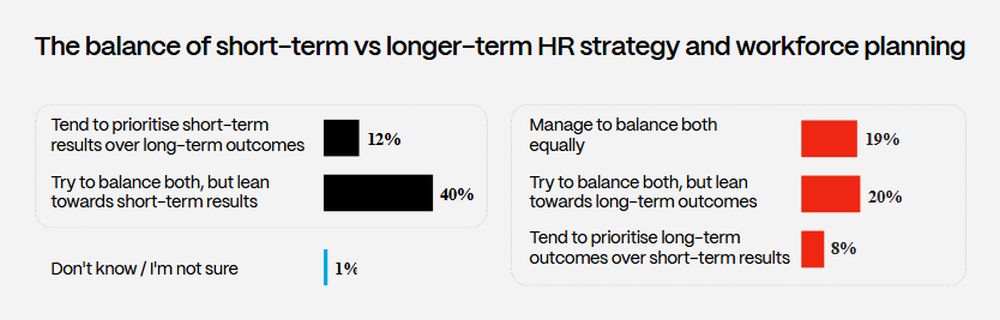
That confidence, however, needs to be tested against the deeper capabilities organisations have in place. Planning is a good example. While 79% of respondents to our Future@Work research said they aimed to balance short- and long-term priorities, more than half, 52%, still ended up prioritising or leaning towards the short term.
That short-term pull is then reinforced by external pressure: 79% said political and regulatory uncertainty hindered sustained HR strategy and long-term workforce planning, while 57% pointed to economic pressures as a significant constraint.
These findings are echoed by PwC’s 2026 Global CEO Survey, which found that CEOs spend 47% of their time on issues with time horizons of less than one year, compared with only 16% on activities with horizons of more than five years. The same pattern appears across many organisations: leaders recognise the need to prepare for longer-term change, while immediate operational, political and economic pressures continue to absorb attention.
Many organisations are good at immediate responsiveness: they can react quickly, mobilise teams, manage urgent issues and keep the business moving. Long-term capability, however, requires something deeper: the ability to anticipate, govern and adapt beyond the issue immediately in front of the organisation.
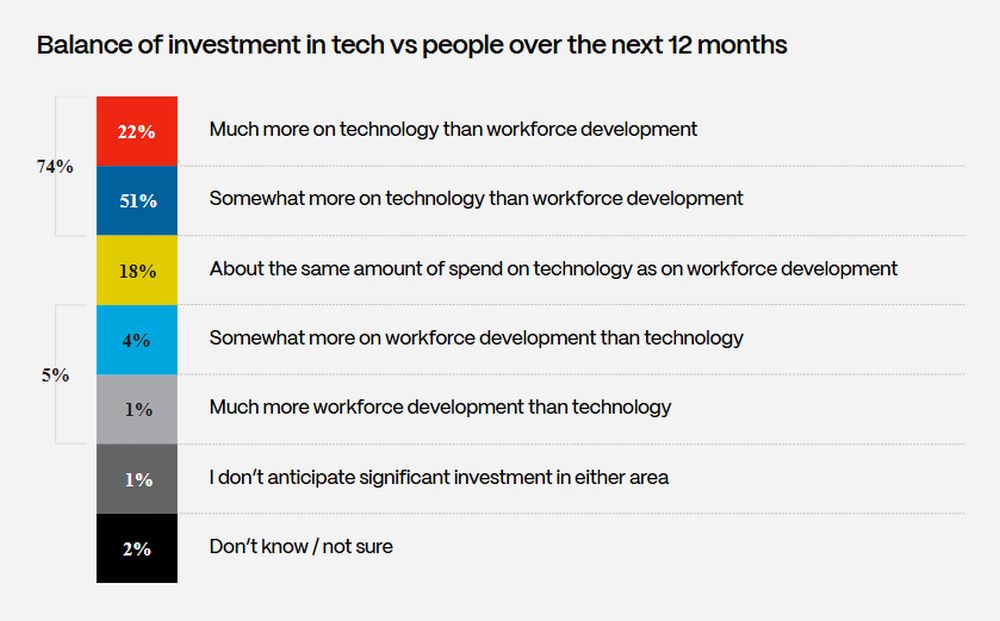
Investment choices also corroborate the gap. Our research found that 74% of investment is skewed towards technology, data and platforms, while only 5% of organisations prioritise workforce development over technological investment. Organisations recognise the importance of skills and capability, but investment does not always follow the need.
Deloitte’s 2026 Human Capital Trends report, which we recently wrote about, makes a similar point: organisations taking a tech-focused approach to AI are more likely to underperform those taking a human-centred approach. This suggests that technology investment alone is unlikely to deliver value without corresponding investment in people, work design, leadership and governance.
The same issue applies to skills infrastructure. BCG and the World Federation of People Management Associations (WFPMA) found that only 54% of respondents use skills-based matching, 48% run structured reskilling programmes, and just 11% have a full enterprise-wide skills taxonomy. This gives a practical example of the gap between recognising skills as strategically important and having the organisational infrastructure to manage them properly.
For international employers, the distinction between short-term responsiveness and long-term capability is particularly critical. Cross-border workforce issues rarely sit neatly in one function, and legal, HR, immigration, mobility, tax, privacy, technology, compliance and business leadership all need to be connected. Yet, while organisations may be busy, compliant and responsive in individual areas, they might also still lack a joined-up view of how the workforce is changing.
The practical question is therefore: “what workforce capabilities do we need to build in order to respond well over time?”.
From mobility to workforce design
International workforce management has often been framed around movement. Can this person travel? Can they work remotely from another country? Can we assign someone to another market? Can we hire someone where they are based?
Those questions remain highly relevant, but they now sit inside a bigger future-of-work question: where should work happen, where will future skills come from, and what kind of international workforce model are we building?
A useful way to think about this is as a question of capability geography: where skills exist, where work can realistically be done, where regulatory and geopolitical constraints allow it, and where the organisation can build durable workforce strength rather than short-term workarounds.
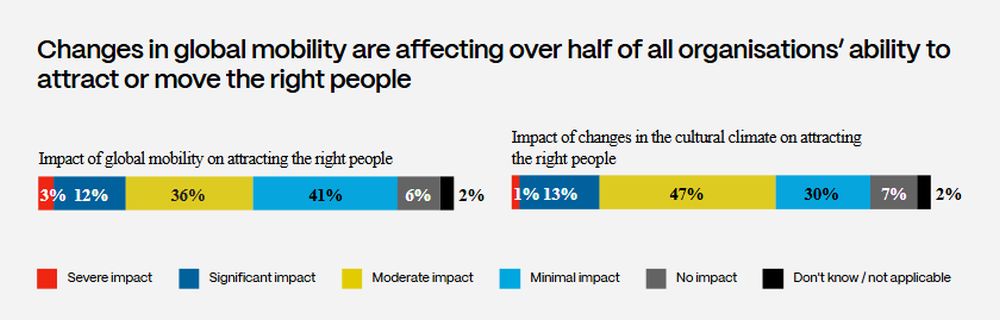
These questions are amplified by rising workforce pressure. In our Future@Work research, 79% of employers said they expect their skills requirements to increase, and 62% expect the size of their workforce to grow over the next year. At the same time, access to the best people is becoming more constrained: 51% said immigration constraints are limiting access to the right skills, while broader geopolitical and cultural shifts are making it harder to attract or move people for 61% of organisations.
This is consistent with wider labour market research. The World Economic Forum’s Future of Jobs Report 2025 found that skills gaps in the labour market are the top barrier to business transformation for 2025 to 2030, cited by 63% of surveyed employers. The WEF has also highlighted that geopolitics and geoeconomics are now directly affecting access to skills and workforce planning, including through labour market interventions, migration and visa restrictions, cyberthreats and regional cost pressures.
In this context, the international workforce extends well beyond expatriates, secondees or formal assignments. Rather, it includes frequent business travellers, temporary cross-border remote workers, international project teams, roles hired in different markets and managers leading people they may rarely meet in person. The WEF has found that 27% of employers globally see enabling remote work across national borders as a promising measure to increase the availability of the right people.
The risk is that international workforce models develop almost by accident. One hiring decision, one remote working exception, one travel pattern, one urgent skills gap or one local workaround may seem manageable on its own. Together, however, they start to determine where work is done, where capability sits, where costs build and where risk accumulates.
Cross-border remote work can begin as a flexibility request but quickly trigger employment law, health and safety, data protection, tax, social security and permanent establishment issues across jurisdictions. Ius Laboris has noted, for example, that hiring ‘satellite employees’ who work from their country of residence can avoid some immigration issues, but raises wider questions about local legal presence, registration, employment terms, health and safety, taxes, social security and permanent establishment risk.
We can already see organisations making these structural choices. In response to geopolitical, regulatory and economic instability, 38% are adjusting their workforce mix, and 32% are increasing flexible or remote working models. Those may be sensible responses, but the question is whether they add up to a deliberate workforce design strategy, or whether they are happening reactively.
The WEF has framed international mobility and diversified skills pools as increasingly important to resilience in a fragmented labour market. That is unequivocally the direction of travel: mobility is becoming less about individual movement alone, and more about how organisations build adaptable, geographically distributed capability.
For international employers, this means moving from permission questions to design questions. Instead of looking only at whether a particular person can work or travel in a particular place, organisations need to ask “where work should happen, where future skills will come from, and how the international capability they need can be built sustainably”.
From AI adoption to workforce governance
AI is one of the clearest examples of the gap between confidence and capability. Many organisations are already using, piloting or exploring AI across the employee lifecycle: recruitment, performance management, employee listening, workforce planning, learning, productivity tools and decision support.
The key future-of-work question, however, is how organisations govern AI’s use responsibly, consistently and effectively across borders.
In our Future@Work research, 41% of organisations said they were very well prepared for developments in AI and technology. There is also a clear sense of opportunity: organisations expect AI to improve productivity, decision-making, workforce experience and customer experience.
But the risks and capability gaps are also significant. The top AI challenge identified by respondents was cybersecurity and data privacy risk, cited by 60%. Organisations also pointed to resistance to change, regulatory uncertainty, lack of workforce skills and training, difficulty identifying the right use cases, and limited leadership knowledge or vision for AI.
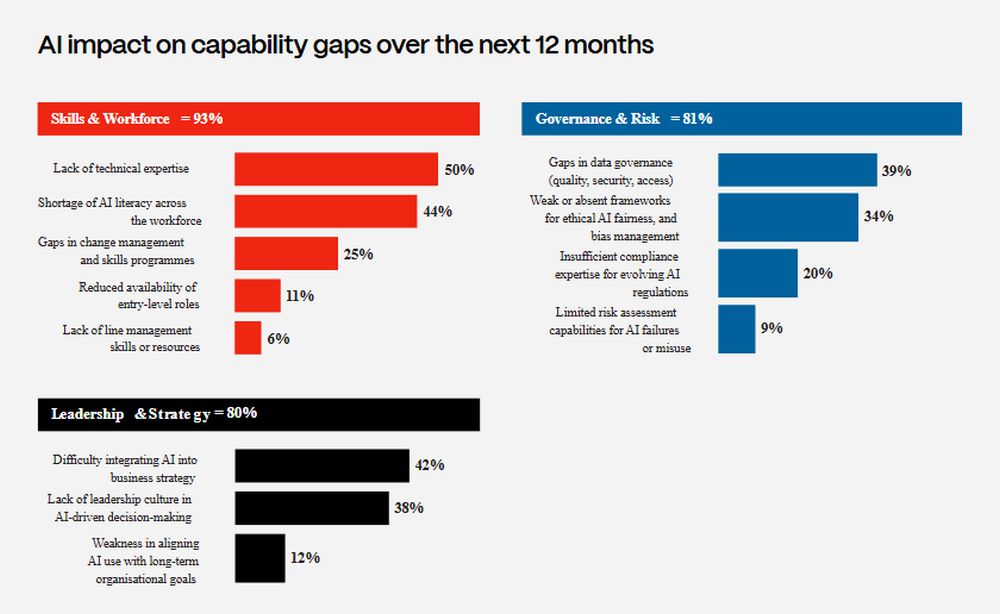
The deeper capability gaps are even more striking. 93% of organisations expect skills and workforce capability gaps linked to AI adoption. 81% report governance and risk capability gaps. 80% report leadership and strategy gaps. Access to AI tools therefore forms only one part of the challenge: organisations also need the skills, governance structures and leadership capability to use them well.
This is consistent with wider research on AI adoption. The CIPD and the Institute for the Future of Work found that more than four in five organisations report some level of AI adoption, but much of that activity remains ad hoc and experimental, with only a small proportion integrating AI into core operations and strategy. They also found that 42% of organisations experimenting with AI are in the low organisational readiness group, compared with 14% of organisations at the integration stage.
In other words, AI activity can run ahead of organisational readiness. Employers can have pilots, tools and use cases without yet having a settled model for how AI changes work, decisions, skills, accountability and employee experience.
That is why AI governance is becoming a workforce operating model question, not only a technology or compliance question. Employers need to decide who owns job redesign, employee consultation, AI-enabled decisions, skills development, risk review, employee communication and cross-border consistency.
CIPD and IFOW make this point clearly, finding that AI adoption is an organisational challenge, with better-prepared organisations showing stronger leadership alignment, people management capability, workforce planning and work redesign. Their research also found that governance frameworks are often evolving alongside adoption rather than shaping it, and are frequently driven by legal or technical risk considerations without being fully integrated with workforce planning, job design or organisational change.
This becomes more complex for international employers who may be trying to create global standards while operating across different legal regimes, cultural expectations, data environments and levels of organisational maturity. Ownership may also be unclear. Workforce AI may involve HR, Legal, IT, Data, Compliance, local management, central leadership, or some combination of all of them.
The investment pattern reinforces the point. As noted earlier, planned expenditure remains heavily weighted towards technology, data and platforms, with workforce development receiving far less priority. In the AI context, this imbalance amplifies the risk that adoption may be advancing faster than the people, skills and governance structures needed to manage its workforce implications.
The same pattern appears in HR-specific research. BCG and WFPMA found that concerns about data privacy or compliance were the most commonly cited barrier to GenAI in HR, at 51%, followed by issues including lack of internal expertise, inadequate technology infrastructure, budget or resource constraints, ethics and responsible use concerns, employee resistance, limited leadership buy-in or vision, and regulatory uncertainty. They also found that 32% of organisations have limited or no processes in place to measure the risk of GenAI use.
Fragmentation is a key risk. AI tools may be adopted locally, informally or function by function, without a clear view of cumulative risk or workforce impact. BCG and WFPMA similarly note that organisations often launch multiple uncoordinated pilots rather than focusing on a comprehensive set of linked initiatives.
Deloitte’s 2026 Human Capital Trends report adds another dimension: 60% of executives regularly use AI to support decisions, but AI use in decisions may be racing ahead of organisational oversight. Deloitte identifies risks including unclear chains of responsibility between decisions and consequences, black-box algorithms, bias, managers not being prepared to supervise AI and executives lacking sufficient AI literacy for oversight.
For employers, this means that AI governance cannot stop at policy, procurement or technical risk review: those are necessary, but they are not sufficient. Organisations also need a workforce governance strategy to connects AI adoption to job design, skills, leadership, employee voice, decision accountability and cross-border consistency.
The strategic question for employers is therefore not only “can we use this technology?” but “who is accountable for how it changes work, decisions and people management across borders?”
From reaction to resilience
International employers are operating in an environment where disruption is more frequent, more connected and harder to contain. Geopolitical volatility, regulatory change, economic instability, immigration restrictions, conflict, public health risks, cyber incidents, climate disruption and employee relations challenges can all have immediate workforce consequences.
The central issue is whether organisations are building the capacity to anticipate, absorb and adapt to disruption before it becomes a crisis. Resilience, in this sense, is an international workforce capability as much as a crisis-response function.
Disruption rarely stays in one lane. A geopolitical event may create mobility, safety, employment, tax, immigration, communications and employee relations issues at the same time. A regulatory shock may affect workforce planning, technology use, consultation obligations and leadership decision-making. A crisis in one region may quickly become a global workforce issue.
This is consistent with the wider risk environment. In the recent Global Risks Report 2026, World Economic Forum has described a global landscape shaped by geopolitical shocks, rapid technological change, climate instability, societal strife and economic risks. It also identifies risks such as geoeconomic confrontation, cyber insecurity, critical infrastructure disruption, involuntary migration, infectious diseases and talent shortages as increasingly interconnected. For international employers, these are not abstract macro risks. They can affect where people can work, whether they can travel, whether operations can continue, whether employees are safe, and whether the organisation can access the skills it needs.
Geopolitical and geoeconomic volatility is now directly a workforce issue. The World Economic Forum’s Chief People Officers’ Outlook notes that geopolitics and geoeconomics are no longer confined to trade, technology and capital flows, but are directly affecting access to skills and workforce planning. It also identifies government labour-market interventions, migration and visa restrictions, cyberthreats, data breaches, energy security, climate geopolitics, trade tensions, regional instability and supply-chain realignment as disruptions driving changes in workforce strategy.
This links closely to the Future@Work theme of short-termism. Many organisations feel prepared because they are equipped for immediate responsiveness. They can react to the urgent issue in front of them. Longer-term planning, scenario thinking and capability building can be pushed further down the list when immediate pressures dominate.
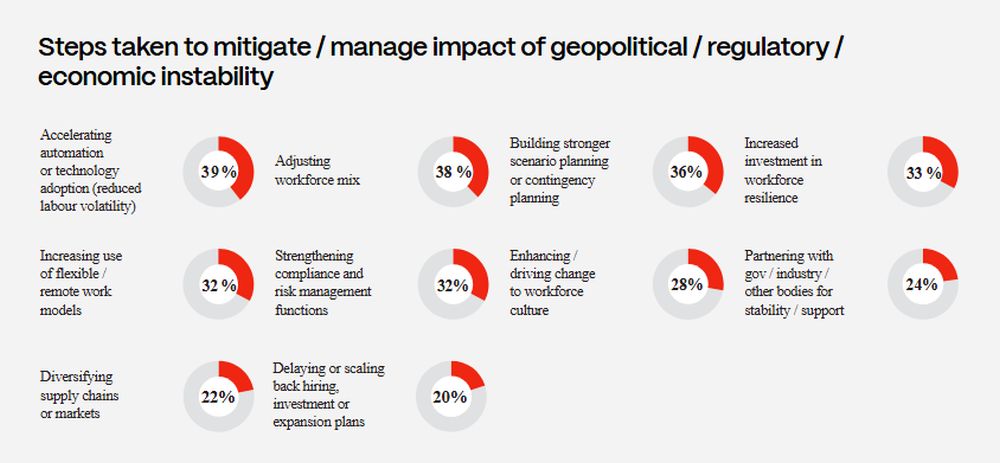
Some organisations are beginning to respond more strategically. In the face of geopolitical, regulatory and economic instability, 36% are building stronger scenario or contingency planning, 33% are increasing investment in workforce resilience, and 32% are strengthening compliance and risk management functions.
A majority, however, are not yet taking those steps. Resilience also depends on culture, leadership and capacity for change. Nearly half of organisations, 49%, expect cultural resistance to slow the adoption of new technologies and new operating models. Continual firefighting can wear down the very qualities organisations need most: trust, leadership bandwidth and learning agility.
This is where scenario-based workforce planning becomes important. McKinsey describes strategic workforce planning as a way for organisations to react more quickly and intentionally to change, monitor leading and lagging indicators, identify and develop new capabilities, and move away from hire-fire cycles towards more sustainable capacity management. Scenario-based approaches can create flexibility under rapidly changing conditions by helping organisations identify future talent gaps and overages across business units before pressure becomes acute.
Resilience is built through more than isolated crisis playbooks, but requires workforce visibility, clear escalation routes, cross-functional governance, scenario planning, leadership under pressure and the ability to make decisions with imperfect information. It also requires the organisation to treat planning as business as usual, rather than something activated only when disruption has already arrived.
The gap between recognising this need and acting on it remains significant. Deloitte’s 2026 Human Capital Trends report found that 85% of respondents say it is critical to develop the ability for the organisation and workforce to adapt at the speed required by today’s world, but only 7% say they are leading in this area. Deloitte also found that only 27% of respondents believe their organisations manage change effectively, and only 8% believe their organisations are highly effective at meeting continuous, always-on learning needs.
The workforce impact of constant change is also material. Deloitte found that the steady cadence of organisational change has led to decreased wellbeing for 68% of workers, increased workload for 60%, and feeling less relevant or left behind for 58%. This reinforces the point that resilience is not only about systems and processes. It also depends on whether people have the capacity, trust and support to absorb change without burning out.
Organisations may handle individual crises well while still lacking the systems, data, leadership habits and planning routines that would make them more resilient next time.
The World Economic Forum’s Global Risks Report 2026 captures the direction of travel well: change is increasingly part of the normal, not an emergency response. For international employers, the strategic task is therefore to embed adaptability into the workforce model itself.
The shift from reaction to resilience therefore means asking “how to build an international workforce that can adapt when conditions change”.
The content of this article is intended to provide a general guide to the subject matter. Specialist advice should be sought about your specific circumstances.
[View Source]