In April 2024, we wrote about Turkey's newly introduced regulatory framework for electric vehicle ("EV") imports and questioned whether a regime requiring certain importers to establish their own (not through any third parties) service networks, operate a forty-person call centre and comply with additional certification and representation requirements could be reconciled with Turkey's international trade obligations1.
Two years later, we have an answer.
On 28 July 2026, the World Trade Organization ("WTO") panel circulated its report in “Türkiye – Measures Concerning Electric Vehicles and Other Types of Vehicles from China (DS629)”, addressing China's challenge to Turkey's measures and finding several elements of the challenged framework inconsistent with Turkey's WTO obligations2.
The dispute comes at a time when governments are increasingly seeking to support domestic EV production while managing growing competition from imported vehicles. The Panel Report shows how WTO rules can affect the measures used to pursue those policies.
For Turkey, the decision is particularly significant. Over the last few years, the government has progressively tightened the regulatory and tariff framework applicable to vehicles imported from China, while simultaneously pursuing policies aimed at attracting automotive investment and supporting domestic production. The Panel has now found important parts of that framework incompatible with Turkey's obligations under the General Agreement on Tariffs and Trade 1994 ("GATT").
The decision is also noteworthy from our perspective. The import requirements examined by the Panel substantially overlap with the regulatory framework we discussed in our 2024 article, Turkey Changed Its Regulatory Framework For EV Imports: Hostility To Japanese And Chinese EVs!. The WTO proceedings, however, went considerably further, encompassing not only those regulatory requirements but also Turkey's additional customs duties on Chinese EVs and other categories of vehicles.
So, what exactly did the WTO decide, how closely does it track the concerns raised when the rules were first introduced, and, perhaps more importantly, what happens next?
How Did We Get Here?
China initiated the dispute in October 2024, challenging Turkey's additional tariffs and import licensing requirements applicable to vehicles originating in China. The complaint concerned, in particular, additional customs duties imposed on Chinese EVs and certain other vehicles, as well as an import permit regime requiring importers to satisfy a series of after-sales service and organisational conditions The latter will sound familiar to readers of our 2024 article.
Under the regime, importers of relevant vehicles were required, among other things, to establish at least 20 authorised service stations across Turkey's seven geographical regions, employ appropriately certified personnel, operate a Turkish call centre with at least 40 personnel, ensure that the manufacturer had an authorised representative in Turkey and provide commitments concerning the monitoring and supervision of battery systems3.
At the time, we noted that these requirements went beyond Turkey's generally applicable after-sales framework and created an asymmetric regulatory structure between different market participants. In particular, Turkey's ordinary consumer protection framework allows manufacturers and importers, subject to the applicable requirements, to rely on existing service networks (through third party dealers etc.) rather than necessarily establishing their own. These measures ultimately became part of China's broader WTO challenge.
Following unsuccessful consultations, a WTO panel was established in February 2025. Its report, circulated on 28 July 2026, found several important elements of Turkey's automotive trade framework inconsistent with the GATT4.
What Did the Panel Find?
The Panel's findings can broadly be divided into two categories:
- Additional customs duties and
- Import restrictions
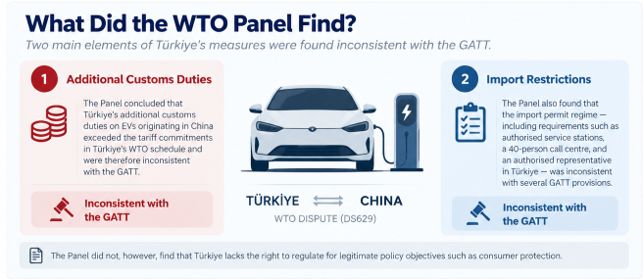
First, the Panel concluded that Turkey's additional customs duties on EVs originating in China exceeded the tariff commitments contained in Turkey's WTO schedule and were therefore inconsistent with the GATT5.
The Panel reached a similar conclusion in respect of certain hybrid vehicles. However, China's challenge was not entirely successful. In particular, the Panel found no inconsistency in respect of certain hybrid vehicles and concluded that China had not established its case in relation to the additional duties imposed on internal combustion engine vehicles.
The Panel also examined exemptions granted to vehicles originating in certain countries with which Turkey has preferential trade arrangements. While these exemptions initially raised an issue under the GATT's most-favoured-nation principle (“MFN”), which generally requires WTO members not to discriminate between their trading partners, the Panel accepted Turkey's reliance on the rules governing trade agreements for most of the relevant countries. The principal exception was Venezuela, as the relevant preferential arrangement did not cover several of the vehicle categories concerned.
Second, and perhaps more importantly from a regulatory perspective, the Panel ruled against Turkey's Import Permit Licensing Scheme ("IPLS").
According to the Panel, the service network, certification, call centre, authorised representative and battery-related requirements, together with the import permit mechanism through which they were enforced, altered the conditions of competition to the detriment of Chinese EVs and externally rechargeable hybrid vehicles. On this basis, the Panel concluded that the relevant measures accorded imported Chinese products less favourable treatment than comparable domestic products and were therefore inconsistent with the GATT's national treatment obligation6.
Turkey relied on several GATT exceptions in defence of the challenged measures, invoking, among other things, health and environmental considerations in relation to the additional duties and compliance with its consumer protection and type-approval framework in relation to the IPLS. The Panel was not persuaded that the applicable requirements for those exceptions had been met.
It is also worth noting that the Panel did not accept every claim advanced by China, nor did it conclude that Turkey cannot regulate imported vehicles or pursue environmental and consumer protection objectives. The Panel's findings instead concern whether the particular measures challenged in this dispute were compatible with Turkey's WTO commitments.
What Does the Decision Change Today?
In short, not as much as might initially appear. The Panel recommended that Turkey bring the measures found to be inconsistent with the GATT into conformity with its WTO obligations. But the report does not itself strike down Turkish legislation, remove the additional duties or invalidate the import permit requirements.
For market participants, the critical distinction is that the Panel Report concludes that key elements of Turkey's regime are inconsistent with its WTO obligations, but those findings do not themselves alter the applicable Turkish regulatory framework. Unless and until Turkey revises the relevant measures, the existing requirements remain part of the domestic regulatory framework and continue to apply to importers. Nor does the WTO have a direct enforcement mechanism capable of compelling Turkey to amend its legislation. If an adopted WTO ruling is ultimately not implemented, the dispute settlement system may allow the successful complainant, following the applicable procedures, to seek compensation or authorisation to suspend concessions against the non-complying member7.
The immediate significance of the Panel report is therefore less about changing the rules at the Turkish border today and more about changing the legal and negotiating leverage surrounding those rules.
And that brings us to the more difficult question: What happens next?
What Happens Next?: The Pharma Precedent
There has already been an important procedural development in the present dispute. On 15 September 2026, China and Turkey jointly requested that the WTO Dispute Settlement Body ("DSB") adopt a decision governing the timing of the adoption or appeal of the Panel Report8. Under the proposed decision, upon the request of either party, the Panel Report would be adopted no later than 27 October 2026, unless the DSB decides by consensus not to adopt it or either party notifies its decision to appeal under the WTO dispute settlement rules. Any such adoption or appeal would be deemed to have occurred within the ordinary 60-day period.
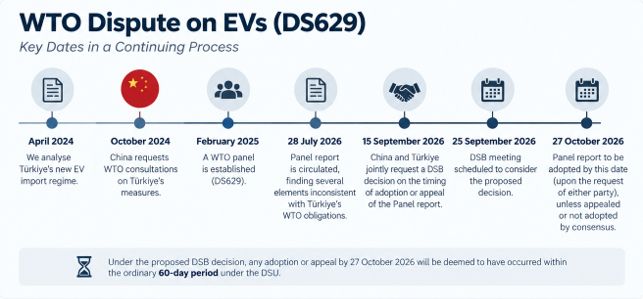
The proposed arrangement therefore preserves the parties' procedural options beyond the date on which the ordinary 60-day period would otherwise expire. It does not, however, indicate whether either party intends to appeal, nor does it establish an alternative appellate mechanism. The joint request states only that the parties consider that the proposed decision, if adopted, would "facilitate the resolution of the dispute.
The procedural position is further complicated by the continuing paralysis of the WTO Appellate Body. The US has refused to appoint new judges and blocked the Appellate Body’s ability to hear cases since 20199.
However, there are alternatives. Turkey's recent WTO practice provides useful examples. The closest precedent may be the EU's WTO dispute concerning Turkey's pharmaceutical localisation policy (DS583), which we discussed in another article10.
That dispute involved a similar tension between domestic industrial policy and Turkey's WTO national treatment obligations. A WTO panel found key elements of Turkey's pharmaceutical localisation requirement inconsistent with the GATT and rejected Turkey's attempts to justify the measure under the GATT's general exceptions.
Importantly, Turkey did not simply leave the dispute in procedural limbo after the Panel's decision. Turkey and the EU agreed to use arbitration under Article 25 of the WTO Dispute Settlement Understanding ("DSU") as an alternative appellate mechanism. The arbitration resulted in an award that maintained the key findings concerning the localisation requirement, after which Turkey informed the WTO that it intended to implement the recommendations and subsequently notified steps taken towards compliance11.
The pharmaceutical dispute is instructive for another reason. Implementation was not simply a matter of removing the challenged policy overnight. Turkey and the EU continued to engage, and Turkey introduced regulatory changes as part of the implementation process. Given the strategic importance of the automotive industry, a similar approach cannot be ruled out in the present dispute.
Turkey's own recent WTO practice also illustrates that there is more than one possible procedural route. In the pharmaceutical localisation dispute (DS583), Turkey agreed with the EU to use Article 25 arbitration. In a separate dispute concerning Turkey's additional duties on certain US products (DS561)12, however, Turkey filed a conventional appeal in January 2024 despite the absence of a functioning Appellate Body. The two cases therefore provide precedents pointing in different directions as Turkey considers its next step in the present dispute concerning Chinese vehicles.
However, Article 25 arbitration is not a route that Turkey can pursue unilaterally. It would require Turkey and China to agree on the applicable arbitration procedure. Turkey may therefore seek appellate review through such an agreed mechanism, pursue a conventional appeal despite the absence of a functioning Appellate Body, or engage directly with China to explore a mutually acceptable solution. These options are not necessarily mutually exclusive: WTO litigation and bilateral discussions can proceed against the background of one another
A negotiated route may be particularly relevant here because Turkey's trade relationship with China is closely intertwined with its investment policy. Turkey has simultaneously sought to manage rapidly growing Chinese vehicle imports and attract Chinese automotive manufacturers to establish production in Turkey. This creates a more complicated negotiating environment than the legal findings alone might suggest.
It's also noteworthy that the turbulent relationship between Turkey and China on trade policy issues may further complicate this process. Hence, it remains difficult to foresee the timeline of such discussions and/or revisions of Turkey's measures, if any.
Hence, for the time being, the Panel report marks an important change in the legal landscape, but its practical consequences will depend on what happens next. Any eventual solution could involve amendments to the additional duties, adjustments to the import licensing framework, an agreed appellate mechanism, bilateral concessions or some combination of these.
Conclusion
The Panel Report also has implications beyond the automotive sector. Governments are increasingly using tariffs, subsidies, localisation incentives and regulatory requirements as tools of industrial policy, particularly in strategically important sectors such as mobility. Importantly, the Panel did not question Turkey's ability to pursue consumer protection, environmental or after-sales service objectives as such. Its findings instead focused on whether the particular measures used to pursue those objectives were compatible with Turkey's WTO obligations.
There is a certain parallel with Turkey's pharmaceutical localisation dispute. In both cases, domestic industrial and regulatory policy measures were subjected to scrutiny under the WTO's non-discrimination rules. At the same time, the pharmaceutical dispute demonstrates that an adverse WTO finding does not necessarily determine how the underlying regulatory framework will ultimately evolve.
For companies operating in the Turkish automotive market, the immediate task is therefore to distinguish the legal significance of the Panel's findings from their practical effect. The Panel Report does not itself alter the applicable Turkish rules, and the challenged measures remain relevant today. How the regulatory framework develops from here will depend on Turkey's response to the Panel Report and the course of its discussions with China.
When we examined Turkey's EV import regime in 2024, we questioned whether its asymmetric structure could be reconciled with Turkey's international trade obligations. Two years later, the WTO Panel has now expressed its view on that question.
The next, and commercially more important, part will be shaped by Turkey's response to the ruling, whether through appeal, implementation, negotiations with China, or a combination of these.
Footnotes
1. Şahin Ardıyok, Armanç Canbeyli and Furkan Kaya, "Turkey Changed Its Regulatory Framework For EV Imports: Hostility To Japanese And Chinese EVs!", Mondaq, 22 April 2024, https://www.mondaq.com/turkey/international-trade-investment/1453610/turkey-changed-its-regulatory-framework-for-ev-imports-hostility-to-japanese-and-chinese-evs.
2. WTO, Türkiye – Measures Concerning Electric Vehicles and Other Types of Vehicles from China, Report of the Panel, WT/DS629/R, 28 July 2026 (“Panel Report”). See also WTO, “WTO panel issues report regarding Turkish measures on EVs and other types of vehicles”, 28 July 2026, available at: https://www.wto.org/english/news_e/news26_e/629r_465_e.htm
3. Panel Report, Section 7.3 (Import Permit Licensing Scheme). https://docs.wto.org/dol2fe/Pages/SS/directdoc.aspx?filename=Q:/WT/DS/629R.pdf&Open=True
4. Panel Report, Sections 7.1–7.3 and 8 (Conclusions and Recommendations). See also WTO, “WTO panel issues report regarding Turkish measures on EVs and other types of vehicles”, 28 July 2026, available at: https://www.wto.org/english/news_e/news26_e/629r_465_e.htm
5. Articles II:1(a) and II:1(b) of the
6. Article III:4 of the GATT
7. Understanding on Rules and Procedures Governing the Settlement of Disputes (“DSU”), Articles 21 and 22. See also Panel Report, Section 8 (Conclusions and Recommendations). Suspension of concessions is subject to the procedures and conditions set out in the DSU and is not an automatic consequence of a panel finding
8. See. Türkiye - Measures Concerning Electric Vehicles and Other Types of Vehicles from China - Joint Request by China and Türkiye for a Decision by the DSB, available at: https://docs.wto.org/dol2fe/Pages/SS/directdoc.aspx?filename=Q:/WT/DS/629-5.pdf&Open=True
9. WTO, “Appellate Body”, noting that the Appellate Body is currently unable to review appeals due to ongoing vacancies, available at: https://www.wto.org/english/tratop_e/dispu_e/appellate_body_e.htm. See also, https://www.dw.com/en/wto-judge-blockage-could-prove-the-beginning-of-the-end/a-51613082
10. Şahin Ardıyok, Armanç Canbeyli and Gökçe Çetinkaya, “International Backlash Against Pharma Localization: EU's Next Move In The WTO Case Against Turkey”, Mondaq, 4 July 2022, available at: https://www.mondaq.com/turkey/life-sciences-biotechnology-nanotechnology/1208106/international-backlash-against-pharma-localization-eus-next-move-in-the-wto-case-against-turkey
11. WTO, Turkey – Certain Measures Concerning the Production, Importation and Marketing of Pharmaceutical Products (DS583), WTO | dispute settlement - the disputes - DS583
12. WTO - Turkey — Additional Duties on Certain Products from the United States
The content of this article is intended to provide a general guide to the subject matter. Specialist advice should be sought about your specific circumstances.