- within Antitrust/Competition Law topic(s)
- within Antitrust/Competition Law, Media, Telecoms, IT, Entertainment and Technology topic(s)
- in United States
- with readers working within the Banking & Credit industries
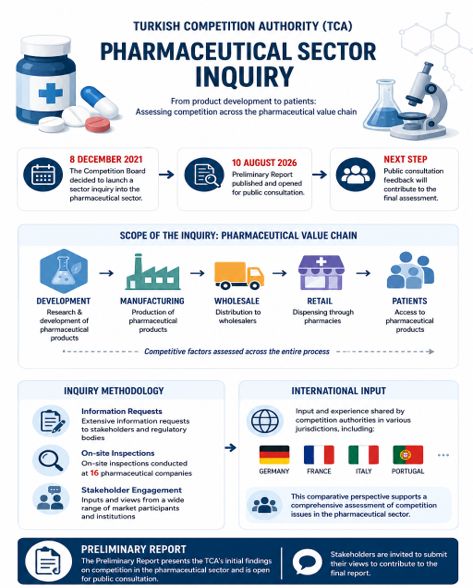
Following a sector inquiry launched by the Competition Board's decision of 8 December 2021, the Turkish Competition Authority ("TCA") published its Preliminary Report on the Pharmaceutical Sector Inquiry (“Preliminary Report”) on 10 August 2026, opening it for public consultation1. The inquiry examined the factors affecting competition throughout the process from the development of a pharmaceutical product to its distribution to patients through the retail channel, drawing on information requests to stakeholders and regulatory bodies; with on-site inspections at 16 pharmaceutical companies and input from competition authorities in various jurisdictions including Germany, France, Italy, Portugal.
The Preliminary Report sets out the TCA's priority enforcement areas, its theories of harm, and its forward-looking agenda for the industry. It is structured around four chapters. The first provides an overview of the pharmaceutical sector both globally and in Türkiye. The second examines the TCA's own enforcement history and advocacy activities in the sector. The third chapter, which is the analytical core of the report, is divided into three parts: Competition at the production stage (patent rights and their intersection with competition law); competition at the market entry stage (the strategic use of licensing and reimbursement rules to impede competitor entry); and competition at the distribution stage (wholesale market structure, exclusivity arrangements, and the Public Institution Discount). The fourth and final chapter summarises the report's findings and sets out its principal recommendations. The Preliminary Report, therefore, warrants careful attention from all undertakings operating in the Turkish pharmaceutical market. This article distils the principal takeaways of the preliminary report.
A Structurally Distinctive Market
The pharmaceutical sector differs from most other markets in a fundamental respect. The party who uses a medicine, the party who decides which medicine to use, and the party who bears the cost are often three different actors. Patients have limited information not only about medicines but about their own conditions and treatment options, decisions in the case of prescription medicines are therefore made principally by physicians, with pharmacists capable of influencing demand where generic substitution is available. Because the bulk of pharmaceutical costs are borne by public health insurers, the patient is only indirectly or belatedly exposed to price signals, creating a tripartite structure in which those who decide, those who benefit, and those who pay are different actors, producing a market dynamic that classical substitution and price-pressure analyses cannot directly address.
This structural separation affects price elasticity. Even where patients do bear costs directly, the acute necessity of treatment keeps demand largely insensitive to price, with substitution elasticity close to zero.
The sector's strategic importance for public health and public expenditure subjects it to intensive regulation; prices and profit margins are set directly by public authorities, and every product must pass through rigorous safety, efficacy, and quality review before it may be authorised for market entry. Patent protection (lasting twenty years) is in turn essential to recoup the high R&D costs of drug development, conferring a degree of monopoly power that shapes both pricing and market structure for the duration of its term. Once protection expires, generic entry introduces price competition and incentivises originator firms to invest in new molecules, a dynamic that underpins the originator-generic interplay at the heart of the report's competition analysis.
The Turkish Market at a Glance
Türkiye's pharmaceutical market has grown steadily from TRY 56 billion in 2020 to TRY 479 billion in 2025, reaching a market value of USD 11.5 billion in 2024, placing Türkiye nineteenth in the global rankings. In volume terms, domestically manufactured products dominate, accounting for approximately 90 per cent of units sold; in value terms, the split is closer, with domestic products representing 59.59 per cent and imported products 40.41 per cent of sales in 2025.
Pricing in Türkiye is governed by an external reference pricing system in place since 2004, under which the lowest ex-factory price among five reference EU Member States; France, Spain, Italy, Portugal, and Greece serve as the ceiling for domestic price-setting.
Moreover, the pricing consequences of patent protection are stark. In 2025, the average price per pack for a patent-protected medicine stood at TRY 3,759, against a market-wide average of TRY 164 — a ratio of approximately 23 to 1 that underscores the decisive pricing advantage that patent protection confers on originator firms. By contrast, the bulk of the market by volume consists of medicines that are no longer patent-protected. Together, these figures demonstrate that patent-protected medicines command prices significantly above the market average, and that patent protection confers a decisive pricing advantage on originator firms — an advantage that shapes competitive dynamics throughout the sector.
A Decade of TCA Enforcement: The Statistical Picture
The Preliminary Report provides a comprehensive statistical review of TCA activity in the pharmaceutical, healthcare and medical supplies sector between 2014 and 2024 — and the data tells a revealing story.
In 2014, 2015, 2016, 2017 and 2019, the pharmaceutical, healthcare and medical supplies sector attracted the highest number of negative clearance and individual exemption decisions of any sector reviewed by the TCA. In terms of competition law infringement decisions, the sector ranked among the top three of the 28 sectors monitored in 2017, 2019, 2020 and 2021. These figures alone establish that pharmaceuticals is one of the TCA's most consistently active enforcement areas.
Two structural shifts are particularly notable. From 2021 onwards, merger and acquisition decisions rose sharply, peaking at 24 decisions in 2023. The Preliminary Report attributes much of this increase to the amendment to Communiqué No. 2010/4 which introduced the concept of "technology undertaking" — defined to include pharmacology, biotechnology and health technologies — and exempted such undertakings from the turnover thresholds that would otherwise trigger a mandatory notification. A 2026 legislative amendment has since narrowed this exemption, restricting it to technology undertakings established in Türkiye and introducing a dedicated TRY 250 million turnover threshold for transactions involving biotechnology, pharmacology and health technology companies.
Second, the number of exemption and negative clearance decisions fell markedly after 2021 — largely because the transformation of public pharmaceutical procurement structures removed much of the commercial rationale for seeking individual exemptions. This shift has a direct practical implication: The compliance and notification landscape for pharmaceutical undertakings operating in Türkiye has changed substantially over the past five years, and the Preliminary Report reflects and reinforces that change.
Competition at the Production Stage: Patents, Settlements and Atypical Conduct
The Preliminary Report draws a clear threshold regarding the intersection of patent rights and competition. Per the Report, it is not the existence of a patent right itself, but its exercise in a manner that exceeds the aim of encouraging and rewarding innovation, that may attract competition law scrutiny.
Against this backdrop, the report identifies a range of atypical forms of infringement that risk crossing that line, including the misuse of divisional patents to block generic entry, providing false or misleading information to patent authorities, furnishing courts with incomplete information with the aim of preventing market entry, and exploiting asymmetric information or financial power through administrative or judicial mechanisms such as interim measures and formal cease-and-desist notices. On evergreening specifically, the report finds that divisional patent practices in Türkiye have not yet reached a level that would significantly impede market entry, however the TCA's stated role going forward is to identify manipulative behaviour that exceeds the legitimate innovation function envisaged by legislation. Between 2019 and 2025, interim measures were granted in 9 of the 76 patent infringement cases brought before the courts; in 2 of those 9 cases, the ultimate decision on the merits was handed down in favour of the generic manufacturer. The report further notes that, in light of the legal conditions governing the grant of interim relief, no finding has been made that this mechanism gives rise to a systematic barrier to market entry.
Furthermore, regarding patent settlements, the TCA screened approximately 350 patent cases initiated since 2015 and found no evidence of pay-for-delay agreements in Türkiye to date. Nevertheless, the TCA designates this as a priority monitoring area and sets out a practical checklist for compliant settlements. To that end, such settlements must rest on a rational basis; must not disproportionately delay generic entry relative to the remaining patent term; must not involve value transfers exceeding the costs of litigation; must not confer unjustified ancillary benefits; and must be limited in scope to the disputed patents and the relevant geographical market.
On compulsory licensing, whilst Article 129 of the Industrial Property Act No. 6769 confers authority on the TCA to grant compulsory licences in cases of competition law infringement, the Preliminary Report identifies deficiencies and ambiguities in the procedural rules governing the exercise of that authority. The report recommends that, to the extent a procedure or benefit beyond that already available under Article 9 of the Competition Act is intended, those deficiencies should be addressed, and that an explicit reference to the TCA should be incorporated into the relevant provisions of the Industrial Property Act.
Competition at the Market Entry Stage: Regulatory Strategy as an Exclusionary Tool
The Preliminary Report's most consequential message for industry is unambiguous: Conduct that is compliant with sector-specific regulations cannot be assumed to be automatically compliant with competition rules when it forms part of a strategy to prevent or restrict competitors' market entry or expansion. This principle is illustrated with two concrete scenarios.
On product hopping, the strategic withdrawal of a reference medicine nearing patent expiry can prevent a generic manufacturer from relying on that product under the abridged licensing procedure, effectively foreclosing market entry. The TCA recommends that legislation governing licence cancellation be reviewed with this strategy in mind, and proposes that, to the extent such a strategy is considered likely to occur in Türkiye, toxicological, pharmacological and clinical trial data should remain available for equivalent marketing authorisation applications for a reasonable period even after the reference product's authorisation is withdrawn at the holder's request.
On reimbursement, the Preliminary Report notes that approximately 95 per cent of pharmaceutical expenditure by volume and over 85 per cent by value in Türkiye is covered by the Social Security Institution ("SGK"), meaning that exclusion from the reimbursement scheme can operate as a de facto barrier to market entry.
The report also identifies a specific vulnerability in the fast-track listing mechanism. The absence of a requirement that a medicine must actually be available on the market when setting the lowest reference price. Because the process of de-listing an unavailable medicine can take up to three years, an undertaking with two products in the same equivalence group can block competitors' rapid entry by anchoring the reference price to a cheaper, unavailable product whilst continuing to generate revenue from its higher-priced product. This is not merely a theoretical concern, the TCA points to its decision of 23 July 20262 concerning an undertaking that maintained a product on the reimbursement list at a price significantly below that of its other product in the same group whilst keeping its market share below the 1 per cent threshold, thereby preventing it from being included in the price band calculation. That investigation was concluded by way of settlement and commitment.
Competition at the Distribution Stage: Concentration, Exclusivity and the Public Institution Discount
The distribution stage receives the most detailed analysis in the Preliminary Report and produces some of its most concrete and immediately actionable findings.
On wholesale market structure, the report identifies a high level of concentration in the independent pharmacy channel; approximately 92 wholesalers serve around 30,000 pharmacies, with 88 of those 92 having no branches at all, and the remaining four operating a combined total of 118 branches. The TCA considers it likely that, in such a concentrated market, discount margins will narrow over time, payment terms offered to pharmacies will worsen, and pharmacies' bargaining power will weaken. This structural assessment carries a direct compliance implication: it must inform how the TCA evaluates exemption requests for vertical agreements incorporating exclusivity between pharmaceutical manufacturers and wholesalers.
On the State Supply Office's ("DMO") Health Market Scheme — under which a sole authorised supplier condition at provincial level was introduced for public pharmaceutical procurement — the TCA concludes that the efficiency gains previously associated with exclusive tender warehouse contracts have been largely internalised by the scheme's centralised structure and can no longer be assumed to persist. The DMO's centralised control and transparency mechanisms have, in the TCA's view, effectively rendered the exclusive arrangement redundant. This conclusion is backed by substantial quantitative evidence.
By contrast, tenders attracting multiple bidders were significantly more likely to close at or below the reference price in both years. Wholesaler profit margins in DMO tenders also exceeded regulated levels, ranging from approximately 16–20 per cent on a weighted average and 26–35 per cent on an arithmetic average — figures that, in the TCA's view, suggest that introducing intra-brand competition could generate meaningful consumer benefits.
The Preliminary Report also draws a comparison with EU law. Following the 2022 revision of the Vertical Block Exemption Regulation (VBER), participation in both public and private tenders is classified as passive sales, meaning that any restriction on such participation constitutes a hard-core restriction. No equivalent framework exists in Türkiye, a gap that the TCA identifies as compounding the competitive concerns raised by the current model.
As a remedy, similar to the EU, the Preliminary Report proposes replacing the sole distributor model with a "shared exclusivity" framework, under which a maximum of five authorised distributors would be designated per province, subject to a requirement that competing products may not be held exclusively by the same wholesaler. The TCA makes clear, however, that undertakings would remain free to seek individual exemptions where they can demonstrate concrete efficiency benefits from exclusive arrangements.
On the private hospital channel, the report finds that between 2022 and 2024, approximately 19.8 to 23 per cent by volume and 11.5 to 20.2 per cent by value of pharmaceutical sales in the private tender channel were supplied through exclusive distribution arrangements — with over a quarter of active substances in that channel distributed exclusively through a single authorised wholesaler in 2024. The fact that the large majority of the market operates without exclusivity undermines the case for treating such arrangements as indispensable. More broadly, the Preliminary Report makes clear that hypothetical or formulaic efficiency arguments will not suffice to justify exemptions for exclusive distribution arrangements; consumer benefits must be demonstrated concretely and tied specifically to the exclusivity in question.
On the Public Institution Discount ("PID"), the Preliminary Report identifies three interlocking concerns. First, whilst SGK contracts are not mandatory, virtually all of Türkiye's approximately 30,000 independent pharmacies operate under one, making the PID framework a near-universal feature of the retail pharmaceutical market. Second, the retrospective verification process requires pharmacies to share prescription and diagnosis information, tracking data, and system credentials with third-party platforms, creating a pathway through which pharmaceutical manufacturers or those platforms could access pharmacies' stock, sales, and turnover data — including information about competitors' products — and giving rise to material information exchange risks under competition law. Third, the absence of a clearly identified responsible party and the lack of precision as to when and how the PID applies generate ongoing uncertainty that is itself a source of commercial and compliance risk.
To address these concerns, the TCA recommends that PID application be limited to SGK-reimbursed prescriptions approved via MEDULA, that verification be conducted through an integrated MEDULA–ITS infrastructure so as to eliminate reliance on third-party platforms, and that a guarantee account be established with SGK to compensate pharmacies where the PID is applied incompletely or not at all.
Three Overarching Themes
The Preliminary Report's final chapter distils its findings into three themes that together constitute a forward-looking compliance agenda.
First, on atypical infringements: The TCA has explicitly committed to assessing potential violations in pharmaceutical markets with a broader and more dynamic perspective. Compliance with sector-specific legislation — whether relating to intellectual property, licensing or reimbursement — does not guarantee compliance with competition rules.
Second, on exclusivity: Exemptions for exclusive distribution arrangements will not be granted on the basis of hypothetical or formulaic arguments. Consumer benefits must be demonstrated concretely, and it must be established that those benefits arise directly and solely from the exclusivity in question.
Third, on incremental improvement: The report's recommendations — supplementing sectoral regulations, reforming the Health Market Scheme, and restructuring the PID framework — are deliberately calibrated to deliver meaningful competitive benefits without requiring a wholesale overhaul of existing legal, administrative and financial structures.
Conclusion
The TCA's Preliminary Report on the Pharmaceutical Sector is a substantive and forward-looking document. The decade-long enforcement record it reviews demonstrates that pharmaceuticals has long been one of the TCA's most active areas; the report signals that this engagement will now deepen and broaden. Its central message — that the boundaries between sectoral regulation and competition law are less distinct than many undertakings may have assumed — will shape enforcement priorities, compliance strategies and transactional risk assessments for years to come. The public consultation period offers an important opportunity for industry stakeholders to engage with the TCA and contribute to shaping the final recommendations.
Footnotes
1 ]https://www.rekabet.gov.tr/en/Guncel/pharmaceutical-sector-inquiry-preliminar-1239594e9794f11194000050568585c9
2 TCA decision dated 23.07.2026 and numbered 26-26/748-308.
The content of this article is intended to provide a general guide to the subject matter. Specialist advice should be sought about your specific circumstances.