Competition enforcement has never been purely domestic, but the degree to which authorities today actively engage with their foreign counterparts, share investigative methodologies, and benchmark their findings against international practice has reached a level that would have seemed remarkable not long ago. Competition law and policy have, in parallel with globalisation, acquired an increasingly international character; cross-border cooperation between competition authorities is no longer confined to high-profile merger reviews or global cartel prosecutions, but permeates sector inquiries, investigations, and even the verification of individual arguments raised by investigated parties.
The Turkish Competition Authority (“TCA”) is a telling example of this dynamic. Over recent years, it has built a dense and multi-layered international network. It participates actively in the multilateral forums that shape global competition policy including the OECD, UNCTAD, the ICN, the WTO, and the World Bank1. Beyond the multilateral sphere, it has built a steadily expanding bilateral network, having signed cooperation protocols with the competition authorities of nearly thirty countries spanning Europe, Central Asia, the Middle East, North Africa, and Southeast Asia. It co-chairs working groups within the ICN (International Competition Network)2, contributes regularly to OECD forums3, leads two regional cooperation platforms of its own creation, one spanning the Balkans, another encompassing Turkic-speaking states4 and shares its expertise with competition authorities in neighbouring and more distant jurisdictions through capacity-building initiatives. The operational dimension of this network is equally tangible: the European Commission has publicly acknowledged conducting dawn raids in coordination with the TCA as seen in the construction chemicals sector5, and the TCA's own practice reveals direct, working-level communication with the Commission.
The TCA's recently published Preliminary Report on the Pharmaceutical Sector Inquiry (“Preliminary Report”) brings this reality into particularly sharp relief and underscores the depth of the TCA's relationship with EU competition authorities in particular. In preparing that report, the TCA sought written input from twelve foreign competition authorities, almost all of them EU Member State regulators, and engaged fourteen pharmaceutical manufacturers and importers with EU operations on questions of European market practice. The composition of the consulted authorities reflects the significant role that EU counterparts play within the TCA's broader international cooperation framework. In the Preliminary Report, the TCA benchmarked Türkiye's distribution practices against those of comparable European markets and drew on European Commission decisional practice as a normative yardstick. The result is a document whose findings and policy recommendations are anchored as much in a comparative European analysis as in domestic market data.
For multinational businesses operating in Türkiye, this extensive and operationally active network has direct practical consequences: a TCA sector inquiry or investigation is no longer a neatly contained local event. It is a data point in a network; one in which information, methodologies, and enforcement priorities flow across borders in both directions.
Information Gathered from Foreign Authorities in the Pharmaceutical Sector Inquiry
When a competition authority launches a sector inquiry into pharmaceutical distribution, the instinctive assumption is that the investigation is a domestic affair — bounded by national law, national markets, and national institutions. The TCA’s recently published Pharmaceutical Sector Inquiry Preliminary Report tells a rather different story.
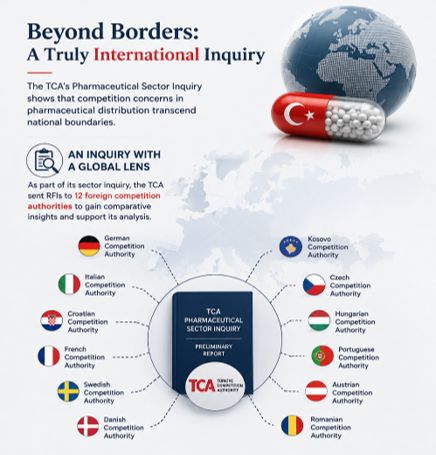
One of the most noteworthy features of the Preliminary Report is its reference to direct correspondence of request for information and documents (“RFI”) with twelve foreign competition authorities during the preparation of the report6. Written replies were received from the German Competition Authority, the Italian Competition Authority, the Croatian Competition Authority, the French Competition Authority, the Swedish Competition Authority, the Danish Competition Authority, the Kosovo Competition Authority, the Czech Competition Authority, the Hungarian Competition Authority, the Portuguese Competition Authority, the Austrian Competition Authority, and the Romanian Competition Authority.
The TCA did not merely contact foreign authorities directly. In the course of the sector inquiry, it also sought information from fourteen pharmaceutical manufacturers and importers active in both Türkiye and the EU, specifically on whether there are any legal requirements to work with exclusive pharmaceutical wholesalers in EU Member States, whether exclusive dealing is the de facto practice even absent a formal requirement, and whether the VBER's (Vertical Block Exemption Regulation) classification of tender participation as passive sales had produced any change in practice7. Separately, the same questions were posed directly to EU Member State competition authorities, yielding substantive written replies.
The German Competition Authority indicated that it had no information regarding any situation in which the relevant regulatory change had become apparent. The Italian Competition Authority confirmed that vertical restrictions in the pharmaceutical sector had not been the subject of an assessment. The French Competition Authority reported that no decision had been adopted on this topic following the 2022 VBER amendment and that there was no specific national legislation directly regulating exclusive arrangements8. The Preliminary Report further references a prior decision of the French Competition Authority (Decision No. 19-D-11 of 29 May 2019) and draws on the findings set out therein.
This comparative methodology is not a merely academic exercise. The benchmarking of Türkiye's current practice against EU norms provides the direct evidential foundation for several of the concrete findings and recommendations set out in the Preliminary Report. The fact that EU Member States — including those with comparable population sizes or geographic profiles — do not, as a rule, impose single-authorised-distributor requirements at sub-national (provincial) level informs the Preliminary Report's policy recommendation that, rather than a single authorised distributor per province, a shared-exclusivity model allowing up to five authorised distributors per province should instead be required.
Throughout the Preliminary Report, European Commission, European Courts, UK Competition and Markets Authority ("CMA"), and US court decisions and instruments also serve as normative reference points. For instance, the Commission's decisions in Lundbeck, Servier, and Fentanyl are invoked when discussing the competitive risks of patent settlement agreements, while the AstraZeneca and Teva decisions are referenced in the context of the strategic misuse of regulatory frameworks as a tool for anticompetitive conduct. The CMA's decisions in GlaxoSmithKline, Reckitt Benckiser, and Aspen are drawn upon in the context of pay-for-delay arrangements and product hopping. The US court's judgment in Mylan Pharma v. Warner Chilcott is likewise referenced in the discussion of product hopping strategies. For market definition purposes, the ATC classification system developed by EphMRA and consistently adopted by the European Commission is applied across the relevant product market assessments.
- The Teva investigation following the Pharmaceutical Sector Inquiry Preliminary Report9: The comparative analysis set out in the Preliminary Report has been followed by a concrete enforcement development. On 21 August 2026, the TCA announced that it has opened a full investigation into the Teva group (comprising Teva İlaçları San. ve Tic. AŞ, Teva Pharmaceuticals Europe B.V., and Teva Pharmaceutical Industries Ltd) to determine whether the group violated Article 6 of the Competition Act by strategically deploying divisional patent procedures and creating a misleading impression before health authorities regarding the efficacy and safety of competitor products, thereby restricting generic competition. The subject matter bears a notable resemblance to the European Commission's own Teva proceedings also referenced in the Preliminary Report. The fact that the TCA has initiated proceedings against the same undertaking on a substantially identical theory of harm demonstrates that the cross-border engagement documented throughout this article extends well beyond the passive exchange of information and methodologies; it carries a tangible enforcement-shaping dimension that actively influences the selection and framing of the cases that a cooperating authority pursues.
Beyond the Pharmaceutical Sector: Documented Instances of Operational Cooperation
The picture emerging from the Preliminary Report is not an isolated one. A review of the TCA's earlier decisional practice reveals several documented instances of concrete operational cooperation with the European Commission.
- The Automotive (Audi, Porsche, Volkswagen, Daimler, BMW) Investigation: In this investigation, the decisions rendered on applications for access to the file by investigated undertakings are particularly significant in terms of the TCA’s cooperation with the European Commission. The decisions record that access to Document-19 (information requested from the European Commission that was neither exculpatory nor inculpatory in nature) was refused on the grounds that no written reply had been obtained from the relevant competition authorities, and that no minutes had been kept of the TCA's meetings with those authorities10. This wording makes it clear that the TCA had in fact approached the European Commission directly during the investigation and had held meetings with a number of foreign competition authorities.
- Diye Danışmanlık Decision11: In what is also known as the Media Barometer case, the investigated undertaking argued that there was no global-level competition law examination of whether media audit services were anti-competitive. In response to this argument, the TCA contacted the European Commission directly to ascertain whether any file or investigation concerning media audit services was pending before it and received a negative reply. The fact that the TCA verified a defence argument raised by the investigated party by consulting the Commission demonstrates how operational the communication channels between the two authorities have become.
- The Construction Chemicals Inspections12: In the unannounced antitrust inspections carried out by the European Commission in the construction chemicals sector, the Commission's official press release stated: "Today's inspections were conducted in coordination with the UK Competition and Markets Authority and the Turkish Competition Authority. The Commission has also been in contact with the United States Department of Justice, Antitrust Division." The fact that the Commission placed the TCA alongside the CMA in a public announcement of coordinated dawn raids illustrates that cooperation between the two authorities has taken on a substantive and institutionalised dimension.
TCA’s Active Participation in International Networks: ICN, OECD, and Beyond
The TCA's engagement with foreign authorities extends well beyond bilateral contacts. It rests on a carefully structured multi-level architecture.
- Co-chairing within the ICN: The ICN is a global network of competition authorities that promotes international cooperation and convergence in competition policy. The TCA served as co-chair of Subgroup 1 (Legal Framework) of the ICN Cartel Working Group during the 2021–2022 ICN year13, contributing to the group’s work on issues including leniency programmes, hub-and-spoke cartels, and crisis cartels. In 2025, the TCA also assumed a co-chair role in the ICN Unilateral Conduct Working Group, alongside other leading competition authorities. The TCA is currently one of the four co-chairs of the UCWG, together with the European Commission, Brazil’s CADE and the Swedish Competition Authority14. This leadership role underscores the TCA’s active contribution to the development and international convergence of competition policy standards.
- OECD: The TCA regularly contributes to OECD Competition Committee meetings and working sessions. Recent contributions have covered subjects including mobile payment services15, the assessment of the impact of competition authorities’ activities16, competition in the provision of cloud computing services17, market studies and other market analysis tools, the balance between prudential regulation and competition in banking, and artificial intelligence, data and competition18.
- The Balkan Competition Platform and the Turkic States Competition Council: The Balkan Competition Platform was initiated by the TCA in 2021 and further institutionalised through the launch of the Platform in 2024. The first Platform meeting, held in Istanbul in September 2024, brought together the competition authorities of Albania, Bosnia and Herzegovina, Bulgaria, Greece, Kosovo, Montenegro, North Macedonia and Romania, with Hungary also participating. Also, the Turkic States Competition Council was established in Istanbul in 2024 at the initiative of the TCA, bringing together the competition authorities of Türkiye, Azerbaijan, Kazakhstan, Kyrgyzstan and Uzbekistan, with Hungary participating as an observer.
Practical Implications of the TCA’s International Network for Undertakings
The accumulated picture carries significant practical consequences for businesses operating in Türkiye. Among the TCA’s international relationships, the TCA's ties with EU institutions and EU Member State competition authorities stand out as particularly close and operationally significant.
- Two-Way Information Flow: The very recent Pharmaceutical Sector Inquiry Preliminary Report makes clear that a sector inquiry conducted in Türkiye generates a channel through which information about EU Member State authorities' investigative agendas, priorities, and methodologies flows into Türkiye. The converse is equally true: Türkiye's investigative findings and legal theories can reach foreign authorities, as concretely illustrated by the coordinated dawn raids in the construction chemicals sector.
- Parallel Investigation Risk: The pattern of cross-border coordination and mutual monitoring among competition authorities means that an investigation initiated by the European Commission or an EU Member State authority in a given sector may prompt the TCA to open a parallel inquiry in the same sector, and conversely, a TCA investigation may trigger a parallel review by the Commission or another foreign authority. Competition authorities increasingly monitor and follow one another's enforcement agendas, such that investigative activity in one jurisdiction materially increases the likelihood of scrutiny in others. Multinational groups should therefore assess the risk of parallel proceedings not only when facing TCA scrutiny, but equally when subject to investigation by the Commission or any other foreign competition authority and should factor this cross-jurisdictional dynamic into their engagement strategy from the outset.
- Regulatory Benchmarking Against EU Standards: The direct use of the VBER as a comparator in the pharmaceutical sector assessment illustrates a broader dynamic: Turkish competition law, which has consistently drawn from EU law as its primary model, tends to evolve in alignment with EU developments. Changes to EU block exemption regulations or the Commission's enforcement priorities in a given sector have a material likelihood of influencing the TCA's approach in that same sector within a relatively short period. Undertakings should factor EU-level regulatory developments into their assessment of Turkish law compliance.
Conclusion
The evidence reviewed in this article points to a clear conclusion: TCA investigations and sector inquiries can no longer be assessed in isolation from the authority's international network. The Pharmaceutical Sector Inquiry Preliminary Report is a case in point; the collection of written replies from twelve foreign competition authorities, the use of EU instruments as a normative benchmark, and the resulting policy recommendations all indicate that the TCA's enforcement process is closely intertwined with a broader, multi-polar international framework. The documented instances of coordinated dawn raids, direct authority-to-authority communication during investigations, and the TCA's active roles within the ICN and OECD reinforce this picture. In this regard, also industries such as digital markets, sustainability, and AI-related enforcement priorities increasingly demand cross-border coordination, this dynamic can only be expected to intensify. For multinational undertakings active in Türkiye, the practical takeaway is straightforward: the TCA's processes are inextricably linked to its international counterparts, and its particularly close operational relationship with EU member states should be taken into account in any assessment of Turkish competition law exposure.
Footnotes
1 https://www.rekabet.gov.tr/tr/Sayfa/Kurumsal/dis-iliskiler/genel-cerceve
2 https://www.rekabet.gov.tr/tr/Sayfa/Kurumsal/dis-iliskiler/cok-tarafli-iliskiler/icn ; https://www.rekabet.gov.tr/tr/Haber/uluslararasi-rekabet-agi-icn-tek-tarafli-442b9774d203f01193e30050568585c9
3 https://www.rekabet.gov.tr/tr/Sayfa/Kurumsal/dis-iliskiler/cok-tarafli-iliskiler/oecd
4 https://www.rekabet.gov.tr/tr/Sayfa/Kurumsal/dis-iliskiler/cok-tarafli-iliskiler/balkan-rekabet-platformu- ; https://www.rekabet.gov.tr/tr/Sayfa/Kurumsal/dis-iliskiler/cok-tarafli-iliskiler/turk-devletleri-rekabet-platformu-
5 https://ec.europa.eu/commission/presscorner/detail/en/ip_23_5061
6 TCA Pharmaceutical Sector Inquiry Preliminary Report, para. 7.
7 TCA Pharmaceutical Sector Inquiry Preliminary Report, para. 367.
8 TCA Pharmaceutical Sector Inquiry Preliminary Report, para. 369-371.
9 https://www.rekabet.gov.tr/en/Guncel/investigation-launched-on-teva-699a5bdb609df11194000050568585c9
10 The TCA decision dated 05.08.2021 and numbered 21-37/530-259.
11 The TCA decision dated 24.04.2018 and numbered 18-12/228-103.
12 https://ec.europa.eu/commission/presscorner/detail/en/ip_23_5061
13 https://www.rekabet.gov.tr/Dosya/rekabet-yillik-rapor-en-2021-5-temmuz-20220705155444722.pdf
15 https://one.oecd.org/document/DAF/COMP/WD(2025)11/en/pdf
16 https://one.oecd.org/document/DAF/COMP/WP2/WD(2025)16/en/pdf
17 https://one.oecd.org/document/DAF/COMP/WD(2025)26/en/pdf
18 https://one.oecd.org/document/DAF/COMP(2024)2/en/pdf
The content of this article is intended to provide a general guide to the subject matter. Specialist advice should be sought about your specific circumstances.