INTRODUCTION
As globalization expands commercial footprints across borders, securing a favorable verdict in a UK or US court is often only half the battle. For multinational corporations, financial institutions, and international judgment creditors, the ultimate success of litigation depends on asset recovery. When a judgment debtor’s assets are located within Nigeria, creditors must navigate the intricate framework of the Nigerian judicial system to achieve enforcement.
The Federal High Court of Nigeria plays a pivotal role in this process, particularly when disputes involve specialized subject matters like maritime, aviation, banking, intellectual property, or federal revenue.
This comprehensive guide by Adeola Oyinlade & Co.—an award-winning, premier commercial law firm in Nigeria—explores the pathways, legal requirements, tactical challenges, and timelines for enforcing UK and US court judgments within the Nigerian jurisdiction.
THE LEGAL DUALISM: TWO PATHWAYS TO ENFORCEMENT
Nigeria operates a dual-track regime for recognizing and executing foreign judgments. The route a creditor takes heavily depends on whether the judgment originates from the United Kingdom or the United States, as the Nigerian legal system treats these jurisdictions differently.
1. Enforcement via Statutory Registration (Reciprocity Regime):
Statutory enforcement is governed by two key pieces of legislation:
- The Reciprocal Enforcement of Judgments Ordinance, 1922 (Cap 175, Laws of the Federation of Nigeria and Lagos 1958).
- The Foreign Judgments (Reciprocal Enforcement) Act, 2004 (Cap F35, Laws of the Federation of Nigeria.
Under the 1922 Ordinance, judgments obtained from superior courts in the United Kingdom (and other designated Commonwealth territories) enjoy a direct statutory registration route, provided the application is brought within 12 months from the date of the judgment.
Conversely, Part 1 of the 2004 Act empowers the Minister of Justice to extend the registration mechanism to any foreign country via a ministerial order based on reciprocity. Because the Minister of Justice has not formally issued this executive order for many jurisdictions— including the United States—the direct statutory registration window under Part 1 remains largely theoretical Commonwealth judgments.
2. Enforcement via Action at Common Law (Suing on the Judgment)
Because US judgments (and UK judgments that miss the strict statutory timelines) cannot easily rely on direct registration, creditors must utilize the Common Law pathway.
Under this framework, the foreign judgment is treated not as a direct mandate to a Nigerian sheriff, but as a substantive cause of action. The judgment creditor must file a completely new lawsuit (a Writ of Summons) in the Nigerian High Court, citing the foreign judgment debt as the foundation of the claim. To accelerate this process, expert litigators typically deploy Summary Judgment Procedures, arguing that the judgment debtor has no viable defense to an existing, finalized overseas order.
THE JURISDICTION OF THE FEDERAL HIGH COURT OF NIGERIA
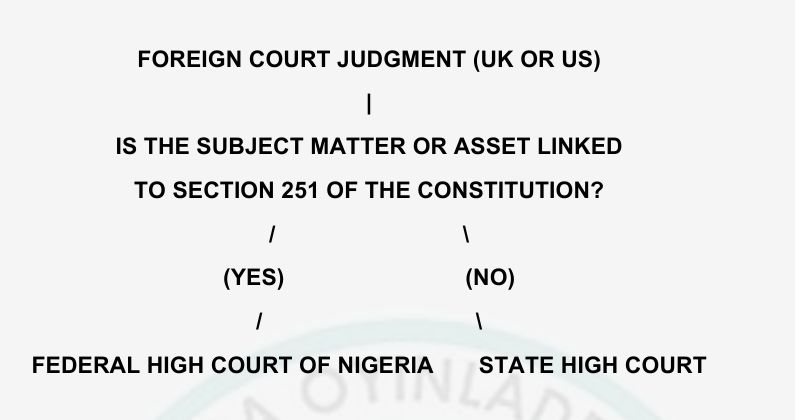
Selecting the correct court is a fatal pitfall for many international litigants. While State High Courts handle general commercial contracts, Section 251 of the Constitution of the Federal Republic of Nigeria 1999 (as amended) grants exclusive jurisdiction to the Federal High Court over specific sectors.
If the underlying dispute or the target assets involve any of the following fields, enforcement proceedings must be initiated in the Federal High Court:
- Admiralty and Maritime Matters (e.g., arresting a cargo ship docked at a Nigerian port).
- Banking, Foreign Exchange, and Currency Regulations.
- Aviation, Aircraft, and Airspace Matters.
- Intellectual Property (Patents, Trademarks, and Copyrights).
- Companies Regulation and Corporate Governance (CAMD).
CRITICAL PREREQUISITES FOR SUCCESSFUL ENFORCEMENT
Before a Nigerian judge will grant recognition to a UK or US judgment, the judgment creditor must satisfy several strict criteria. Failing to clear even one of these hurdles can lead to the suit being struck out.
1. Finality and Conclusiveness: The judgment must be final and conclusive between the parties in the court of origin. If an active appeal is pending or the judgment is subject to an ongoing stay of execution in the UK or US, it cannot be enforced in Nigeria.
2. A Competent Monetary/Liquidated Sum: The judgment must be for a definite, fixed sum of money. It must not represent a fine, tax, penalty, or punitive damages, as Nigerian public policy strictly prohibits the enforcement of foreign penal or revenue laws.
3. Proper Personal and Subject-Matter Jurisdiction: The originating foreign court must have possessed competent jurisdiction over the judgment debtor under Nigerian conflict-of laws principles (e.g., the debtor voluntarily submitted to the foreign court's jurisdiction or was actively carrying on business within that country).
4. Adherence to Natural Justice: The judgment debtor must have been properly served with the originating processes of the foreign court and granted a fair hearing. Default judgments are heavily scrutinized in Nigeria to ensure no breach of natural justice occurred.
STEP-BY-STEP PROCEDURE FOR ENFORCEMENT
Strategy A: Statutory Registration (Applicable primarily to UK Judgments)
1. The Application: Filed via an Ex-Parte Motion or a Motion on Notice at the Federal High Court registry, accompanied by an originating summons.
2. Affidavit in Support: Must contain a certified, authenticated copy of the judgment issued by the high court of origin (often authenticated via an Apostille or consular seal at the Nigerian High Commission/Embassy).
3. The Order of Registration: Once satisfied, the judge grants an order registering the judgment.
4. Notice to the Debtor: The creditor must serve Notice of Registration on the debtor, giving them a specific timeframe (usually 14 days) to apply to set the registration aside.
5. Execution: If no application to set aside is made, or if it is dismissed, the judgment is executed using local enforcement mechanisms like a Garnishee Order or a Writ of Fieri Facias (Fi.Fa)
Strategy B: Action at Common Law (Applicable to US and out-of-time UK Judgments)
1. Filing the Writ: The creditor files a Writ of Summons alongside a Statement of Claim, relying on the foreign judgment as a debt.
2. Summary Judgment Motion: Simultaneously, the creditor files an application for summary judgment under the relevant Federal High Court Civil Procedure Rules, supported by an affidavit stating the debtor has no defense.
3. Defense Evaluation: The debtor may attempt to show cause by filing a statement of defense. If they fail to raise a triable issue, the court enters judgment in favor of the creditor.
4. Execution: The judgment becomes a domestic order and is executed immediately.
PRACTICAL TRAPS AND STRATEGIC CONSIDERATIONS
1. The Limitation Windows (The Clock is Ticking)
For statutory registration under the 1922 Ordinance, the application must be made within 12 months of its delivery. While courts possess discretionary power to extend this, the threshold for demonstrating "just cause" is exceptionally high. At Common Law, the limitation window for enforcing a judgment debt expands to 6 years (or up to 12 years depending on interpreted limitations), but delaying still exposes assets to dissipation.
2. Currency Fluctuations and Conversions
If a judgment is awarded in US Dollars ($) or British Pounds Sterling (£), Section 17 of the Foreign Judgments Act and local fiscal laws dictate how foreign currencies are handled. Creditors can secure enforcement in the original foreign currency, or convert it to Nigerian Naira ($\text{NGN}$) utilizing the official prevailing exchange rate dictated by the Central Bank of Nigeria (CBN) at the time of the application.
3. Asset Tracing and Injunctions
To prevent a debtor from emptying accounts or moving assets out of Nigeria during litigation, international creditors should instruct counsel to file a Mareva Injunction (an asset-freezing order). This safeguards the debtor’s local assets until the enforcement proceedings conclude.
FREQUENTLY ASKED QUESTIONS (FAQS)
1. Can I enforce a US default judgment in Nigeria?
Yes, but it is subject to rigorous scrutiny. The creditor must conclusively prove that the defendant was properly served with the US court processes and given sufficient opportunity to defend the suit.
2. Can a foreign judgment for an injunction be enforced in Nigeria?
Generally, both statutory registration and common law actions require the judgment to be for a definite, liquidated sum of money. Non monetary judgments (such as permanent injunctions or specific performance orders) are immensely difficult to enforce unless pursued through alternative equitable remedies or international arbitration recognition frameworks.
3. How long does it take to enforce a foreign judgment in the Federal High Court?
An uncontested statutory registration or an un opposed summary judgment application can take anywhere from 6 to 12 months. However, if the judgment debtor files aggressive appeals or contests jurisdiction, the timeline can extend significantly. Efficacious strategy deployment, such as attaching temporary freezing orders early on, is vital to keeping the pressure on the debtor.
The content of this article is intended to provide a general guide to the subject matter. Specialist advice should be sought about your specific circumstances.
[View Source]