
- within Media, Telecoms, IT and Entertainment topic(s)
- in European Union
- in European Union
- in European Union
- in European Union
- in European Union
- in European Union
- in European Union
- in European Union
- in European Union
- in European Union
- in European Union
- with readers working within the Banking & Credit, Property and Retail & Leisure industries
- within Media, Telecoms, IT, Entertainment, Corporate/Commercial Law and Finance and Banking topic(s)
- with Finance and Tax Executives
India's online gaming sector has moved from a fragmented regime of state gambling laws and court-led 'skill versus chance' jurisprudence to a central, stakes-based statutory framework. The Promotion and Regulation of Online Gaming Act, 2025 received Presidential assent and was published as Act No. 32 of 2025; the Promotion and Regulation of Online Gaming Rules, 2026 were notified by the Ministry of Electronics and Information Technology on 22 April 2026 and came into force on 1 May 2026.
The framework is not a mere licensing regime for real-money gaming. Its core policy choice is sharper: online money games are prohibited irrespective of whether the underlying game involves skill, chance or a combination of both. At the same time, the statute and rules create a developmental and registration pathway for e-sports and online social games, subject to determination, user-safety, grievance-redressal and compliance obligations.
For gaming companies, investors, advertisers, payment intermediaries and digital platforms, the practical question is therefore no longer whether a game is predominantly skill-based. The threshold issue is whether any payment, deposit, token, credit, in-game asset or other stake is linked to an expectation of monetary or other enrichment.
Background: Why the Framework Matters
India's online gaming market has grown into a significant component of the digital economy. Government materials accompanying the new rules state that the Indian market generated approximately INR 232 billion in 2024, that transaction-based games accounted for 77 per cent of this revenue, and that the sector is projected to reach INR 316 billion by 2027 at an estimated compound annual growth rate of 11 per cent. These figures explain both the commercial significance of the sector and the regulatory urgency that informed the new framework.1
Before the 2025 Act, the regulation of gaming in India was largely mediated through state gambling enactments, the Public Gambling Act, 1867 in certain territories, the Information Technology Act, 2000 and delegated intermediary rules, and a long line of judicial decisions distinguishing games of skill from games of chance. That architecture produced serious uncertainty for online operators because an activity could be treated differently depending on the state law, the structure of the game, and the court before which the issue arose.
Prior to the enactment of the Act, Indian gaming jurisprudence was principally organised around the distinction between games of skill and games of chance. The Supreme Court, in the State of Bombay v. R.M.D. Chamarbaugwala, AIR 1957 SC 699; and later in State of Andhra Pradesh v. K. Satyanarayana, AIR 1968 SC 825, and Dr. K.R. Lakshmanan v. State of Tamil Nadu, (1996) 2 SCC 226, recognised that competitions or games in which skill predominates are not to be treated in the same manner as gambling simpliciter. That principle formed the legal foundation on which several real-money gaming operators, particularly in rummy, fantasy sports and other skill-based formats, sought to defend their business models under the pre-Act framework.
The 2025 Act deliberately changes that centre of gravity. It does not ask whether the game is mostly skill or chance for purposes of the online money game prohibition. Instead, it asks whether the online game involves payment, money, other stakes and an expectation of winning monetary or other enrichment. This is the central legal shift that must be understood by any market participant considering India-facing online gaming activity.
Legislative Architecture of the 2025 Act
The long title and preambular recitals of the Act reflect a dual policy objective: to promote e-sports, educational games and social gaming as components of India's digital and creative economy, while prohibiting online money gaming activities viewed by Parliament as causing financial, psychological, social, public-health and national-security harms. The recitals specifically identify addictive design, undisclosed algorithms, aggressive
advertising, fraud, money-laundering, tax evasion and potential terror-financing risks as matters requiring central intervention.
The Act applies across India and also extends to online money gaming services offered within India or operated from outside India. This extra-territorial formulation is important, because the law is designed to reach offshore platforms that target Indian users even where the operator is incorporated or hosted abroad. Practical enforcement, however, will still depend heavily on payment blocking, platform blocking and cooperation with intermediaries.
The New Taxonomy: E-sports, Online Social Games and Online Money Games
The Act creates three principal categories of online games. The classification is not cosmetic; it determines whether the activity is capable of lawful recognition or registration, or whether it falls within the statutory prohibition.
- E-sport: An e-sport is an online game played as part of multi-sports events, involving organised competitive events between individuals or teams in multiplayer formats governed by predefined rules, recognised under the National Sports Governance Act, 2025 and registered with the Authority or relevant agency. The outcome must be determined solely by factors such as physical dexterity, mental agility, strategic thinking or similar skills. Registration or participation fees for entry or administrative costs and performance-based prize money are permissible, but bets, wagers and other stakes are excluded.
- Online social game: An online social game is an online game that does not involve staking money or other stakes, and does not involve participation with an expectation of monetary gain in return for money or other stakes. A subscription fee or one-time access fee may be charged, provided that such fee is not in the nature of a stake or wager. The game must be offered for entertainment, recreation or skill-development purposes, and must not be an online money game or e-sport.
- Online money game: An online money game is any online game, irrespective of whether it is based on skill, chance or both, where a user pays fees, deposits money or provides other stakes in expectation of winning monetary or other enrichment in return. The Act separately clarifies that “other stakes” include credits, coins, tokens, objects or similar things, whether real or virtual, if recognised as equivalent or convertible to money and purchased directly or indirectly in relation to an online game.
The statutory definition of online money game is therefore deliberately broad. A platform cannot avoid the prohibition merely by asserting that its product is skill-based. Nor is the risk confined to cash deposits. Convertible tokens, credits, coins or other in-game assets may trigger analysis if they operate as money-equivalent stakes or are capable of being monetised outside the game environment.
Prohibition of Online Money Games
Sections 5, 6 and 7 of the Act create an integrated prohibition framework across the three most important parts of the online money gaming ecosystem: operation, promotion and financial facilitation.
- Operational prohibition: Section 5 prohibits any person from offering, aiding, abetting, inducing or otherwise engaging in the offering of an online money game or online money gaming service. The provision contains no saving for games of skill once the statutory elements of an online money game are present.
- Advertising prohibition: Section 6 prohibits any person from making, causing, aiding, abetting, inducing or otherwise being involved in any advertisement, in any media including electronic means, that directly or indirectly promotes or induces participation in any online money game or activity promoting such game. The breadth of the formulation is significant for celebrities, influencers, affiliate marketers, ad-tech intermediaries and platforms carrying promotional content.
- Financial-rails prohibition: Section 7 prohibits banks, financial institutions and any other persons facilitating financial transactions or authorisation of funds from engaging in or facilitating transactions or fund authorisations towards payment for any online money gaming service. In effect, the statute makes payment infrastructure a primary enforcement point.
The Act also permits blocking of information generated, transmitted, received or hosted through computer resources in relation to online money gaming services by using the mechanism under Section 69A of the Information Technology Act, 2000. Further, the Act is expressed to operate in addition to other laws, and to override inconsistent laws to the extent of inconsistency.
Penal Exposure and Corporate Liability
The Act combines criminal sanctions, civil consequences for breach of directions, and vicarious liability for companies and persons responsible for the relevant business conduct. The penalty architecture is material for founders, directors, key managerial personnel, advertisers, payment intermediaries and investors with board or observer rights.
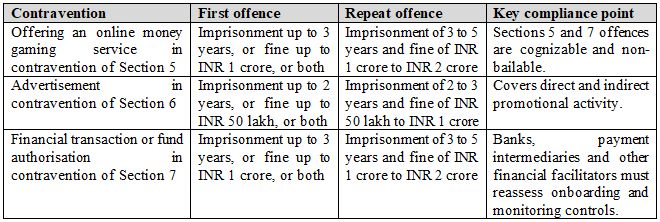
Section 11 creates company-offence liability for the company and for every person who, at the time of the offence, was in charge of and responsible to the company for the conduct of that part of the business. A statutory defence is available where the person proves absence of knowledge or exercise of due diligence. Separately, where consent, connivance or neglect of a director, manager, secretary or other officer is proved, that person may be deemed guilty. Independent and non-executive directors who are not involved in actual decision-making are expressly protected from liability under that provision.
Non-compliance with directions issued under Section 8(3) may also attract a penalty up to INR 10 lakh and may include suspension or cancellation of registration and prohibition from offering, facilitating or promoting games for a specified period, after an opportunity of hearing.
Online Gaming Authority of India
The Act empowers the Central Government to constitute an Authority for online gaming, and on 22 April 2026 the Government constituted the Online Gaming Authority of India (“OGAI”). OGAI is chaired by the Additional Secretary, MeitY, with ex officio joint secretary-level members from the Ministry of Home Affairs, Department of Financial Services, Ministry of Information and Broadcasting, Ministry of Youth Affairs and Sports, and Department of Legal Affairs.
The Rules structure OGAI as an attached office of MeitY, with its head office in the National Capital Territory of Delhi and a digital-first mode of functioning. This institutional design is significant. Online gaming regulation cuts across technology policy, financial integrity, advertising, sport, consumer harm and public order; a multi-ministry authority is therefore intended to avoid a purely technology-ministry view of risk.
OGAI's functions include maintaining and publishing lists of online games determined to be online money games; maintaining records of determined or registered games; inquiring into complaints; issuing directions or orders to persons offering, organising or facilitating online games, advertisements and financial transactions; issuing guidelines or codes of practice in consultation with the Central Government; hearing grievance appeals; and coordinating with financial institutions, law-enforcement agencies and other regulators.2
Determination of Online Games under the Rules
A key feature of the Rules is that determination is not compulsory for every online game by default. Rule 8 provides that determination is required where OGAI directs a provider to obtain determination on a suo motu basis, where the provider intends the online game to be offered as an e-sport, or where the Central Government notifies a category of online social games requiring determination having regard to the nature, volume or value of financial transactions or fund authorisations permitted for participation or access.
Rule 9 sets out the determination factors. OGAI must examine whether a user is required to pay fees, deposit money or provide other stakes at any stage; whether the user participates with an expectation of monetary or other enrichment; how payments are structured; whether payments are connected to prize pools, rewards or wagers; the revenue model of the provider; and whether credits, coins, tokens, objects or other in-game rewards can be transferred, redeemed, monetised or otherwise used outside the game environment.
Rule 10 makes the determination provider-specific. A determination that one provider's game is not an online money game does not automatically validate a structurally similar game offered by another provider. This matters for white-labelled products, franchise-like gaming models, platform aggregators and group companies operating similar game formats through separate entities.
A determination is to be made, as far as practicable, within 90 days from receipt of a complete application or issuance of notice in a suo motu proceeding, excluding time taken to obtain information in the latter case. The determination remains valid only so long as changes to the online game do not affect payment facilitation or fund authorisation for participation or access. OGAI may review, suspend, withdraw or require fresh determination where the product is materially modified.
Registration of E-sports and Online Social Games
The Rules create a registration regime, but it is not universal. Registration is required where
the Central Government notifies a game or category of online social games for registration, or where an online game is sought to be offered as an e-sport. In deciding whether a category requires registration, the Government may consider harm risk to users, including children; the nature of the outcome; public impact; scale of participation; transaction volume and value; and the provider's country of origin.
An online money game cannot be registered as an e-sport. An e-sport must also be recognised under the National Sports Governance Act, 2025. Registration is game-specific and provider-specific, and OGAI issues a digital Certificate of Registration with a unique number. The certificate may be valid for up to 10 years, unless surrendered, suspended or cancelled earlier. Grounds for suspension or cancellation include material changes that may cause the game to be treated as an online money game, repeated non-compliance, loss of e-sport recognition, false statements in the application, non-payment of penalty, or breach of applicable law.
Service providers must prominently display determination or registration details on the computer resource through which the game is offered or made available, and must not misrepresent an online game as a determined online social game or a registered game unless the relevant determination or registration has actually been obtained.
User Safety, Grievance Redressal and Data Governance
The Rules impose affirmative user-protection obligations on online social game and e-sport providers. The expression 'user safety features' is defined broadly to include technical, procedural, operational, behavioural and system-related safeguards appropriate to the risk profile of the relevant game. Illustrative safeguards include age verification or age-gating, time restrictions, parental controls, user reporting and grievance redressal, counselling support, and fair-play and integrity-monitoring tools.2
Rule 20 requires every online game service provider offering an online social game or e-sport to establish and maintain a functional internal grievance redressal mechanism. A user dissatisfied with the provider's resolution may approach OGAI within 30 days of the provider's decision or non-resolution. OGAI is expected to endeavour
to dispose of such appeal within 30 days, and a further appeal lies to the Appellate Authority, namely the Secretary to the Government of India in MeitY.
From a data and technology governance perspective, Rules 16 and 17 require compliance with OGAI directions, orders, guidelines or codes of practice relating to designation of a point of contact and retention or storage of traffic data, metadata and related information on computer resources located in India. These obligations operate without prejudice to requirements under other applicable laws, including information technology, cybersecurity, privacy and law-enforcement frameworks.
The Digital Personal Data Protection Act, 2023 and rules made thereunder, once applicable to the relevant processing activity, will need to be separately mapped to user onboarding, behavioural analytics, age verification, fraud monitoring, grievance handling, profiling and data retention practices. The Rules should not be read as displacing privacy compliance; rather, gaming-specific data retention and safety requirements will have to be reconciled with broader data-protection principles such as notice, consent where required, purpose limitation, security safeguards and deletion or retention discipline.
Consequences for Market Participants
a. Gaming Companies
The first compliance step for any India-facing gaming operator is a product-by-product classification audit. The audit should not begin with the question whether the game involves skill. It should begin with payment flows, user deposits, reward structures, monetisation of credits or in-game assets, transferability, secondary-market behaviour, prize mechanics and user expectations of enrichment.
Where an offering falls within the online money game definition, the commercial response cannot be limited to improved disclosures or responsible-gaming controls. The prohibition is categorical. Operators will need to cease India-facing online money gaming services or restructure products into non-stake-based social gaming, subscription, advertising, access-fee or entertainment models that do not create an expectation of monetary or other enrichment in return for money or other stakes.
Permissible social games and e-sports are not unregulated spaces. Providers must prepare for determination or registration where triggered, implement user safety features, maintain grievance-redressal architecture, designate contact points when required, maintain technical and compliance records, and ensure that public representations do not overstate regulatory status.
b. Advertisers, Influencers and Digital Platforms
The advertising prohibition is intentionally broad and covers direct and indirect promotion. Brand campaigns, affiliate arrangements, referral links, influencer videos, surrogate promotions, app-store descriptions, push notifications and performance-marketing creatives should be reviewed for exposure if they induce participation in an online money game or an activity promoting such game.
For media and platform intermediaries, the compliance question is not merely whether the advertiser is incorporated in India. Offshore platform promotions targeted at Indian users may create risk if they promote prohibited online money gaming services. Contractual undertakings, advertiser diligence, takedown protocols and repeat-offender controls should be updated accordingly.
c. Banks, Payment Aggregators and Financial Intermediaries
Payment intermediaries are not passive market infrastructure under this framework. They are expressly within the statutory prohibition where funds are facilitated for online money gaming services. Under the Rules, banks, financial institutions and other payment facilitators must comply with directions relating to financial transactions and authorisation of funds, verify determination orders or Certificates of Registration where required before facilitating transactions for e-sports or online social games, and promptly suspend, restrict or discontinue facilitation where directed by OGAI.
Merchant onboarding, MCC mapping, transaction monitoring, suspicious-pattern escalation, chargeback review and contractual termination rights should therefore be recalibrated for online gaming merchants. Payment entities should also preserve evidence of diligence and direction-compliance, because failures may carry both statutory and reputational consequences.
d. Investors and Acquirers
Investors in the gaming sector must now conduct regulatory classification diligence at the product level. General warranties that a target is 'compliant with law' will be inadequate. Transaction documents should address online money game exposure, determination and registration status, advertising and influencer arrangements, payment flows, in-game asset economics, OGAI directions, user grievances, data retention, age-gating, and any regulatory correspondence.
Material adverse effect and termination provisions should be drafted to capture adverse determinations, suspension or cancellation of registration, blocking directions, inability to process payments, criminal exposure or significant product restructuring. Board nominees and observers should also be sensitive to the corporate-liability provisions where they become involved in actual decision-making or product-level compliance approvals.
Offshore Platforms and Enforcement Realities
The Act's extra-territorial reach is clear in language, but enforcement against foreign operators without Indian presence will remain operationally difficult. The most effective enforcement points are likely to be payment blocking, website or app blocking, advertising controls, domain and mirror-site monitoring, and cooperation with intermediaries and foreign regulators.
The offshore-risk problem should not be underestimated. If domestic operators exit or restructure while offshore platforms continue to target Indian users through mirror domains, virtual private network workarounds, crypto or alternative payment rails, the formal market may become cleaner while the informal market becomes harder to supervise. OGAI's effectiveness will therefore depend not only on rule-making but also on enforcement coordination and technology-driven monitoring.
Regulatory Procedure, Anti-Money Laundering Rationale And Market Impact
The Act and Rules introduce a structured enforcement procedure rather than a mere policy declaration. The Online Gaming Authority will be empowered to determine whether a particular online game is an “online money game”, register or recognise permissible categories such as e-sports and online social games, issue directions and codes of practice, and address complaints. Once a game falls within the prohibited category, the consequences are wide: the platform cannot offer or facilitate it; advertisers, influencers and media agencies cannot directly or indirectly promote it; and banks, payment gateways, wallets and financial institutions cannot process transactions connected with it. The statute also creates criminal exposure, including imprisonment and monetary penalties, while empowering authorities to block access to unlawful online money gaming services and investigate, search and seize both physical and digital assets. This framework is designed to attack the entire operating chain—platform, promotion, payment flow, user acquisition and offshore access—rather than only the game operator.
A key policy justification for the ban is the Government’s concern that online money gaming had become a channel for addiction, financial ruin, fraud, money laundering, tax evasion and, in some cases, terror financing and national-security risks. The Government’s explanatory material also states that online money games affected an estimated 45 crore people and caused losses of more than ₹20,000 crore. In market terms, the impact was immediate: several prominent real-money gaming brands and platforms reportedly suspended or discontinued money-gaming operations, including Dream11, MPL, Zupee, Games24x7, A23, PokerBaazi and Probo; Flutter also ceased money-based online gaming operations in India through Junglee, while Gameskraft reportedly undertook major layoffs after the change in law. For India, the expected benefit is twofold: first, consumer protection through reduction of predatory stake-based gaming, money-laundering channels and unauthorised
payment flows; and second, regulatory redirection of the sector towards e-sports, educational games, social games, digital creativity, employment generation, exports and responsible innovation.
Constitutional and Litigation Outlook
The prohibition-centric architecture is likely to remain constitutionally contested. The principal lines of challenge may include legislative competence, the displacement of the historical skill-based jurisprudence, Article 14 arbitrariness, proportionality, and restrictions on trade under Article 19(1)(g). Public reports indicate that the Supreme Court has transferred to itself petitions challenging the constitutional validity of the Act that were pending before several High Courts. Unless and until the law is stayed, read down or struck down, however, compliance must proceed on the basis that the statutory and rules-based framework is operative.7
The Government is expected to defend the law on the basis of user harm, public health, financial integrity, national security, inter-state digital activity and offshore evasion. The industry, by contrast, is likely to argue that a categorical ban on stake-based games of skill is disproportionate when less intrusive regulatory alternatives could have been considered. The constitutional outcome will therefore be central to the long-term shape of India's online gaming economy.
Conclusion
The Promotion and Regulation of Online Gaming Act, 2025 and the Promotion and Regulation of Online Gaming Rules, 2026 represent India's most consequential intervention in the online gaming sector to date. The regime moves decisively away from the prior litigation-led skill-versus-chance framework and replaces it, for online games involving financial stakes, with a stakes-based prohibition.
For online money gaming operators, the message is direct: the commercial model is prohibited where the statutory elements are present, irrespective of skill. For e-sports and online social gaming businesses, the framework creates a formal pathway, but not a compliance-free pathway. Determination, registration, user safety, grievance redressal, data retention, payment verification and regulatory representation will now become embedded features of India-facing gaming operations.
The success of the regime will depend on OGAI's institutional capacity, the clarity of future directions and codes of practice, the handling of constitutional challenges, and the ability of regulators to address offshore platforms without suppressing lawful innovation. For now, every participant in the ecosystem should treat the new framework as an immediate board-level and compliance-level issue, not merely as a policy development.
Footnotes
1. Press Information Bureau, 'A New Era of Online Gaming Governance', 30 April 2026: https://www.pib.gov.in/PressReleasePage.aspx?PRID=2256973
The content of this article is intended to provide a general guide to the subject matter. Specialist advice should be sought about your specific circumstances.