
1. Analysis of BRSR Reporting: Introduction
The introduction of Business Responsibility and Sustainability Report (BRSR) is a major leap in the disclosure landscape of companies in India. SEBI has mandated the top 1,000 listed companies to share Sustainability-related information. The framework is designed to achieve consistency, comparability and transparency of business environmental, social and governance (ESG) practices. The BRSR's intent is progressive though the road of compliance is still in its infancy.
After reviewing the top 400 companies across a variety of industries over the last two financial years, it's clear there are a few enterprises that are going above and beyond the call of duty, and then there are others with recurring issues and inconsistencies. These vary from lack of reporting, vague policy statements, to not being aligned with materiality and no measurable targets set. These problems not only weaken the effectiveness of the BRSR but also reduce the stakeholders' trust in its reports that they use for informed decision making.
2. Top discrepancies in BRSR disclosures
The companies surveyed show that even some of the most mature industries, from manufacturing, to financial services, automotive, IT consulting, infrastructure and consumer products, still have some recurring issues with compliance and disclosure in the BRSR framework.
In this exposure, a number of general themes of errors arise:
2.1 Rationalisation Issues
Most companies publish the quantitative information in a rationalised manner but do not usually include notes of explanation for this information. Without notes, the sharp changes (e.g., attrition, P6 data) seem arbitrary and less reliable and interpretable.
2.2 Boundary and Scope Issues
Many companies report boundaries inconsistently. For instance, disclosures are only included in manufacturing plants, exclusions are made for offices or for international operations, even though they are reported under consolidated rules. This makes it difficult to compare and leave stakeholders in confidence. Some companies have been observed of not reporting all data on standalone basis. Some companies have put consolidated BRSR but have done only standalone assurance.
2.3 Subsidiary Coverage
Only a handful of companies have been able to report BRSR figures on their subsidiaries, associate companies or joint ventures. Interestingly, some companies even state “Yes” for consolidated reporting but have prepared their BRSR on a stand-alone basis leading to inconsistent disclosure and diluted disclosures.
2.4 Risk vs Opportunity Misclassification
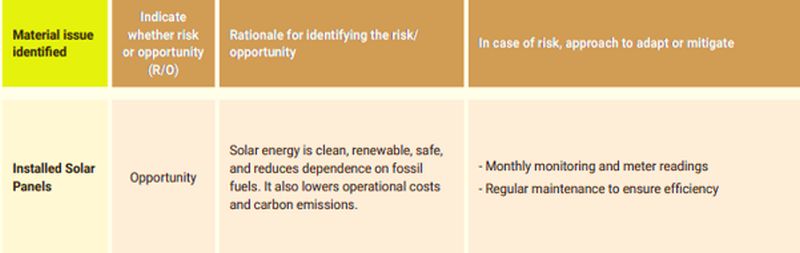
A common error is misclassifying opportunities as risks, and offering risk-mitigation solutions for what they define as an opportunity. This causes confusion when it comes to the understanding of materiality and business impact. Companies are matching their risks and opportunities as outlined in their internal audit risk register. However, the compliance requirements demonstrates material issues related to E and S. Guidance note on the same has been issued by the respective stock exchanges in the past.
2.5 Policy Gaps
Some companies don't align statutory policies, certifications and codes of conduct with individual NGRBC principles or individual plants / offices. On the contrary, there are general provisions (such as to SEBI LODR or the Factories Act) made, which do not fall within the ambit of the disclosure.
In several instances, companies have checked “Yes” for all the policies being rolled out to value chain partners, but have not disclosed this on the questionnaire. Second, most companies have not requested independent third party assessment and/or evaluation of their policies, reducing credibility and accountability.

2.6 Certification Gaps
The Companies have provided details of their ISO certification but have not explained the scope of the said ISO & the the locations at which the standards have been implemented. The same does not meet the compliance requirement as laid down in the guidance note issued by SEBI.

2.7 Value Chain Assessments
Some companies state that value chain partner (VCP) assessments are not applicable or do not carry out these assessments. In certain instances, the training disclosures of VCPs are not specific enough or are disclosed in percentage of procurement spend, not percentage of partner covered.

2.8 Data Quality and Professional language
Unprofessional use of language (short forms, such as “Pls”); vague training topics (e.g., “NGRBC principles” with no detail); different types of grievance incidents being reported as being both “closed” and “pending”. Furthermore, the term “NA” is used instead of “0” and “–”, adding to the confusion of whether the parameter is not applicable, not available, or indeed zero.
2.9 Regulatory Compliance Alignment
There are several companies which have not followed the amendments made by SEBI on 31st December 2024 in the Disclosures and Assurance requirements, Penalty etc. for the top 250 Companies.

2.10 Remuneration Disclosures
The median remuneration for female director or KMPs is often missing or is shown as zero without any explanation or the remuneration of KMPs is not calculated. This reflects an inadequate level of rigour in disclosures under Principle 5.
2.11 Unit Inconsistencies
There have been disclosures from several companies which have reported the wrong or inconsistent units. Values are not always standardised according to Principle 6. PPP adjusted in some cases have been reported in INR rather than USD, leading to inaccuracies and lack of comparability of data.

2.12 Non-disclosure of Leadership Indicators
A number of companies have restricted their reporting to essential indicators only, leaving out the leadership indicators. Although these are voluntary disclosures, SEBI has not provided the option to alter or bypass the prescribed template. Non-disclosure reduces the depth of reporting and overlooks the opportunity to demonstrate industry leadership and advanced ESG practices.
2.13 Non-Disclosure of Scope 3 Emissions in Detail
Some businesses only report on their Scope 3 emissions where they are clearly related to waste, and exclude other important categories of emissions including business travel, upstream & downstream transportation, and purchased goods & services. This partial disclosure will diminish the completeness and usefulness of their carbon footprint reporting.
2.14 Non-Compliance with ISF Standards for BRSR Assurance/Assessment
There are a number of companies that have not aligned with the Industry Standards Forum (ISF) standards for the assurance and evaluation of BRSR through the circular dated 28th March, 2025 by the SEBI. In such instances, ESG reporting is not done to a recognised industry standard, thus the confidence of stakeholders in the ESG disclosures is diminished and concerns about the accuracy, completeness and reliability of ESG disclosures are raised.

2.15 Non-Undertaking of Mandatory Assurance/ Assessment
Several companies have not been able to get assurance/assessment for their BRSR disclosures, even if required by SEBI circulars for the top-ranking companies. In such situations, reports are not independently verified and are therefore not as credible as they could be and may lead to a loss of investor trust and doubts regarding the validity, completeness and accuracy of reported ESG information. This also contradicts the purpose of assurance i.e., to give credibility and comparability between companies.
2.16 EPR-Related Non-Disclosure
There are several companies that are clearly applicable under Extended Producer Responsibility (EPR) that have reported “Nil” or “NA” with regard to reclaiming and reusing, or recycling of products. This means either non-compliance or difficulties in reporting, and decreases transparency on their environmental responsibility and circular economy activities.
2.17 Policies and Certifications Unmatched to NGRBC Principles
Some Companies state policies and certifications in their BRSR, but do not link them to the appropriate NGRBC principles. This is a drawback for evaluating the conformance to sustainability standards and hiding the connection between corporate governance, corporate practices and ESG results.
2.18 Inconsistencies in Water Data
Water data is reported inconsistently and/or technically implausibly by multiple companies. For instance, effluent discharge is reported as zero even if there is no ZLD system installed, or the discharge is reported as equal to the consumption or the water withdrawal is reported as less than the consumption. These differences are likely due to either data collection or reporting errors, making environmental disclosures less reliable and credible.
2.19 Inconsistencies in Waste Data
Many companies don't offer an explicit list of the details found in their waste management data. In particular, the separation of hazardous from non-hazardous waste is frequently lacking and waste recovery/disposal is not also separated.
2.20 Avoiding Maternity Benefit Disclosures
Some companies report maternity benefits for non-permanent female employees as zero, despite legal obligations under the Maternity Benefit Act. This misrepresentation reflects either gaps in policy implementation or errors in reporting, undermining the accuracy and compliance of social disclosures.
2.21 Incorrect LTIFR calculations
There are some reports with a number of workplace injuries and a zero Lost Time Injury Frequency Rate (LTIFR). This indicates that there was a mistake when calculating the metric or a lack of understanding on how the metric is calculated.
2.22 Mismatch in Grievance Data Across Sections.
The complaints reported under Principles 3, 5 and 9 do not correspond with the number of complaints reported in Section A in many reports. A company for example could have 2 incidents of sexual harassment in section 5, and state “no complaints” in section A. The holes in these types of gaps indicate internal disconnects in the compilation and verification of the information, and they make the report less credible to its readers.
2.23 Inconsistencies between minimum wage and coverage of ESIC benefits
Some reports show that the percentage of employees or workers reporting equal to minimum wage is greater than those that reported being covered by the ESIC benefits. The data showing that employee wages are less than the minimum wage compliance threshold are not consistent given that employees who are paid equal to minimum wage should be covered by ESIC.
2.24 Lack of Clarity on ISF Alignment
No footnotes, references or explicit indications are provided in the reports and it is somewhat difficult to infer whether companies have applied the ISF standards to their BRSR disclosures.
2.25 Interchangeable Use of “NA” and “No”
There is some confusion among the companies regarding the use of “NA” (Not Applicable) and “No.” This can lead to misunderstandings since “NA” means “Not applicable” to a question while “No” means that “No data” exists or that the company has not performed the activity.
The overall analysis indicates that operational excellence in the core industries, does not necessarily correlate with disclosure excellence. These companies are the biggest by market cap in India, but their BRSR filing shows that there's still a lot to be done when it comes to maturity in sustainability reporting and making it more than a compliance exercise.
3. Conclusion
The study of BRSR disclosure by the top 1000 listed companies in India clearly indicates that the journey towards increased sustainability reporting is being made but there is a huge gap in quality, consistency, and depth of BRSR disclosures. Many companies are still treating the BRSR as a compliance process, as evidenced by recurring challenges with incomplete boundary coverage, unclear and/or inaccurate data, policy and certification mismatch, poor value chain assessments and poor assurance practices.
With the evolving maturity of BRSR, it becomes a platform for the Indian corporates to embed ESG principles in their daily activities and demonstrate their accountability to the level of global expectations. Annual BRSR should not only seek compliance, but rather the creation of credibility, the reduction of risks, and the creation of lasting values in addressing the apparent errors observed. In the future, businesses that adopt BRSR disclosures in a comprehensive and sincere manner will be not just regulatory compliant, but also trailblazers in the growing area of responsible and sustainable business.
The content of this article is intended to provide a general guide to the subject matter. Specialist advice should be sought about your specific circumstances.