

Legal work first moved to India to save money. Today’s centres are expected to own that work, and whether they succeed turns on design choices that a cost model won’t show.
|
Key takeaways • Build for ownership. India’s legal centres now run whole processes and own the results, so the question for general counsel is what to build and how. • Decide what the centre is for. No two of the eight bank centres we studied are built alike, some work matures faster than the rest, and a well-planned middle layer is what keeps people. • Budget for seniority. The saving is about 85% on junior lawyers but 68% on the senior lawyers a centre depends on. • Fit the model to the work. The right operating model depends on how clearly defined the work is and how committed you are to owning it. • Make Indian law part of the design. In-house lawyers in India cannot claim privilege or practise, and the data protection exemption for foreign data is narrow. • Make the case internally. The strongest case shows onshore lawyers that the centre frees them for higher-value work, and points to risks already flagged in audits and to the outside-counsel fees now paid for routine work. |
The work has changed
Many general counsel in New York or London still picture India as a document review project from a decade ago, or a saving that never earned their trust. That picture is out of date.
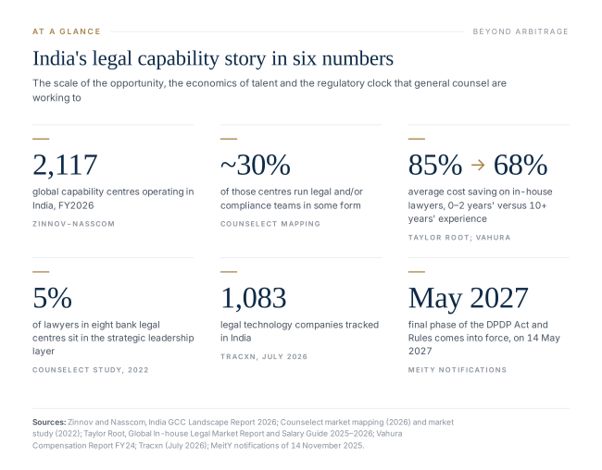
India has 2,117 global capability centres (GCCs), which earn about US$98.4 billion and employ 2.36 million people.1 By our count, about three in ten have a legal or compliance team.2 Because these teams now take on work of a different kind, the decision to build one has moved from finance to the legal department.
Four waves, from cost to capability
Legal centres in India have grown in four waves (Exhibit 1). Banks and other early adopters came from about 2007, and pharmaceutical and engineering firms followed after 2015. Retail, technology and platform companies have joined since 2020, and in a fourth wave now forming, India teams lead legal operations and global GenAI rollouts.
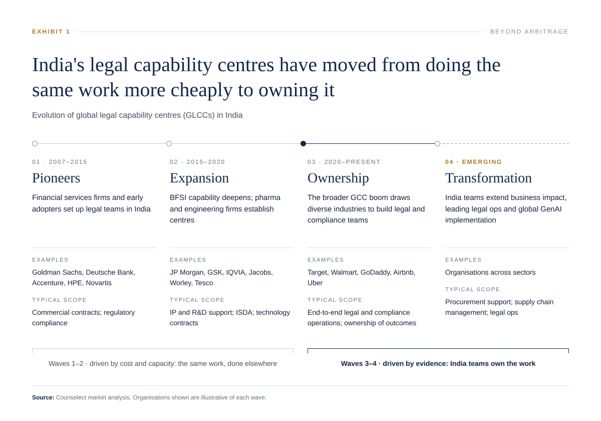
The first two waves moved the same work somewhere cheaper. From the third, India teams earned more responsibility by proving themselves, moving from templated work to the exceptions, then to negotiations, and finally to designing systems and piloting AI tools for global use.
Five kinds of legal work are moving to India
Five changes in legal work explain the move, and none of them is mainly about cost.
Table 1: What is pulling legal work to India
|
Shift |
What it means for the India team |
|
Contracting has broadened |
Multi-jurisdiction and framework agreements run from India, which escalates only questions that need local sign-off. |
|
KYC never stops |
CDD, EDD, refresh and remediation run end to end, with legal and compliance in the escalation path. |
|
IP is a portfolio to run |
Filing, docketing, renewals and clearance at volume, by counsel, patent agents and IP operations staff. |
|
Regulation keeps changing |
Tracking circulars, assessing impact and filing returns need a standing team. |
|
Obligations outlast the deal |
Settlement and post-closing obligations run for years and need systems that show compliance. |
Source: Counselect.
Some see GenAI as a threat to these centres, because work that can be standardised can also be automated. The better centres use it to make tailored work affordable instead. A contracting team that once sent every counterparty the same template can now adjust its terms to each counterparty’s risk, using what its KYC checks found.
What eight banks’ India centres show
Banks are the best reference point because they have run India legal centres the longest. In 2022, Counselect studied about 300 lawyers at eight international banks’ India centres, where legal teams ranged from 13 to 92 lawyers.3 The banks built their teams very differently, but in every centre the same kinds of work matured first, and the senior layer was thin.
Each team was built for a purpose
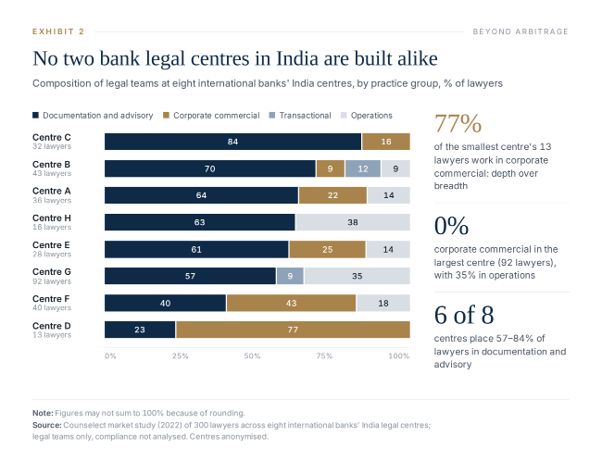
Team make-up varied widely (Exhibit 2). In six centres, documentation and advisory work took 57% to 84% of lawyers. The smallest centre put ten of its 13 lawyers on corporate commercial work, the bank’s own contracts with suppliers and vendors. The largest had no one on that work, having chosen to focus on client contracts that bring in revenue. Both choices made sense because each bank had first decided what its India team was for.
Financial-markets work matures first
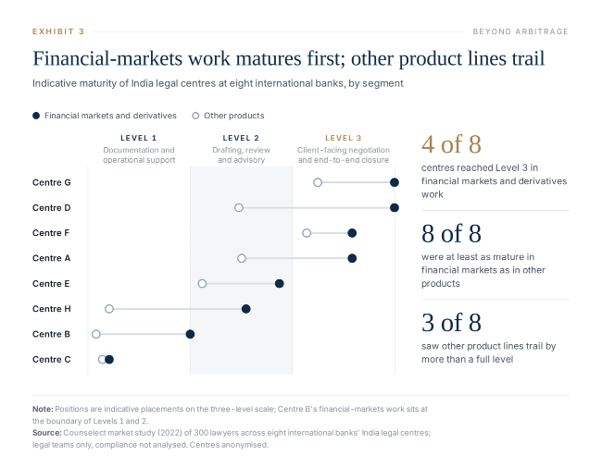
We placed each centre on a three-level scale, running from documentation support to client-facing negotiation. Financial-markets work, meaning the derivatives and trading contracts behind a bank's markets business (for example ISDAs, collateral terms, FX and repos), was at least as mature as work for the bank's other product lines (lending, trade finance, transaction banking and wealth) in every centre, and four centres had reached the top level in it. In three, the other product lines trailed by more than a level (Exhibit 3). Repeatable, high-volume work matures first and advice that rests on judgment follows slowly, if at all, which onshore colleagues should be told to expect.
Few leadership roles sit in India
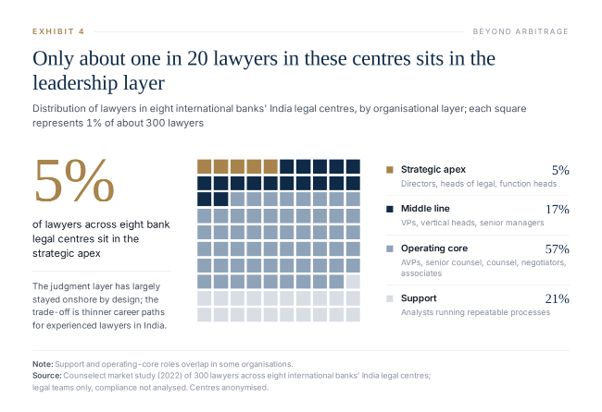
Only 5% of lawyers were directors or function heads, against 57% in the operating core (Exhibit 4). This is partly by design, since regional counsel who own relationships and regulatory accountability mostly stay onshore, and usually should. The cost is short career ladders and knowledge held by a few people. In Bengaluru, lawyers often switch banks after two or three years when their pay stalls, so a centre that plans its middle layer with care keeps its people longer.
The saving shrinks with seniority
The saving is real. An in-house lawyer in India with up to two years’ experience costs about 85% less than one in the US, the UK, Singapore or Australia (Exhibit 5).4
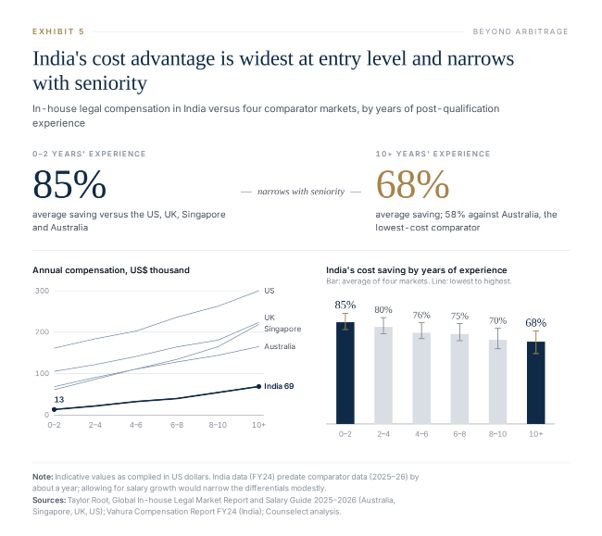
Beyond ten years, though, the average saving falls to 68%, and to 58% against Australia. Quality control, escalation judgment and retention all rest on these middle and senior lawyers, so a business case built on junior headcount alone will look excellent in year one and fragile by year three.
|
Case study: from five lawyers to more than 100 When the bank surveyed its US, UK and Singapore teams, they doubted India on quality and distance and saw it as back-office support. The bank began with five lawyers of two to three years’ experience, at about a quarter of onshore cost, on low-risk work such as regulatory remediation, LIBOR amendments and templates. A three-month free trial with the London team changed minds. Quality beat expectations, so scope grew to derivatives documentation and research, and six more lawyers joined. The centre went on to pass 100 lawyers, hiring at five to eight years’ experience as its focus moved from cost to capability. Growth sped up when the bank tied onshore headcount to India adoption. That worked, but it is also why many onshore lawyers still hear “India” as “replacement”. |
Senior talent is scarce outside contracting and M&A
India has 1,942 registered centres of legal education5 and a common-law tradition shared with the US, the UK, Canada and Australia, and its more than 1,000 legal technology companies6 have trained people in contract and AI tools.
Depth varies by skill and seniority, though (Exhibit 6). Junior talent is plentiful almost everywhere, but senior talent is readily available only in commercial contracting and M&A. Data privacy, eDiscovery and compliance lose senior people for lack of growth paths, and legal operations talent is still developing.
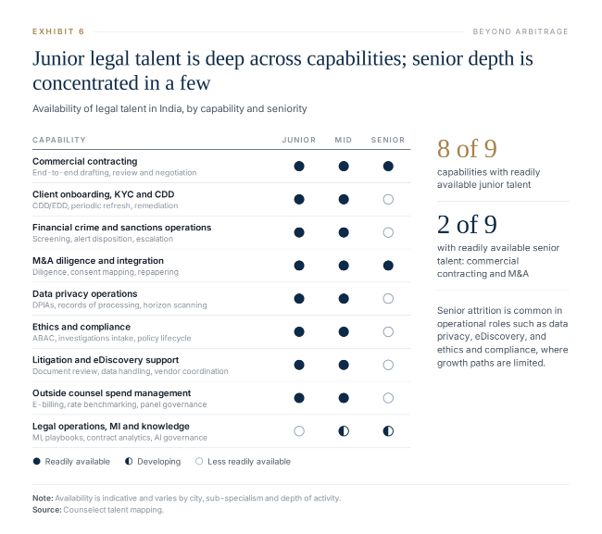
Good centres don’t staff every task with lawyers. Data protection impact assessments need legal training, while high-volume data access requests can go to trained non-lawyers under supervision, so the task is to find the decisions that need legal judgment.
Match the model to the work
Setbacks at a legal centre are often put down to its location, though a poor fit between the operating model and the work is usually the real cause. The right model depends on how clearly defined the work is and how committed the organisation is to owning it (Exhibit 7).
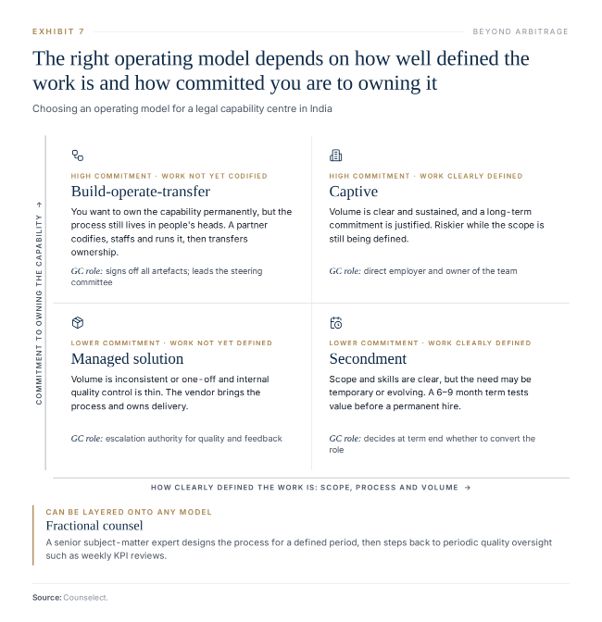
When organisations pick a model without asking these two questions, two mistakes tend to follow. The first is hiring full-time lawyers for uneven volume and then moving them across unrelated The second is treating process design as legal work (Exhibit 8).
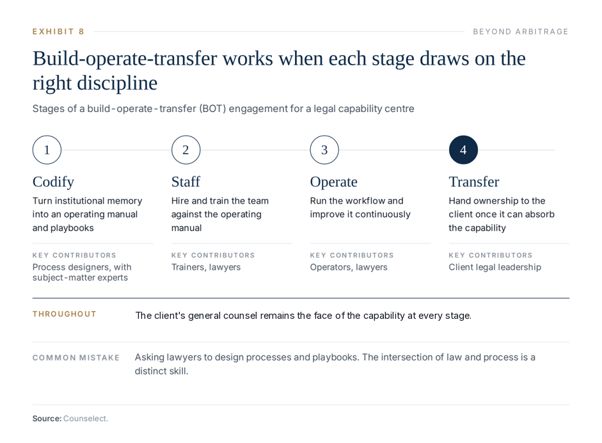
Fractional counsel can sit on top of any model. A senior expert redesigns a process over about three months and then steps back to periodic oversight, such as weekly KPI reviews. One organisation used this to move its KYC process to India without hiring a full-time head of KYC, while onshore colleagues still knew an expert answered for quality.
Where Indian law shapes the design
Three features of Indian law need planning for, though none of them undermines the model.
In-house lawyers cannot claim privilege. In October 2025, the Supreme Court held that in-house counsel, as salaried employees who do not practise as advocates, fall outside Section 132 of the Bharatiya Sakshya Adhiniyam, 2023, though Section 134 may still cover confidential communications with external advisers.7 Whatever a US or UK court decides, Indian authorities can seek work held in India, so advice that must stay privileged should go through onshore or external counsel.
Employed lawyers cannot practise. Under Rule 49 of the Bar Council of India Rules, a salaried advocate must stop practising while employed.8 India teams therefore advise within documented risk positions, and local-law opinions, court work and final sign-off stay with onshore or external counsel, as they already do in mature centres.
The data protection exemption is narrow. Most of India's data protection law does not apply when an India centre handles personal data about people outside India on behalf of a company or other party abroad, under a contract with it. For most centres, that contract is the services agreement with their parent. The centre must still keep the data secure and answer for how it is handled (Sections 8(1) and 8(5)). The exemption does not cover data about Indian customers or the centre's own staff, and foreign laws such as the EU's GDPR still apply to the foreign data. With the rules under India's data protection law coming into force in stages until May 2027, centres should work out now which of their data the exemption covers.
Make the case internally
The hardest audience is often the onshore legal team, which may suspect, with some reason, that an India proposal means job cuts. It helps to say plainly that regional counsel stay, and that the centre frees them for work only they can do.
Two anchors make the case concrete. The first is risk already on record, since linking the centre to risks flagged in audits or annual reports answers what regulators will ask. The second is the legal budget. Small in-house teams often send routine, high-volume work to outside law firms and pay the same hourly rates they would for complex advice. Moving that work to an India centre shows up directly in the budget. Start with the next one to three years’ priorities and the areas of highest spend and risk.
|
Seven questions to ask each function 1. What are your priorities for the next one to three years? 2. What worries you most? 3. Where is talent hardest to find? 4. Where does your team spend time on essential but low-value work? 5. How will your legal team change in three years? 6. What do you think of capability centres, and why? 7. Where do you outsource, and does the billing suit the volume? Start with question 4, because it presents the India team as a way to free onshore lawyers for more valuable work. Question 6 matters as much, since past experience with India cuts both ways. Meet doubts with current data and use goodwill to move faster. |
Design decides the outcome
India is cheaper, but cost is no longer the main argument. KYC cycles, regulatory change and IP portfolios never stop. That work is best handled by a dedicated team with settled processes, and such a team is hard to build onshore at the same scale.
The centres that work have a clear purpose from the start. They plan for uneven maturity, budget for middle and senior lawyers, fit the model to the work and make Indian law part of the design. When a centre struggles, it is usually because work was moved to India before anyone had decided what the team there was meant to do.
Footnotes
1 Yashasvi, I’ve reworked the takeaways for readers who may only glance at this box. Each point now opens with a short bold instruction followed by one sentence explaining it, and the points follow the order of the article. I’ve split the operating model and Indian law into separate points, and added one on making the case internally, as that section had no takeaway. The wording is indicative, so please adjust anything that doesn’t reflect your view.
2 I’ve reframed this section. The earlier heading, “no single template”, fits only the team make-up data (Exhibit 2). Exhibits 3 and 4 show patterns all eight banks share: financial-markets work matures first, and the senior layer is thin. So the heading is now neutral, the intro flags both, and the “no template” point sits under “Each team was built for a purpose”, where the data supports it.
3 Yashasvi, I’m suggesting this rewrite for clarity, since “buy-side” may read as asset managers to a finance audience. I’ve taken corporate commercial (buy-side) work to mean the bank’s contracts with suppliers and vendors, and revenue-side contracting to mean client contracts. Could you confirm that’s accurate?
4 Correct. Reads much better now.
5 Yashasvi, could we add a source for the Bengaluru point (lawyers moving between banks after two or three years, when pay stalls)? If it comes from Counselect’s own placement data or the 2022 study, a short footnote saying so would be enough.
6 It came from HDFC Bank Integrated Annual Report 2025-26, but i dent want to mention any bank's name into this.
The content of this article is intended to provide a general guide to the subject matter. Specialist advice should be sought about your specific circumstances.
