
- within Criminal Law topic(s)
- in Asia
- in Asia
- in Asia
- in Asia
- in Asia
- in Asia
- within Criminal Law, Privacy, Litigation and Mediation & Arbitration topic(s)
The Dubai Police provide an online “File Criminal Complaint” service through its website and mobile application. This step-by-step guide explains how to file a criminal complaint in Dubai apply and use the Dubai Police web service.
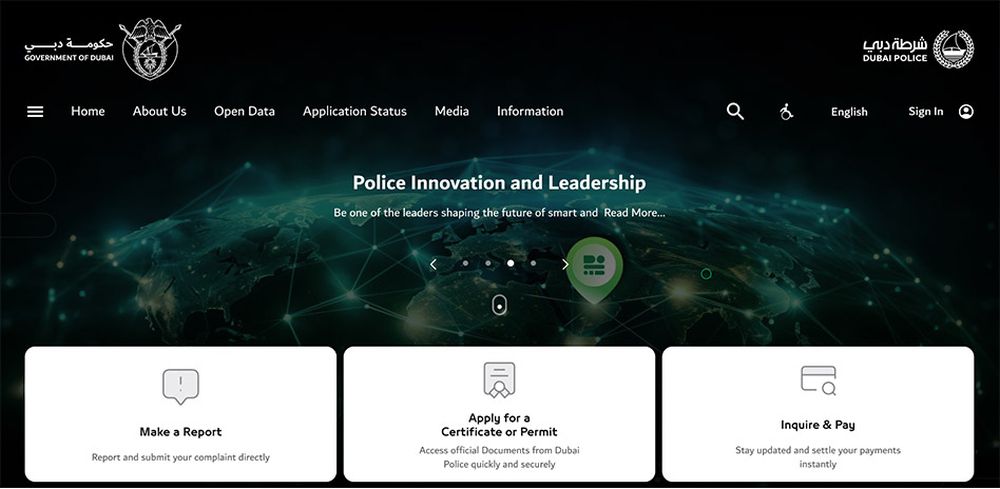
Step 1: Open the Dubai Police portal and select “Make a Report”
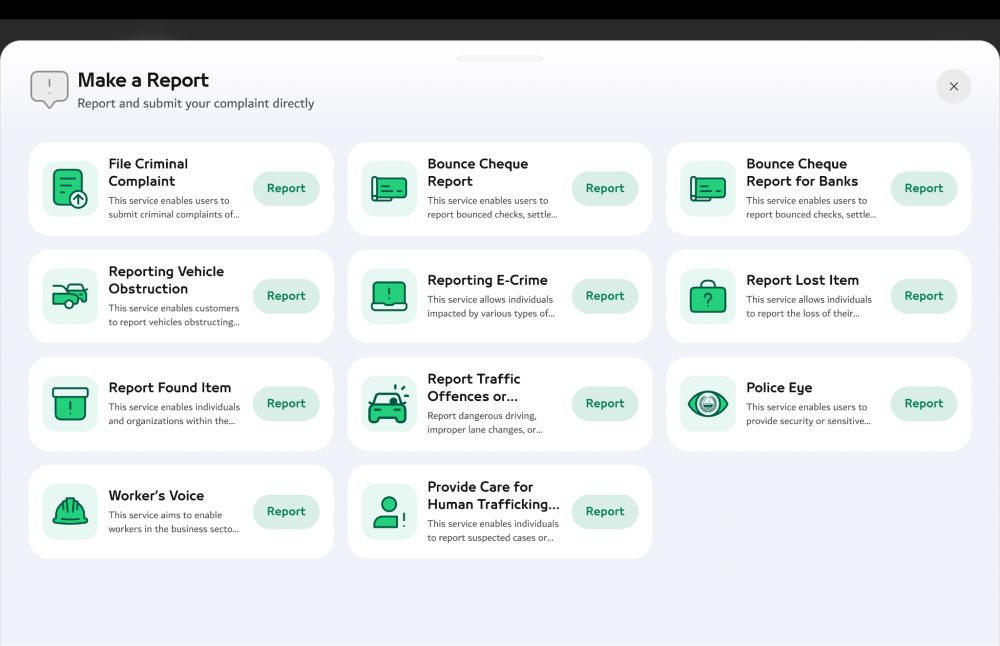
Start from the Dubai Police website or mobile application. From the main services screen, select “Make a Report”. The portal presents a number of reporting options, including criminal complaints, e-crime reports, bounced-cheque reports and other services.
Step 2: Choose “File Criminal Complaint”
Within “Make a Report”, select “File Criminal Complaint”. This opens the digital filing service. The service panel shown in the screenshots identifies the service as free of charge and gives an indicative duration of four working days. This is an administrative service indication, not a guarantee that the complaint or any subsequent investigation will be concluded within that period.
Step 3: Complete the Complainant Letter
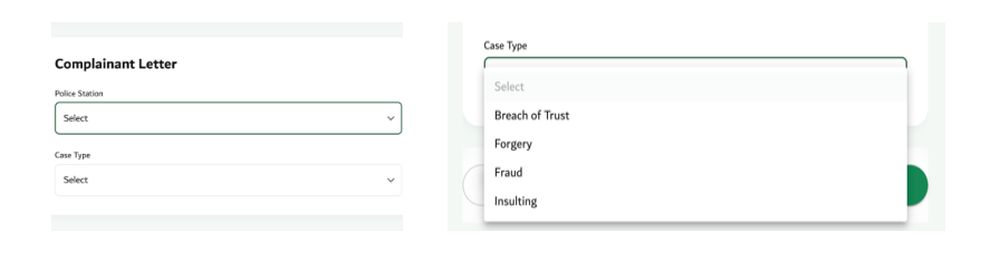
The first portal stage is the Complainant Letter. Select the police station connected with the location of the incident. The portal’s own terms state that the relevant police station should be selected based on where the incident occurred.
Next, select the case type. The current dropdown shown in the portal includes:
- Breach of Trust
- Forgery
- Fraud
- Insulting
Select the category that best matches the facts and the evidence available. The factual account and documents must support the criminal allegation selected.
Step 4: Check the documentary requirements before you begin
The portal changes the required-document list according to the selected case type. Gather the documents before starting the form so that the complaint can be submitted in a coherent and properly supported manner.
Breach of Trust
The portal lists the following documents for a breach-of-trust complaint:
- Copy of Emirates ID card or passport;
- Certified legal auditor’s report;
- Power of Attorney, if applicable;
- Legal Arabic translation of documents, if available;
- Trust receipt.
Forgery
The portal lists the following documents for a forgery complaint:
- Copy of Emirates ID card or passport;
- Document subject to the complaint, for examination purposes;
- Power of Attorney, where applicable.
Fraud
The portal lists the following documents for a fraud complaint:
- Copy of Emirates ID card or passport;
- Account statement, where the transfer was made through a bank;
- Proof of transfer where payment was made through non-banking means, such as an electronic record or receipt voucher;
- Proof of the agreement or alleged fraud in chats or documents;
- Power of Attorney, where applicable.
Defamation and Insult
Although the case-type dropdown is labelled “Insulting”, the supporting-document list refers to “Defamation and Insult”. The portal lists:
- Copy of Emirates ID or passport;
- Screenshots of conversations containing the alleged insults or defamatory content, translated into Arabic;
- Power of Attorney, where applicable.
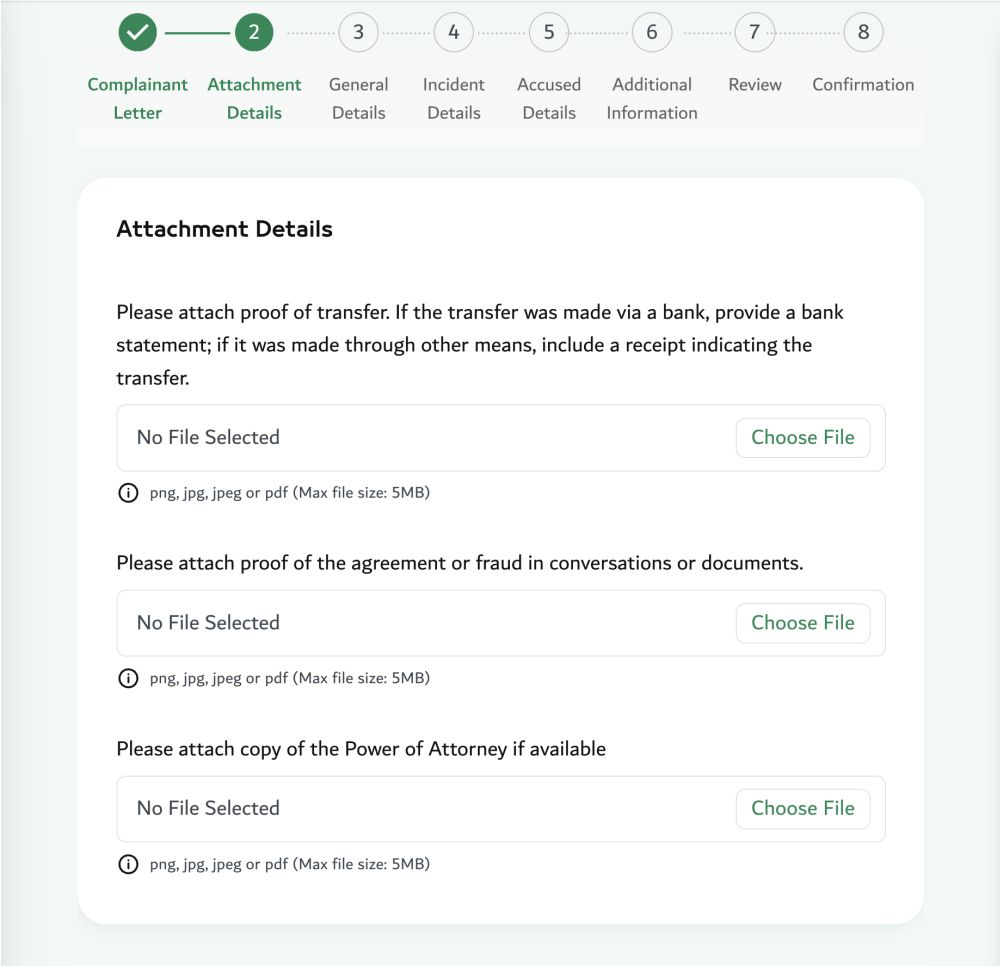
Step 5: Upload the documents in the Attachment Details stage
The second portal stage is Attachment Details. Upload the documents requested for the case type selected. For example, the fraud workflow shown in the portal asks for proof of transfer, evidence of the agreement or alleged fraud in conversations or documents, and a Power of Attorney where available.
Keep the original records, screenshots and source documents. Avoid editing or selectively cropping material in a way that removes dates, names, account details or the surrounding context.
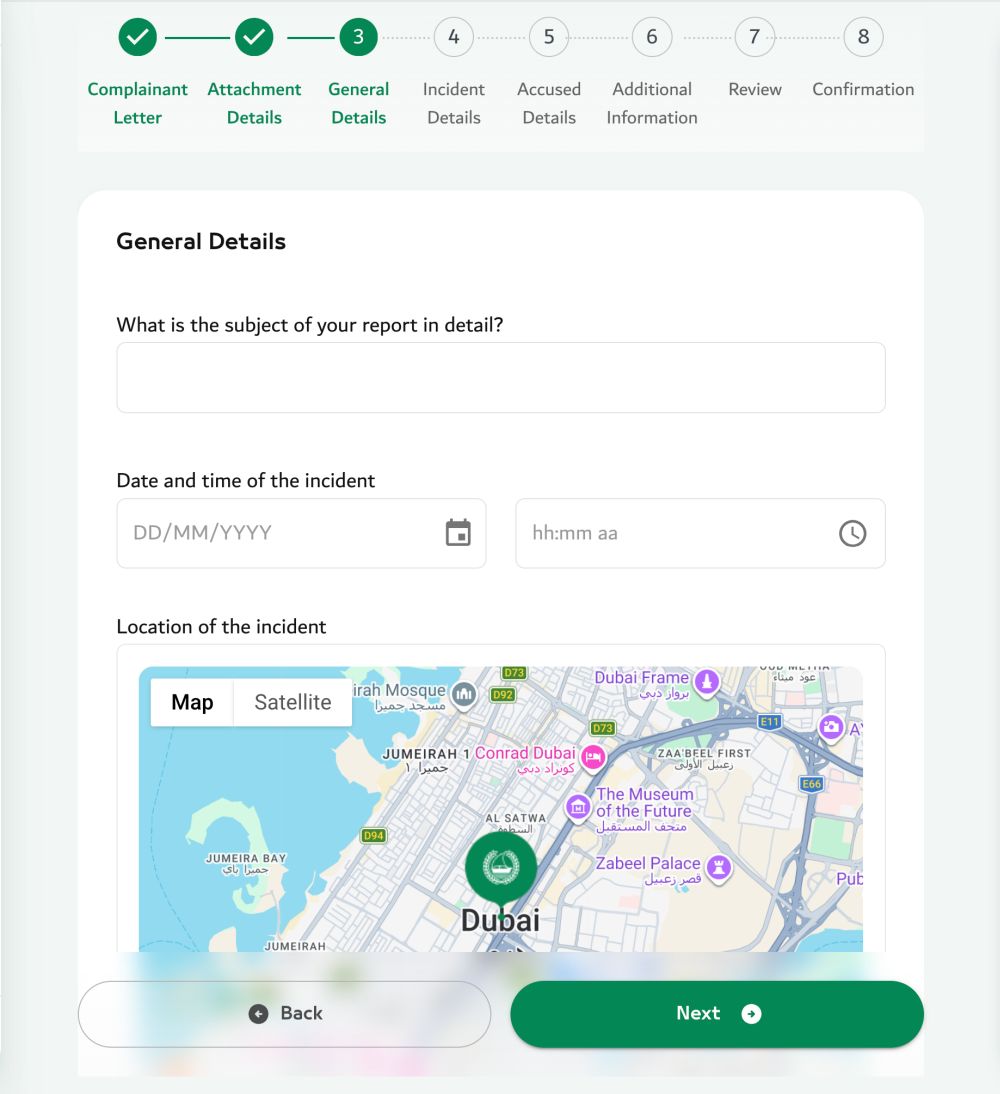
Step 6: Provide the General Details of the incident
The General Details stage asks for the subject of the report, the date and time of the incident, and the location where it occurred. The written description should be concise, factual and chronological.
A clear summary should state:
- the relationship between the complainant and the accused person or entity;
- what happened and how the alleged conduct occurred;
- the key dates, locations and transaction details;
- the loss, damage or other impact alleged;
- the documents, messages and records attached in support.
Avoid assumptions, unnecessary emotion or legal conclusions that are not supported by the evidence. The aim is to provide a clear factual record that can be checked against the documents uploaded.
Step 7: Add the Accused Details and any additional information
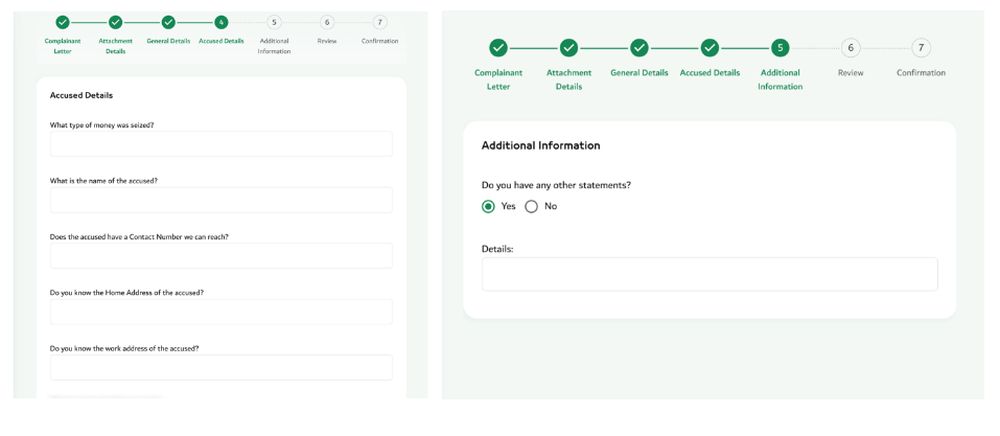
The portal then asks for information about the accused person or entity. The exact questions vary by case type. Provide every identifying detail available, including full name, phone number, address, company name, business location, trade-license information, social-media account or other relevant identifier. This helps the authorities identify the person or entity referred to in the complaint.
The Additional Information stage allows the complainant to add further statements or details. Use this section to address facts that do not fit neatly elsewhere, identify witnesses, explain the significance of a document, or provide other relevant information. Do not repeat the entire complaint; add only material that assists the review.
Step 8: Review, confirm and retain the reference number
The final portal stages are Review and Confirmation. Before submitting, check that the correct police station and case type have been selected, all mandatory documents are attached, dates and amounts are accurate, and the summary of events matches the evidence uploaded.
Where the complaint is filed by a company or through another representative, ensure that the supporting authority documents, including a Power of Attorney where applicable, are included. After submission, retain the complaint reference number and keep copies of all documents uploaded.
What Happens After Submission?
Submitting the online form does not automatically mean that a criminal case has been accepted. Dubai Police will review the complaint, the documents and the legal nature of the allegation. The service information shown in the portal states that the complaint file may be referred to the judicial authorities after the validity of the complaint has been verified.
The complainant may be contacted by SMS, telephone or another official channel and asked to attend the police station to provide a statement, present original documents or clarify the evidence. The police may request further records, Arabic translations, witness information, financial documents, technical material or other supporting evidence.
Where the authorities consider that the complaint discloses a criminal allegation and requires further action, the accused person may be contacted or summoned for a statement. Once the police investigation is complete, the file may be referred to the Public Prosecution for further investigation and a decision on whether criminal proceedings should continue.
Common Issues That Delay or Weaken a Complaint
- Selecting a police station that is not connected with the incident location;
- Selecting a case type that does not match the facts or evidence;
- Treating a contractual dispute or unpaid debt as a criminal matter without evidence of a criminal element;
- Submitting incomplete screenshots that do not show the account, phone number, date, time or surrounding context;
- Omitting proof of payment, transfer or financial loss in a fraud-related complaint;
- Submitting documents in another language without legal Arabic translations where required or available;
- Filing through a representative without attaching a Power of Attorney where applicable;
- Providing a vague narrative that does not clearly explain what happened, when it happened or how the documents support the allegation.
Frequently Asked Questions
Do I need to attend a police station after filing online?
Possibly. The police may ask the complainant to attend to provide a statement, clarify the facts, submit original documents or answer questions. An attendance request does not by itself mean that the complainant is under investigation.
What if I do not know all the accused person’s details?
Provide every detail available, such as the person’s name, phone number, email address, company name, address, bank details, social-media account, transaction reference or documents showing how the person can be identified. Incomplete identifying information can make the review and investigation more difficult.
What is the difference between fraud and breach of trust?
Fraud generally involves alleged deception or dishonest representations that caused a person to make a payment or transfer. Breach of trust generally concerns funds, property or documents entrusted to another person for a particular purpose and allegedly misused, retained or dealt with contrary to that purpose. The correct classification depends on the specific facts and evidence.
Is the online service free and how long does it take?
The service panel shown in the portal states that the service is free of charge and has an indicative duration of four working days. This appears to refer to the service process and does not guarantee the duration of police review, investigation or any subsequent prosecution.
What happens if the police close my criminal complaint?
If Dubai Police closes the complaint at the police-station stage, the complainant may submit a grievance to Dubai Public Prosecution against the decision to close the complaint.
The grievance should include the police complaint reference number, the name of the relevant police station and a clear summary of the complaint and the reasons why the closure decision should be reviewed. The complainant may appoint a lawyer to do so, subject to providing the required authority documents.
The Public Prosecution will review the grievance and determine whether any further action should be taken. This may include maintaining the closure decision or taking further steps in relation to the complaint.
Conclusion
Dubai Police’s online “File Criminal Complaint” service gives complainants a structured route to begin certain criminal complaints digitally. The key steps are selecting the correct police station and case type, preparing the documents requested by the portal, providing a clear and factual account of the incident, and retaining the reference number after submission.
The quality of the evidence matters. A well-organized chronology, complete communications, payment records, original documents, Arabic translations where required or available, and proper authority documents can assist the authorities in reviewing the complaint. Where the facts involve significant financial loss, complex corporate records, alleged fraud, breach of trust, forgery, or online communications, legal advice before filing may help ensure that the complaint is properly classified and supported.
MIO & Partners advises individuals and businesses on criminal matters across the UAE. Contact our team today to arrange an initial discussion.
The content of this article is intended to provide a general guide to the subject matter. Specialist advice should be sought about your specific circumstances.
[View Source]