

With the Federal Act on the Transparency of Legal Entities and the Identification of Beneficial Owners entering into force on 1 October 2026, certain trustees with a Swiss nexus will face new documentation and record-keeping obligations. Trustees already subject to the Swiss Anti-Money Laundering Act are not affected by this specific regime. This newsletter provides practical guidance for trustees on assessing whether they fall within scope of the new law, identifying the relevant persons connected to a trust, organizing the required documentation and preparing for the new regulatory framework.
Ready or Not: Navigating the New Transparency Act – A Practical Roadmap for Trustees
Ahead of the entry into force of the Federal Act on the Transparency of Legal Entities (the Act) on 1 October 2026, trustees and advisors should prepare by first evaluating whether they fall within its scope. Practical steps then include mapping all persons connected to the trust, improving information-gathering and record-keeping procedures, and clarifying roles among service providers. Regular review of trust data and early adaptation to future regulatory changes are also essential. This newsletter highlights these developments and offers trustees practical insights to navigate the new regulatory landscape.
1. General Description of the Act
The Act aims to enhance the integrity of the Swiss financial and economic sector by introducing an official register of beneficial owners. This legislation is a response to evolving international standards – particularly those of the Financial Action Task Force (FATF) – and to the need for Swiss authorities to have effective tools to identify the true economic beneficiaries of legal entities, thereby combating money laundering, terrorism financing, corruption, and circumvention of sanctions.
The main consequences of the Act include the following:
- Swiss companies, as well as certain foreign entities with ties to Switzerland, must identify their beneficial owners;
- such beneficial owners must be entered in a non-public official register maintained by the Federal Office of Justice; and
- certain trustees with a sufficient Swiss nexus will be subject to specific identification, verification and documentation obligations.
- This newsletter examines the specific obligations imposed on trustees under the Act and their practical consequences, with a particular focus on trustees acting in their capacity as such within a trust structure, as opposed to situations where trustees may be subject to the Act solely by virtue of controlling Swiss companies governed by the Act. In particular, it analyses the requirements relating to the identification, verification, and documentation of beneficial owners that trustees will be required to fulfil, as well as the risks and liabilities they may face in the administration of complex structures under the new legal framework.
2. Which Trustees are affected?
The Act does not regulate trusts as such, but imposes specific obligations on certain trustees.
The regime applies to trustees that are domiciled in Switzerland, have their registered office in Switzerland, or administer a trust from Switzerland, provided that they are not already subject to the Swiss Anti-Money Laundering Act (the AMLA). Trustees subject to the AMLA are excluded from this specific regime, as they are already subject to comparable identification and due diligence obligations.
Against this background, the relevant question is whether the trustee has a sufficient Swiss nexus and falls outside the AMLA framework.
Trustees domiciled or having their registered office in Switzerland will, in principle, fall within the scope of the Act. This is, however, subject to an important carve-out: trustees subject to FINMA authorisation under the Federal Act on Financial Institutions (the FinIA) are also subject to the AMLA and are therefore excluded from the Act’s trust regime.
In practice, the Act is thus primarily relevant for trustees that fall outside the FinIA framework. This will typically be the case where trustee activities are not carried out on a professional basis within the meaning of the FinIA. Under the Financial Institutions Ordinance (the FinIO), a trustee is deemed to be acting on a professional basis if certain thresholds are met, including where it:
- generates annual gross revenues exceeding CHF 50,000;
- maintains more than 20 ongoing business relationships; or
- has an unlimited power of disposal over assets exceeding CHF 5 million at any given time.
Trustees operating below these thresholds, or whose activity remains limited in scope, may therefore fall outside the FINMA licensing regime and, consequently, outside AMLA supervision.
The same applies to certain structurally exempted arrangements. In particular, trustees acting exclusively for persons that are closely related (by means of economic or family nexus), such as in the context of private trust companies (PTCs) or single-family structures, are not subject to the FinIA. These structures, which do not provide services to the public, typically fall outside the FINMA authorisation regime and may therefore be captured by the Act.
The Act also extends to trustees that are neither domiciled nor registered in Switzerland, but administer a trust from Switzerland. This notion is not expressly defined in the Act and must therefore be assessed on a case-by-case basis.
The Federal Council Dispatch indicates that, for territoriality purposes, the relevant question is whether the trustee effectively administers the trust in Switzerland. In our view, this should primarily be understood as referring to the place where the day-to-day administration of the trust is actually carried out. This may, for example, be the case where a trustee formally established abroad relies on a person or affiliated entity in Switzerland to perform the ongoing administration of the trust.
Relevant considerations may therefore include where the trustee’s day-to-day management activities are carried out and where their ongoing administrative activities relating to the trust are performed.
The mere use of Swiss banks, asset managers or other service providers should not, as such, be sufficient to establish that a trust is administered from Switzerland.
On this basis, a trust may be regarded as administered from Switzerland if the day-to-day administration of the trust is effectively carried out from Switzerland, even if the trust is formally established and governed abroad. That said, the precise scope of this notion remains uncertain and will ultimately depend on the interpretation adopted by the competent Swiss authorities in practice.
3. Who is Considered as Beneficial Owner of a Trust?
Under the Act, the beneficial owners of a trust are defined as (i) the settlor, (ii) the trustee, (iii) the protector, (iv) the beneficiary(ies), and (v) any other natural person who ultimately exercises control, directly or indirectly or by any other means, over the trust.
This includes, in particular, the beneficial owners of any legal person acting as settlor, trustee, protector, or beneficiary. The implementing Ordinance of the Act (the Ordinance) clarifies that ultimate effective control over a trust includes control exercised through a chain of control, as well as cases where another natural person has the power to determine who may exercise control over the trust.
“Control over the trust” is defined broadly and may be exercised alone or jointly, or acting in concert with third parties. It includes the right or effective ability to: (i) sell or invest the trust fund; (ii) direct, execute, or approve distributions; (iii) add or remove a person as beneficiary or as member of a class of beneficiaries; (iv) appoint or remove trustees; and (v) dissolve or revoke the trust.
In line with FATF recommendations and the standards of the Global Forum, all parties to the trust (settlors, trustees, protectors, and beneficiaries), as well as any person exercising effective control, are categorized as beneficial owners whose identities must be disclosed and verified. Where a legal entity is involved in any of these roles (e.g., a corporate trustee), the beneficial owner to be identified is the natural person that controls the respective legal entity. For example, if a legal entity is appointed as trustee of a trust, the legal entity itself can never qualify as the beneficial owner, as the beneficial owner must, by definition, be a natural person. In such a scenario, the beneficial owner is the natural person that exercises control over the company appointed as trustee.
For instance, if the trustee of Trust C is B SA, a company wholly owned and controlled by shareholder A, then A is both the beneficial owner of B SA and, by extension, the beneficial owner of Trust C. Similarly, if D is designated as the beneficiary of a trust but is, in reality, acting in a fiduciary capacity for its relative E (to whom he transfers the trust distributions), E would, by virtue of this chain of control, exercise ultimate control over the trust and thus qualify as its beneficial owner.
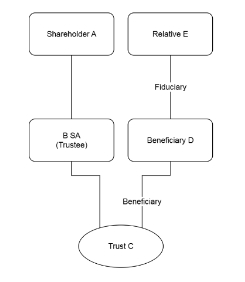
While it is true that these definitions enable Switzerland to align itself with the FATF recommendations and the standards of the Global Forum, the concepts of “control” over a trust as introduced by the Act remain inherently abstract. They do not necessarily correspond to the actual control exercised by the individuals concerned under the law governing the trust. In particular, the Swiss regime requires the identification of persons as beneficial owners based on formal or presumed links that may differ significantly from the effective powers or roles attributed to those individuals by the relevant trust deed or the law governing the trust. This conceptual divergence may create both legal uncertainty and practical difficulties for trustees that must reconcile Swiss reporting requirements with the sometimes very different reality of control and beneficial interest as recognized in common law trust jurisdictions.
4. No Direct Filing with the Transparency Register – But Internal Duties
Unlike Swiss companies or certain foreign entities, which are required to report their beneficial owners for entry in the Swiss transparency register, trustees are not required to report beneficial ownership information relating to a trust for entry in the register, and no separate filing is made in respect of the trust as such.
This does not, however, mean that trusts fall outside the scope of the transparency regime. On the contrary, the Act establishes a distinct, documentation-based framework designed to ensure that competent authorities can access accurate and up-to-date information on the beneficial owners of a trust at any time.
In particular, trustees must identify the beneficial owners of the trust and verify both their identity and their status as beneficial owners with the level of diligence appropriate to the circumstances. This includes, where relevant, an understanding of the control structure of the trust and of any chain of ownership or control, especially where legal entities are involved.
The scope of these obligations extends beyond the trust parties themselves. Trustees must also collect information on the financial intermediaries and other service providers maintaining a business relationship with the trust, including financial institutions and external advisors involved in the administration or functioning of the trust (such as asset managers, tax advisors or fiduciaries). This obligation is limited to persons whose services are directly connected to the administration or operation of the trust, and does not extend to third parties with no such functional link (for example, legal counsel acting solely in the context of a dispute). It is further limited to identifying such persons and the nature of their relationship with the trust, and does not entail a formal identification or verification of their identity.
These obligations are accompanied by ongoing duties. Trustees must ensure that the information collected is properly documented, periodically reviewed and kept up to date. Where beneficiaries are defined by reference to categories, the trustee must determine and document the criteria allowing the identification of such beneficiaries. Such criteria must be sufficiently precise to enable the trustee to determine which person qualifies as a beneficiary, and they should not consist of purely descriptive or unspecified categories.
Moreover, trustees are required to retain the information collected for a period of five years following the end of their functions and to ensure that it remains accessible in Switzerland at all times. Trustees remain responsible for the proper maintenance and availability of this information, irrespective of their domicile or place of establishment.
5. What Information Must be Collected in Practice?
For each category of persons connected to a trust, the Act specifies the information that must be collected and maintained by the trustee.
For each beneficial owner (natural person) of the trust, the trustee must collect:
- full name;
- date of birth;
- nationality;
- address and country of residence; and
- where applicable, information on the nature and extent of the control exercised.
Where a legal entity, a partnership or another trust is involved in the structure (e.g. as settlor, trustee, protector or beneficiary), the trustee must collect:
- name or corporate designation; and
- registered office or address.
For financial intermediaries and other service providers maintaining a business relationship with the trust, the trustee must collect:
- name or corporate designation;
- address or registered office; and
- type of business relationship with the trust.
Where beneficiaries are defined by reference to categories, the trustee must identify and document the criteria allowing the determination of such beneficiaries.
6. To-Dos
In light of the upcoming entry into force of the Act, trustees and advisors should consider taking the following steps:
- Assess scope: determine whether the trustee falls within the scope of the Act, in particular whether it has a sufficient Swiss nexus and is not already subject to the Swiss Anti-Money Laundering Act.
- Map the structure: identify all relevant persons connected to the trust (settlor, trustee, protector, beneficiaries and any other person exercising control), including any entities involved in the structure.
- Review information flows: ensure that the trustee has access to the information required to identify beneficial owners, including in cross-border structures or where third-party service providers are involved.
- Clarify roles with service providers: identify the financial intermediaries and advisors involved in the administration of the trust and ensure clarity as to their respective roles and information-sharing arrangements.
- Anticipate ongoing obligations: establish processes for periodic review and updating of the information, in particular in case of changes in the trust structure or in the circle of beneficiaries.
- Monitor developments: follow the broader enforcement framework, including any developments in relation to sanctions.
The content of this article is intended to provide a general guide to the subject matter. Specialist advice should be sought about your specific circumstances.
[View Source]