On 1 October 2026, Switzerland will introduce new transparency requirements under the Federal Act on the Transparency of Legal Entities and the Identification of Beneficial Owners ("LETA" or "Transparency Act"). The LETA enables authorities to access information on the beneficial owners of legal entities and trusts (Art. 1 para. 3 LETA). To achieve this, the Act requires legal entities to identify, verify, and report their beneficial owners to the register of beneficial owners ("Transparency Register") (Art. 1 para. 2 LETA). Consequently, beneficial owners form the cornerstone of the LETA, making their precise qualification critical.
This Part I on the beneficial owner explains the control categories and when a natural person qualifies as a beneficial owner under the LETA through direct or indirect participation in a legal entity. Part II, which we will publish next, explains how a natural person may control a legal entity by other means. A subsequent blog post will address the specific rules for beneficial owners of trusts, foundations, associations, investment companies with variable capital ("SICAV") and limited partnerships for collective investments ("LPCI").
Parts I and II on the beneficial owner are part of the VISCHER blog series on the new Transparency Act. An initial overview of the LETA can be found in our blog post "Prepared for the new Transparency Register". The second blog post in the series deals with the scope of application of the LETA and the reporting modalities (see blog post "Scope of the LETA and Reporting of Beneficial Owners").
Who in principle qualifies as a beneficial owner?
A beneficial owner is any natural person who controls a company by holding, directly or indirectly, alone or in concert with third parties, at least 25 percent of the capital or voting rights, or by exercising control through other means (Art. 4 para. 1 LETA). If no such person can be identified, the highest-ranking member of the executive body is deemed to be the beneficial owner on a subsidiary basis (Art. 4 para. 2 LETA and Art. 20 para. 3 LETO). Depending on the specific circumstances, a company may have multiple beneficial owners.
The legal definition of a beneficial owner establishes four categories of control:
-
Control through direct participation (capital or voting rights)
-
Control through indirect participation (capital or voting rights)
-
Control by other means
-
Control through acting in concert
These control categories exist independently and require individual examination. Unlike the Anti-Money Laundering Act ("AMLA"), no examination cascade applies. The AMLA cascade primarily requires identifying only those natural persons who control a legal entity through a shareholding. Only secondarily—if doubts arise or no such shareholding exists—must one examine whether a natural person exercises actual control. Furthermore, a natural person may control a company under the LETA through a combination of these control categories.
As previously noted, different provisions govern trusts, foundations, SICAVs and LPCIs.
Finally, it should be noted that the definition of the beneficial owner introduced by the LETA differs from the previous definition of the beneficial owner pursuant to Art. 697j and Art. 790a of the Swiss Code of Obligations ("CO"). Consequently, the identification of beneficial owners cannot rely on the persons identified under the previous law.
Control through direct participation (capital or votes)
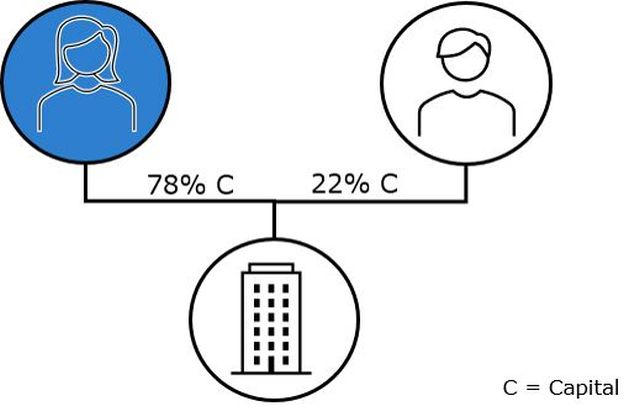
A natural person is considered a beneficial owner if they directly, i.e. without the interposition of one or more natural persons, legal entities or trusts, hold at least 25 percent of the capital and/or voting rights of the company concerned (Art. 4 para. 1 LETA and Art. 1 LETO).
The following diagram illustrates this relationship, highlighting the beneficial owner in blue:
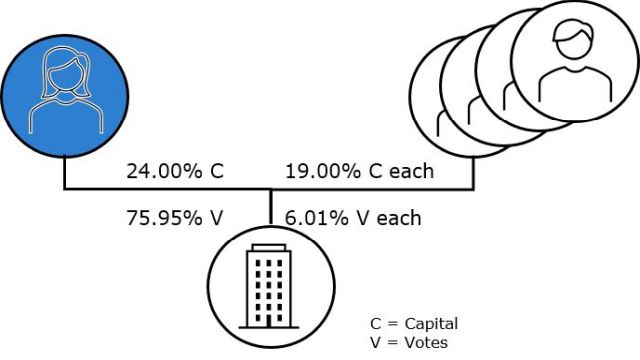
Determining voting rights requires considering all equity securities that grant a voting right. Consequently, in a stock corporation, participation certificates and profit participation certificates remain irrelevant for this determination.
The following diagram illustrates this relationship, highlighting the beneficial owner in blue:
Control through indirect participation (capital or voting rights)
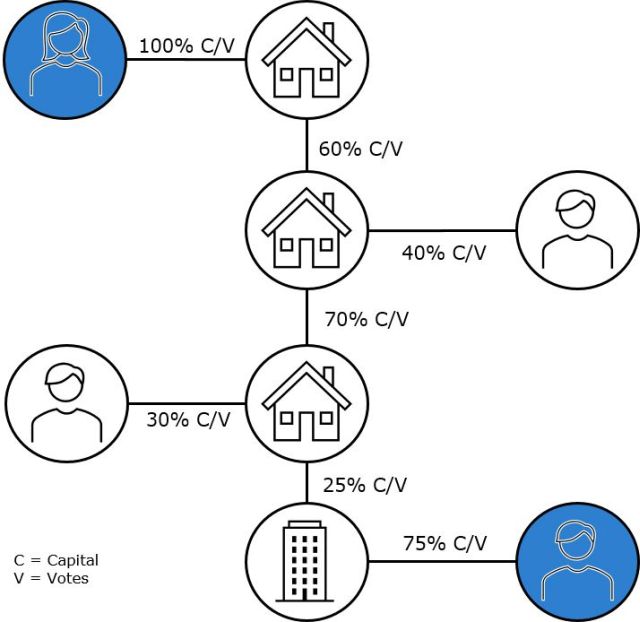
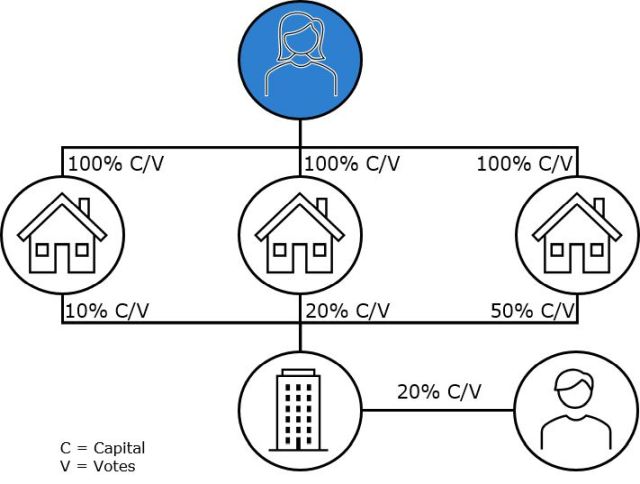
Under Art. 4 para. 1 LETA, a natural person qualifies as a beneficial owner if they indirectly hold at least 25% of a company's capital or voting rights. Pursuant to Art. 2 para. 2 LETO, an indirect participation establishes control if the beneficial owner holds more than 50% of the capital or voting rights of one or more intermediary entities, which themselves directly or indirectly hold at least 25% of the target company's capital or voting rights. The Federal Council's dispatch on the LETA notes that indirect participation must account for vertical and horizontal chains of control, which is particularly critical in private equity structures:
- Vertical chain of control: A natural person holds more than 50% of the capital or voting rights of a company, which in turn holds more than 50% of the capital or voting rights of intermediary companies that (together) hold at least 25% of the target company's capital or voting rights. This assessment does not multiply the participations. The following diagram illustrates this relationship, highlighting the beneficial owner in blue:
Horizontal chain of control: A natural person holds more than 50% of the capital and/or voting rights in several intermediary companies, which collectively hold at least 25% of the capital and/or voting rights in the affected company (the addition test). The following diagram illustrates this relationship, highlighting the beneficial owner in blue:
In practice, vertical and horizontal control chains often manifest as mixed forms.
Control through acting in concert
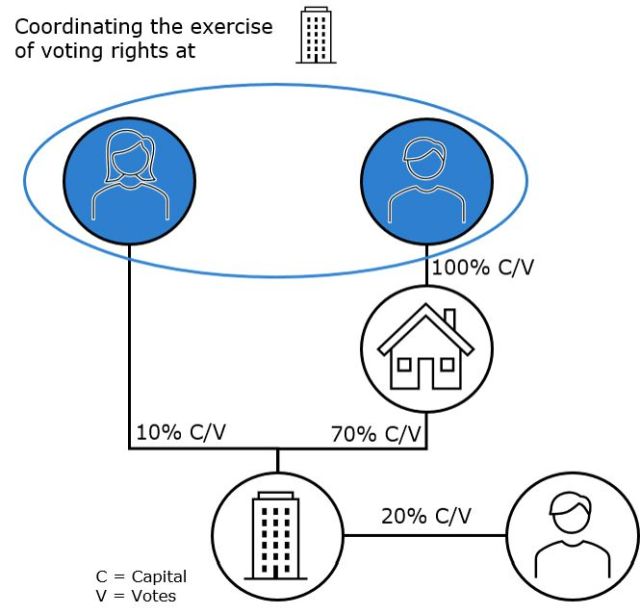
Under Art. 4 LETO, persons act in concert if they coordinate their conduct with third parties to exercise control over a company, whether through a participation or otherwise. Rather than introducing a new type of control, this fourth category builds on the existing ones (direct participation, indirect participation, and control in another way).
The LETA adopts the legal concept of "acting in concert" from Art. 120 para. 1 of the Financial Market Infrastructure Act. Under Art. 12 para. 1 of the Financial Market Infrastructure Ordinance-FINMA, persons act in concert if they coordinate their conduct with third parties by contract, other organized arrangements, or by law to acquire or sell equity securities or exercise voting rights. According to the Federal Council's dispatch on the LETA, the parties' agreement need not aim to hold a controlling interest; the mere possibility of coordinated voting suffices. This marks a shift from the previous reporting regime under Art. 697j CO: the LETA now captures not only the coordinated acquisition of a controlling interest but also agreements aimed at the coordinated exercise of control.
Regarding the categories of "control through direct participation" and "control through indirect participation" discussed in this Part I, we believe the following non-exhaustive situations qualify as acting in concert under the LETA and the LETO:
-
Two or more persons agree to acquire a direct participation of at least 25% of the capital or voting rights of the target company;
-
Two or more persons agree to acquire, via intermediary companies within a vertical or horizontal chain of control (see above), an indirect participation of at least 25% of the capital or voting rights of the target company;
-
Two or more persons agree to coordinate the exercise of their voting rights, or parts thereof, in the target company. The following diagram illustrates this relationship, highlighting the beneficial owner in blue:
Regarding acting in concert under the third control category "control by other means", Part II of this blog post will explain when shareholder agreements, fiduciary relationships, capital instruments, and statutory provisions lead to one or more natural persons controlling a company, thereby qualifying as beneficial owners under the LETA.
The diverse corporate forms and numerous control mechanisms can make identifying the beneficial owner complex in individual cases. We would be pleased to support you in this analysis and assist you in preparing the notification to the transparency register.
The content of this article is intended to provide a general guide to the subject matter. Specialist advice should be sought about your specific circumstances.
[View Source]