On 1 October 2026, Switzerland will introduce new transparency requirements under the Federal Act on the Transparency of Legal Entities and the Identification of Beneficial Owners ("LETA" or "Transparency Act"). The LETA enables authorities to access information on the beneficial owners of legal entities and trusts (art. 1 para. 3 LETA). To achieve this, the Transparency Act requires legal entities to identify, verify, and report their beneficial owners to the register of beneficial owners ("Transparency Register") (art. 1 para. 2 LETA). Consequently, beneficial owners form the cornerstone of the LETA, making their precise qualification critical.
Part I on the beneficial owner (see blog post "Who is the beneficial owner under the new LETA? Part I") outlined the relevant control categories and examined when a natural person qualifies as a beneficial owner under the LETA through direct or indirect participation in a legal entity. This Part II explores when a natural person exercises control over a legal entity by other means (e.g., through shareholders' agreements, capital instruments, and fiduciary relationships).
For an initial overview of the LETA, please refer to our blog post "Prepared for the New Transparency Register?". The second contribution in this series covers the scope of application of the LETA and the reporting modalities (see blog post "Scope of the LETA and Reporting of Beneficial Owners"). The third contribution, divided into Part I and Part II, addresses the beneficial owner (see blog post "Who is the beneficial owner under the new LETA? Part I").
Control by Other Means in General
A beneficial owner of a legal entity is any natural person who controls the legal entity, among other things, by other means (art. 4 para. 1 LETA).
The Federal Council has specified by ordinance when such control by other means exists (art. 3 LETO). A natural person controls the relevant legal entity by other means, in particular where they, directly or indirectly, alone or in concert with third parties, hold the legal right or the actual capability (Art. 3 para. 1 (a)–(c) LETO):
- to appoint or dismiss a majority of the members of the legal entity's management or administrative body;
- to veto decisions of the legal entity's competent bodies concerning amendments to the corporate purpose, the election of management, adjustments to corporate strategy, budgeting and investment planning, or equity and debt financing; or
- to determine decisions regarding profit distributions or other dispositions of the legal entity's assets.
A person may exercise control by other means, in particular, in the following ways:
- Contracts with shareholders or partners (discussed below);
- Capital instruments, such as options, debt instruments, convertible bonds, or participating loans (discussed below);
- Provisions in the deed of incorporation or the articles of association of the legal entity;
- Statutory representation relationships, specifically under family law (such as the exercise of parental authority, legal representation, and guardianship), or voluntary, long-term representation relationships;
- Fiduciary relationships (discussed below); and
- Relationships between related parties.
This list of situations establishing control by other means is non-exhaustive, meaning other forms of "control by other means" may also exist. According to the Federal Council, control by other means always exists whenever means enable legal or de facto control over the legal entity. Waiving the exercise of legal or de facto control does not—analogous to the duty of consolidation pursuant to art. 963 CO—result in the lapse of control by other means.
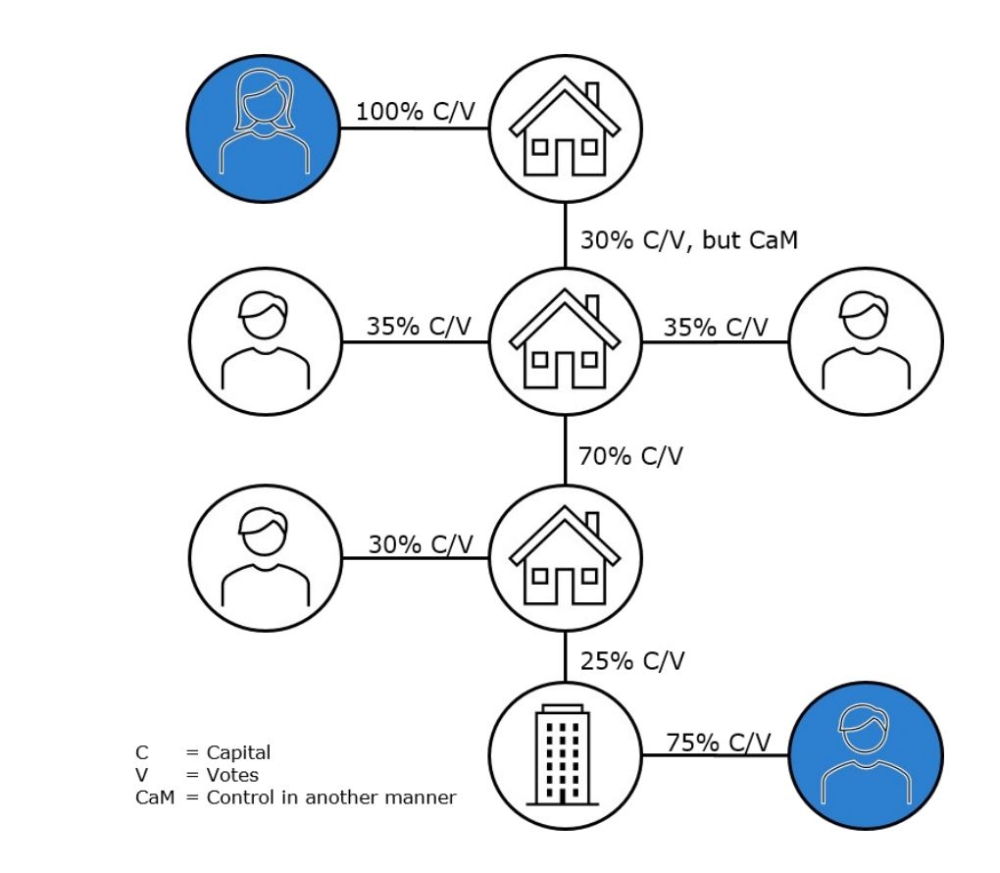
A party may exercise control by other means directly or indirectly. Indirect control occurs where an individual or entity exercises it via one or more intermediate natural persons, legal entities, or trusts. The following diagram illustrates this structure, with the beneficial owners coloured in blue:
Finally, third parties can also exercise control by other means by acting in concert. For detailed analysis of the legal concept of "acting in concert", please see Part I on the beneficial owner (available here: "Who is the beneficial owner under the new LETA? Part I").
Control by Other Means through Shareholders' Agreements
A shareholders' agreement (or partnership agreement) does not automatically establish control by other means. Rather, each case must be assessed individually.
For example, if the parties to the shareholders' agreement form a simple partnership, control in other ways generally does not arise. Instead, exceeding the relevant thresholds establishes control through direct and/or indirect participation (capital/voting rights). Similarly, voting pooling agreements do not constitute control by other means; rather, parties establish control through direct and/or indirect voting participation acting in concert when they exceed the relevant thresholds.
However, control by other means may arise if the shareholders' agreement grants veto rights to individual shareholders. In this context, veto rights encompass both veto rights in the narrower sense and consent requirements. A veto right in the narrower sense allows a resolution to pass unless the entitled party actively vetoes it. In contrast, a consent requirement mandates that a resolution takes effect only with the entitled party's explicit approval. Under the LETA, this distinction is irrelevant because the mere possibility of exercising control suffices to qualify a person as a beneficial owner. Both instruments—the veto right in the narrower sense and the consent requirement—generally confer such control.
Shareholders' agreements often stipulate consent requirements based on a specific voting percentage of certain share classes (typically contractual or statutory preferred shares). In our view, such requirements do not per se constitute control by other means where shifting majorities remain possible (i.e., where no single shareholder reaches the voting threshold alone), unless the parties act in concert regarding this consent requirement.
Finally, control by other means exists where a shareholder (individually or together with others) holds the right to appoint or dismiss more than half of the board members.
In summary, the following aspects govern shareholders' agreements, subject to a mandatory case-by-case assessment:
| Criteria | Form | Control by other means |
|---|---|---|
| Simple partnership | The parties to the shareholders' agreement constitute a simple partnership | No, but direct or indirect participation (capital/voting rights) may confer control |
| The parties to the shareholders' agreement do not constitute a simple partnership | No, however, individual control remains possible | |
| Voting Agreement | Shareholders' agreement contains voting commitments | No, however, parties may establish control by mutual agreement through direct or indirect participation (capital or voting rights) |
| The shareholders' agreement contains no voting commitment | No, review the additional control criteria | |
| Veto rights | The shareholders' agreement grants individual shareholders (e.g. preferred shareholders) veto rights | Yes, if (i) an individual shareholder can exercise a sole veto right, or (ii) multiple shareholders exercise a veto right jointly by common agreement No, if shifting majorities may exercise the veto right and no common agreement exists |
| Nomination rights | The shareholders' agreement entitles individual shareholders to nominate members of the board of directors | Yes, if the relevant shareholder (individually or in concert with other shareholders) holds the right to appoint or remove a majority of the board of directors |
Control by Other Means through Capital Instruments
In our view, the term capital instruments encompasses classic debt instruments, notably (subordinated) loans, notes, or bonds, as well as hybrid debt instruments, particularly convertible loans, convertible bonds, and warrant-linked bonds.
Because these debt instruments do not inherently confer equity or voting rights in the legal entity concerned, direct or indirect participation (via equity and/or voting shares) cannot establish control.
However, the governing terms of these debt instruments may grant debt providers formal rights enabling them to influence key company resolutions (e.g., strict veto rights or consent requirements). Absent such formal rights, one must examine whether the debt providers nonetheless exercise effective control over the legal entity. In our view, the threshold for establishing such de facto control remains high; the mere provision of debt capital does not suffice to affirm it.
Control by Other Means through Fiduciary Relationships
A fiduciary relationship arises when a nominee holds shares in their own name on behalf and for the account of a nominator. However, a fiduciary relationship alone does not automatically constitute control by other means. Instead, the nominee must either meet the relevant direct or indirect shareholding thresholds or exercise control by other means (e.g., via strict veto rights). From a legal doctrine perspective, the legislature should have classified fiduciary relationships as a subset of indirect shareholding rather than under control by other means.
When the nominator is a natural person, they qualify as the beneficial owner. Where the nominator is a legal entity, one must identify the beneficial owner of that legal entity.
Given diverse corporate structures and various mechanisms for exercising control, identifying the beneficial owner often proves complex. We would be pleased to assist you in this assessment and in preparing the appropriate notification to the transparency register.
The content of this article is intended to provide a general guide to the subject matter. Specialist advice should be sought about your specific circumstances.
[View Source]